Monday, June 22nd, 2026 - The Evening Roar
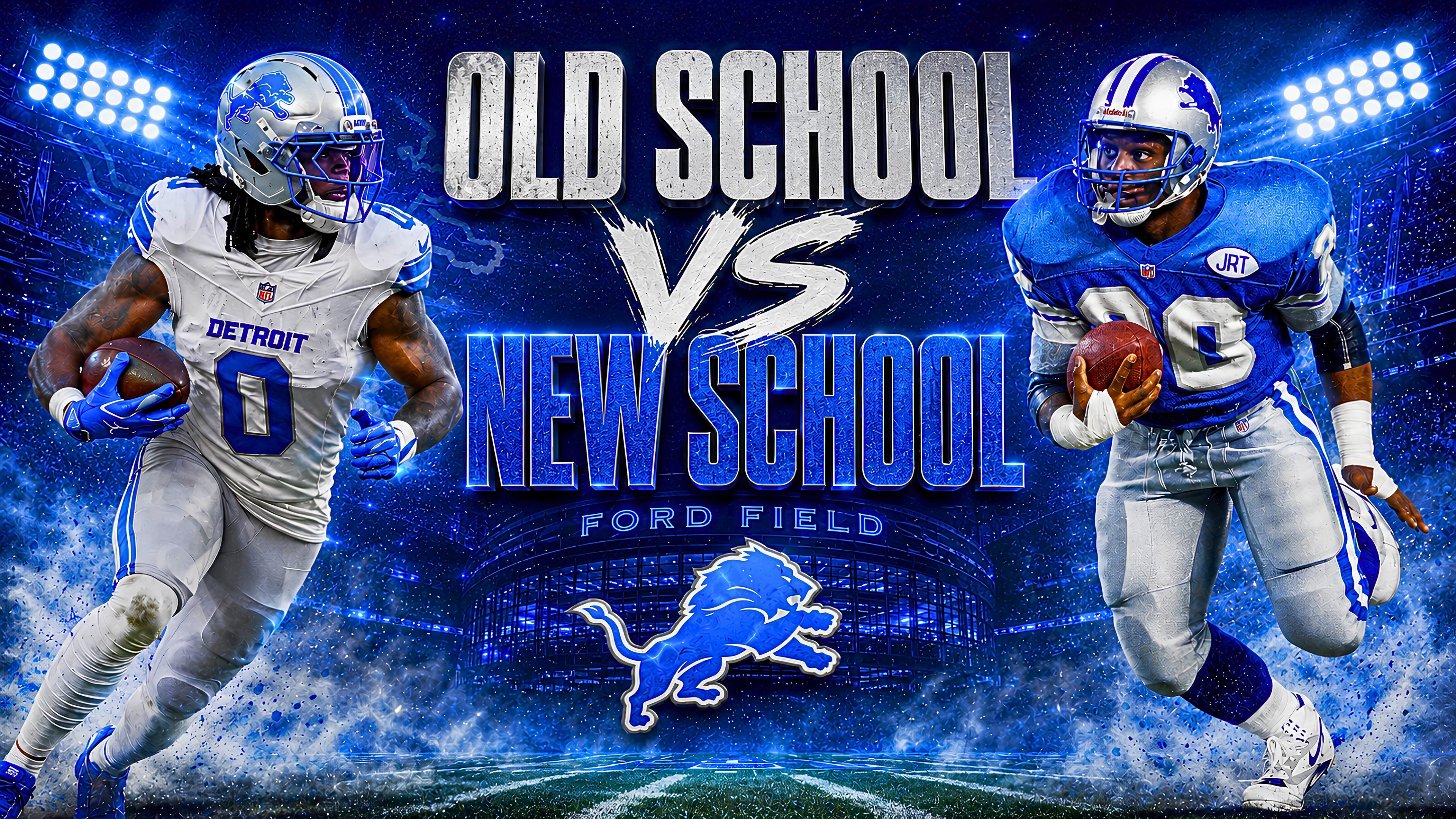
Dan Campbell calling Jahmyr Gibbs Detroit’s “Bell Cow” sounds like a return to an old school style of football that began to die out around 2014. I can assure you—it is not the same. The label still identifies which running back the offense trusts most, but the workload attached to it—well, that has changed dramatically.
The 1990s and early 2000s “Bell-Cow” was measured first by carries. The modern version is measured by total touches, snap share, passing-game value and how many parts of the offense run that player. Gibbs can become Detroit’s unquestioned primary back in 2026 with one major difference. He won’t be used like Barry Sanders, Emmitt Smith, Curtis Martin, Jerome Bettis or Terrell Davis.
That distinction is the key to understanding what the Lions are bringing to the table this season.
The Old-School Workhorse
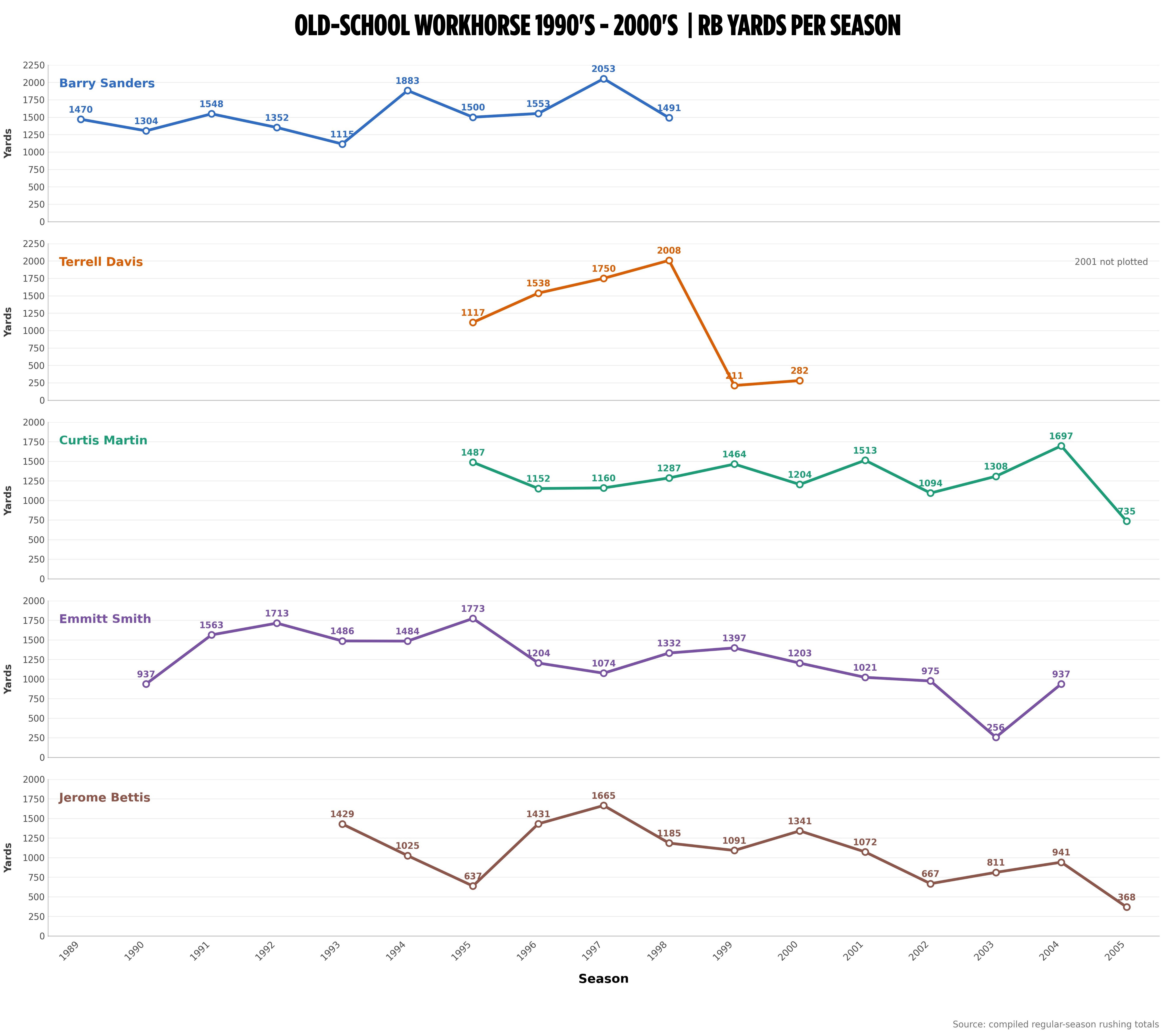
The historical graphs I have prepared below will show a workload that would be considered EXTREME in todays NFL. Among the five featured backs 300-carries or more was reached in 30 of the 55 players-seasons analyzed. Curtis Martin crossed that line eight times. Barry Sanders and Emmitt Smith did it seven times apiece. Jerome Bettis did it five times, while Terrell Davis produced three straight seasons above 300 before injuries changed his career.
The peaks were even more revealing. Davis handled 392 carries in 1998. Bettis reached 375 in 1997. Smith had 377 in 1995. Sanders finished with 343 in his final season, and Martin carried 371 times at age 31 in 2004. Those totals came during 16-game seasons. A 350-carry year required nearly 22 rushing attempts per game, while Davis’ 392 carries averaged 24.5 per game before his receptions were added. Over today’s 17-game regular season, that same 22-carry average would give Jahmyr Gibbs 374 rushing attempts.
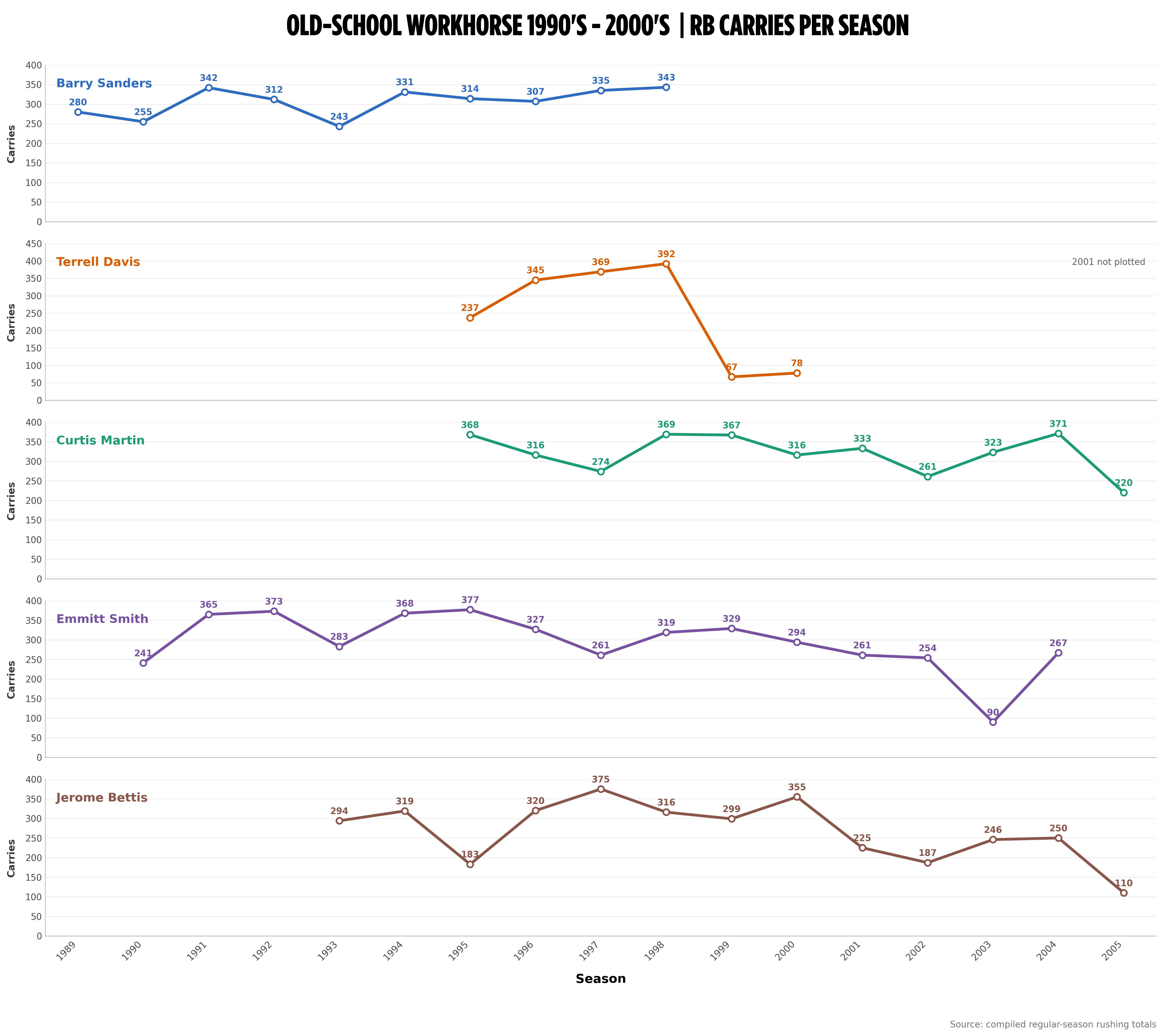
Old-school stars were not one-dimensional. Sanders, Smith and Martin were capable receivers and complete players. The major difference was that their passing-game work sat on top of a rushing workload that frequently exceeded 300 carries. The offenses did not merely feature them—they were the offenses default answer on early downs, short yardage, four-minute situations and high-volume game plans.
The tradeoff was the yardage payoff. These backs routinely converted massive workloads into 1,200-, 1,500- and even 2,000-yard seasons. Sanders surpassed 1,300 rushing yards in nine of his 10 seasons and reached 2,053 in 1997. Davis rushed for 2,008 yards one year later.
The production was elite, but so was the physical burden required to create it.
Abandon The Run Or Redistributed It?
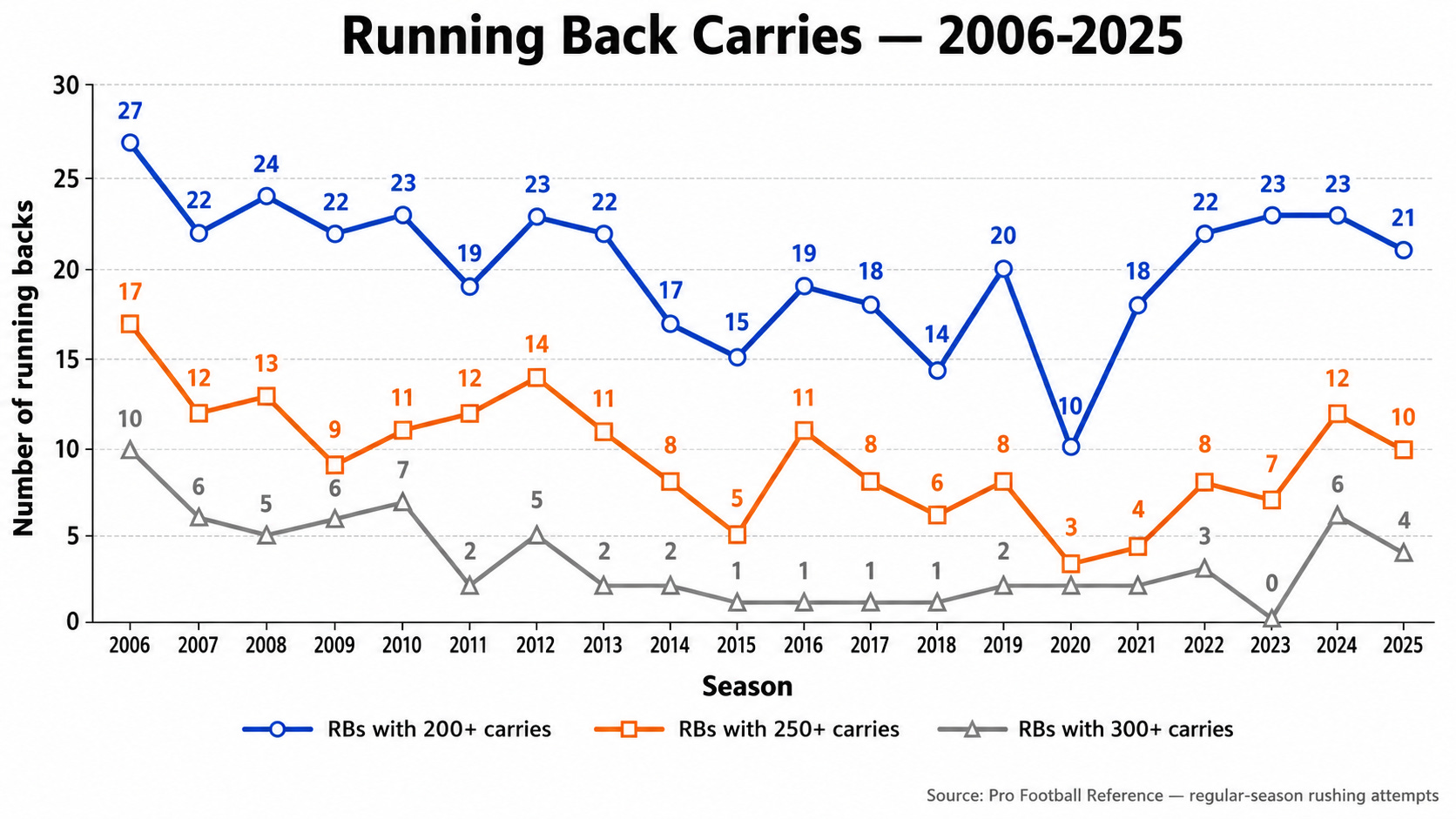
The league-wide carry graph shows how sharply that model faded. The decline of the traditional bell cow did not mean NFL teams abandoned the running game. They simply evolved and redistributed the workload.
In 2006, 27 running backs recorded at least 200 carries, 17 reached 250 and 10 surpassed 300. By 2023, 23 backs still reached 200, but only seven reached 250 and none reached 300.
That separation is glaring as it is important
Teams did not stop using running backs. They stopped giving as much of the position’s total work to one player.
Modern backfields are built around specialization, matchup flexibility and workload management across a longer season. A second back may handle an entire series, short-yardage work, pass protection or a specific package. The lead player can still dominate the offense without monopolizing every carry.
The 200-carry threshold has remained fairly common, but 300-carry seasons have become much less frequent. That shift is why rushing attempts alone no longer define every true feature back.
2023: The Carry-Based Low Point
The 2023 season represented the low point of the traditional carry-based bell cow.
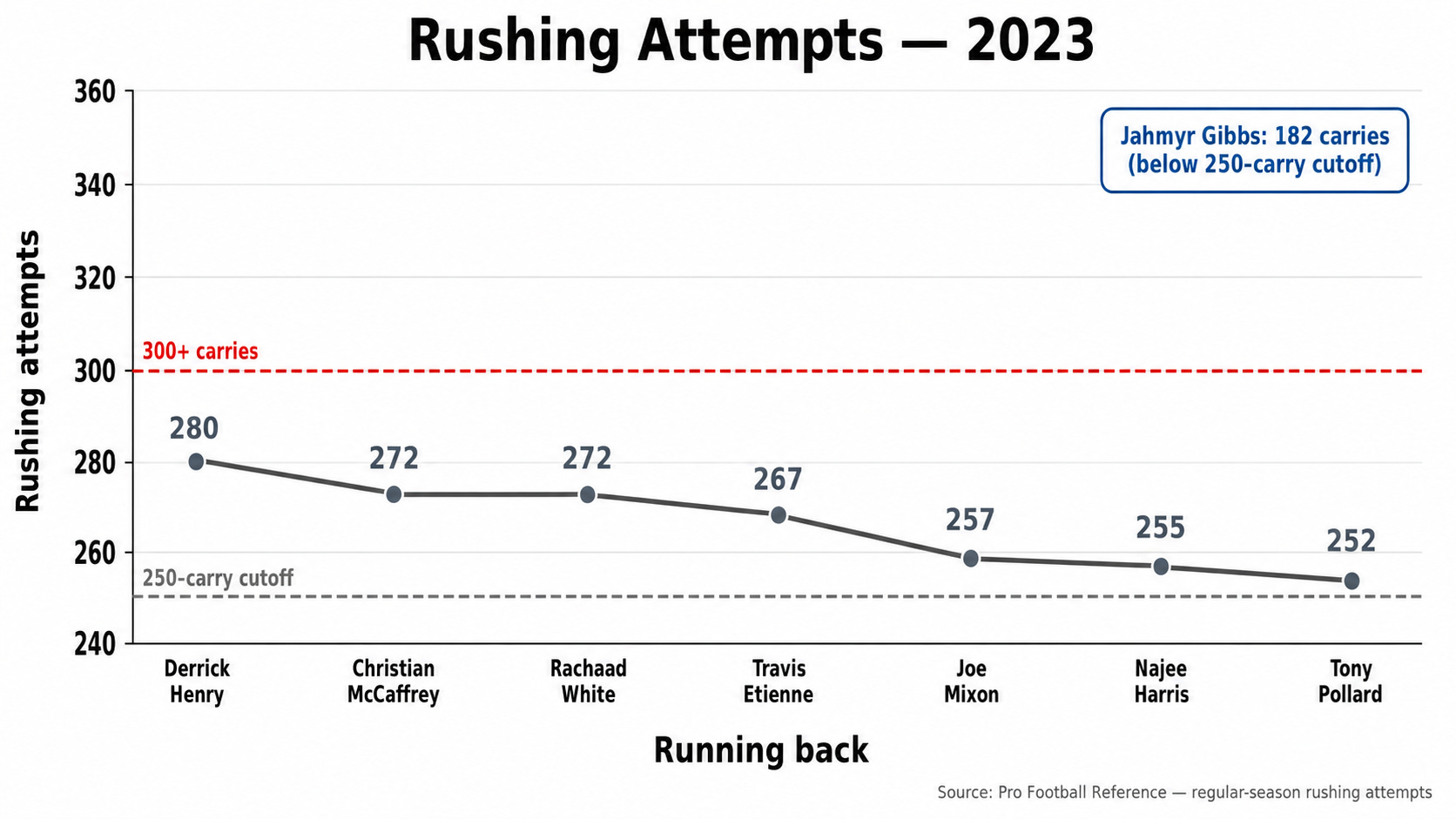
Derrick Henry led the NFL with 280 attempts. Christian McCaffrey and Rachaad White followed with 272, while only seven backs reached 250. No running back received 300 carries for the first time in the timeline.
Gibbs finished his rookie season with 182 attempts—far below the historical bell-cow standard—but Detroit was already using him differently. His 52 receptions raised his total to 234 offensive touches.
The carry total alone did not fully describe his role.
2024: The Selective Workhorse Return
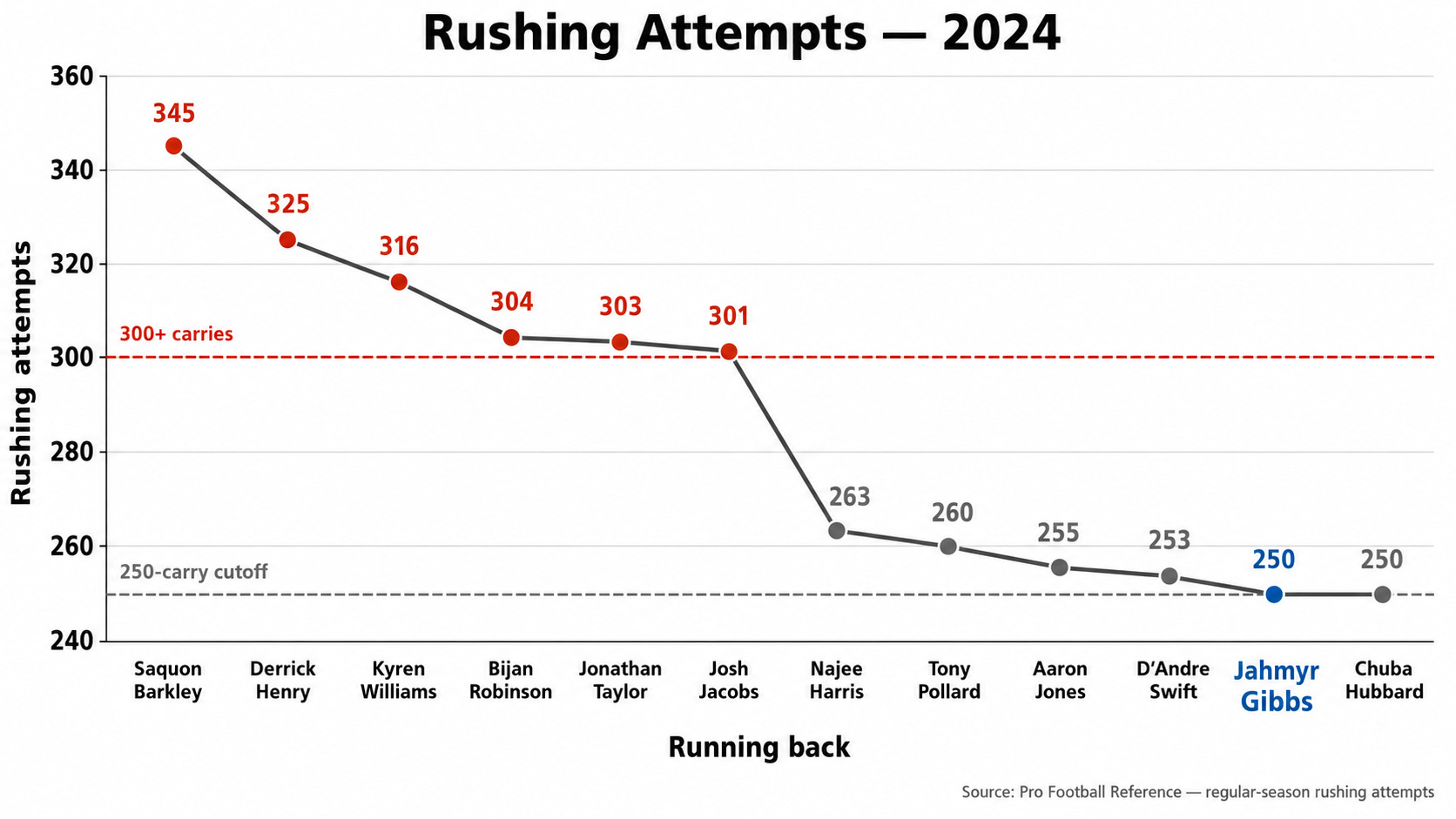
The response in 2024 was dramatic. Six running backs surpassed 300 attempts: Saquon Barkley, Derrick Henry, Kyren Williams, Bijan Robinson, Jonathan Taylor and Josh Jacobs. Twelve reached 250, including Gibbs at exactly 250.
Barkley led the league with 345 carries and turned them into 2,005 rushing yards. Henry followed with 325 attempts and 1,921 yards.
The old-school workload had not completely disappeared. It had become concentrated among a smaller group of elite runners whose offenses were specifically built to support it.
Gibbs remained below that group in rushing volume, but his 52 receptions increased his total workload to 302 touches.
2025: The Workhorse Tier Holds
The 300-carry tier remained alive in 2025, but it narrowed. The traditional 300-carry workload did not disappear in 2025, but it remained limited to a small group of backs.
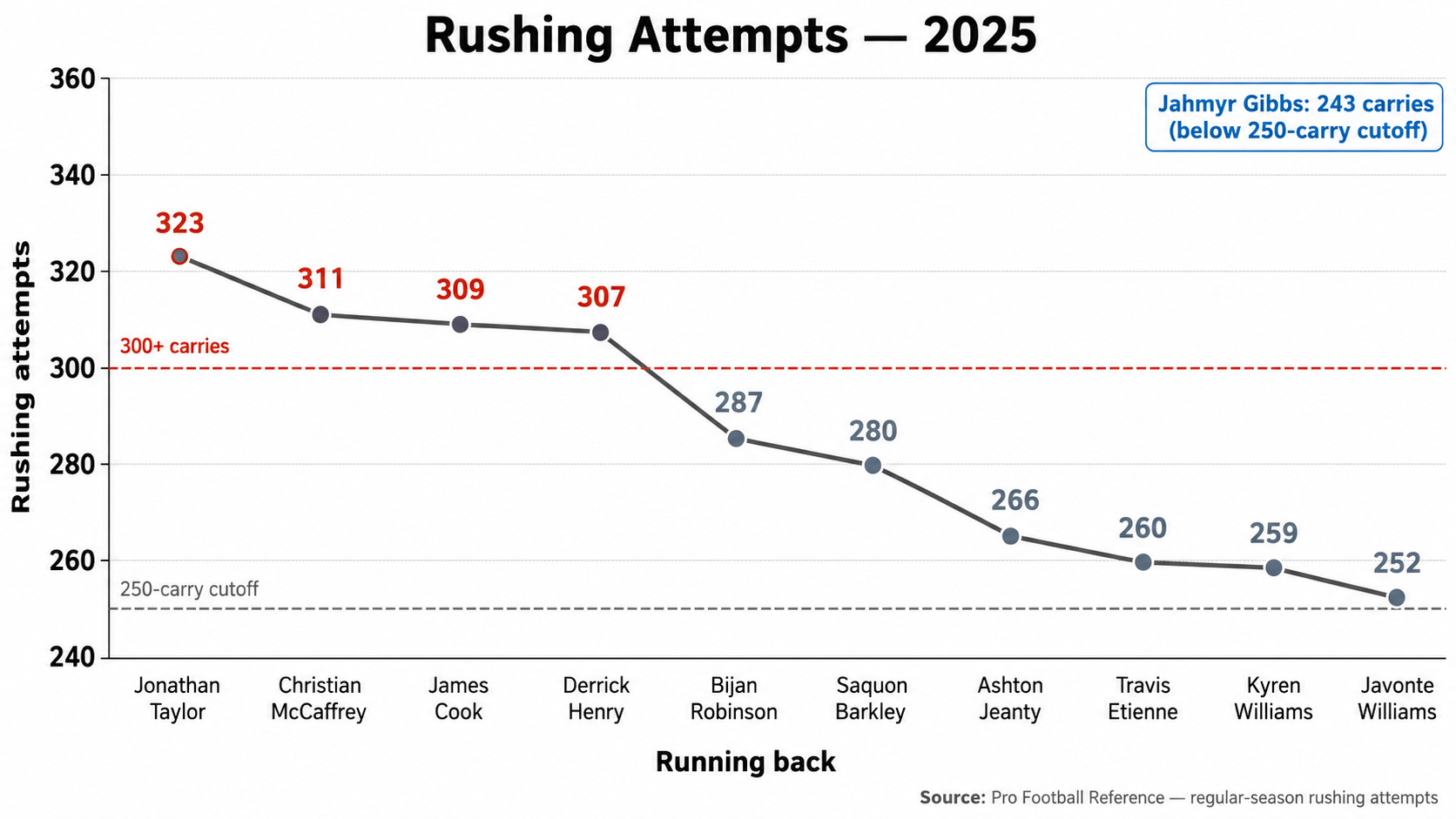
Jonathan Taylor led the NFL with 323 attempts, followed by Christian McCaffrey with 311, James Cook with 309 and Derrick Henry with 307. Ten running backs reached 250 carries, while 21 finished with at least 200.
Gibbs ended the season just below the 250-carry mark with 243 attempts, ranking 11th in the league.
Those numbers do not suggest that the NFL has returned to the workload patterns of the 1990s and early 2000s. Instead, they show that 300-carry seasons are now concentrated among a select few. Six of the 23 backs with at least 200 carries reached 300 in 2024, but only four out of 21 players did the same in 2025.
Players such as Taylor and Henry can still control an offense through traditional rushing volume. Gibbs represents a different model—one in which carries, receptions and total offensive involvement matter more than reaching a specific rushing-attempt total.
The 1,000-Yard Resurgence
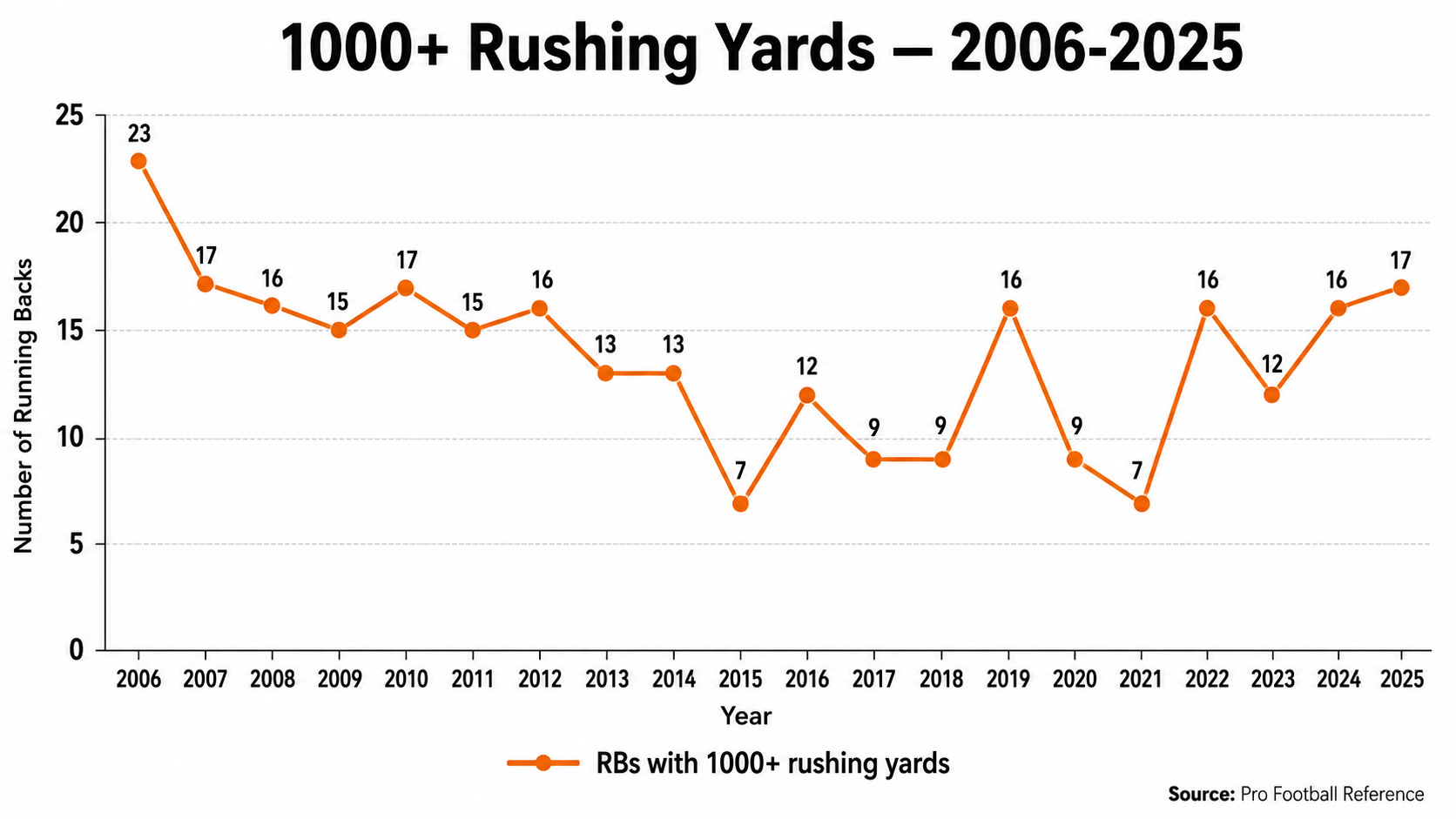
The 1,000-yard graph below makes the evolution of the position more clear. Only seven players reached 1,000 rushing yards in 2015 and again in 2021. That total climbed to 16 in 2022, slipped to 12 in 2023 and returned to 16 in 2024. Seventeen backs reached the mark in 2025—the highest total since 2010.
That does not mean 17 old-school bell cows returned. Matter of fact, only four players with 1,000+ yards rushing received 300+ carries in 2025.
Part of the increase can be explained by the 17-game schedule. A player now needs to average 58.8 rushing yards per game to reach 1,000, compared with 62.5 yards per game across a 16-game season. The rest may also reflect changes in offensive schemes and rules enforcement that have created more opportunities for offenses.
Efficiency also matters. Gibbs rushed for 1,223 yards on 243 attempts in 2025. He did not need 300 carries to produce like one of the league’s top runners.
The modern rushing resurgence is broader than a return of the traditional bell cow. More running backs are producing significant yardage, but only a select few are carrying the football at a historical rate.
The running game is healthy again without recreating the old-school workload structure.
Gibbs Is a Modern-Day Workhorse
Jahmyr Gibbs’ three-year progression shows why rushing attempts alone no longer define a bell-cow. His carries increased from 182 in 2023 to 250 in 2024 before dipping slightly to 243 in 2025. His total touches moved in the opposite direction, climbing from 234 to 302 and then 320.
The difference was Detroit’s expanded use of Gibbs as a receiver. He caught 52 passes in each of his first two seasons before jumping to 77 receptions in 2025. Nearly one-quarter of his touches came through the passing game as he produced 1,839 scrimmage yards, 18 total touchdowns and a career-high 67 percent offensive snap share.
By the old-school, carry-only definition, Gibbs was not a bell cow in 2025. By the modern standard of total offensive involvement, he was already one of the NFL’s most heavily used and productive backs.
More Than One Way
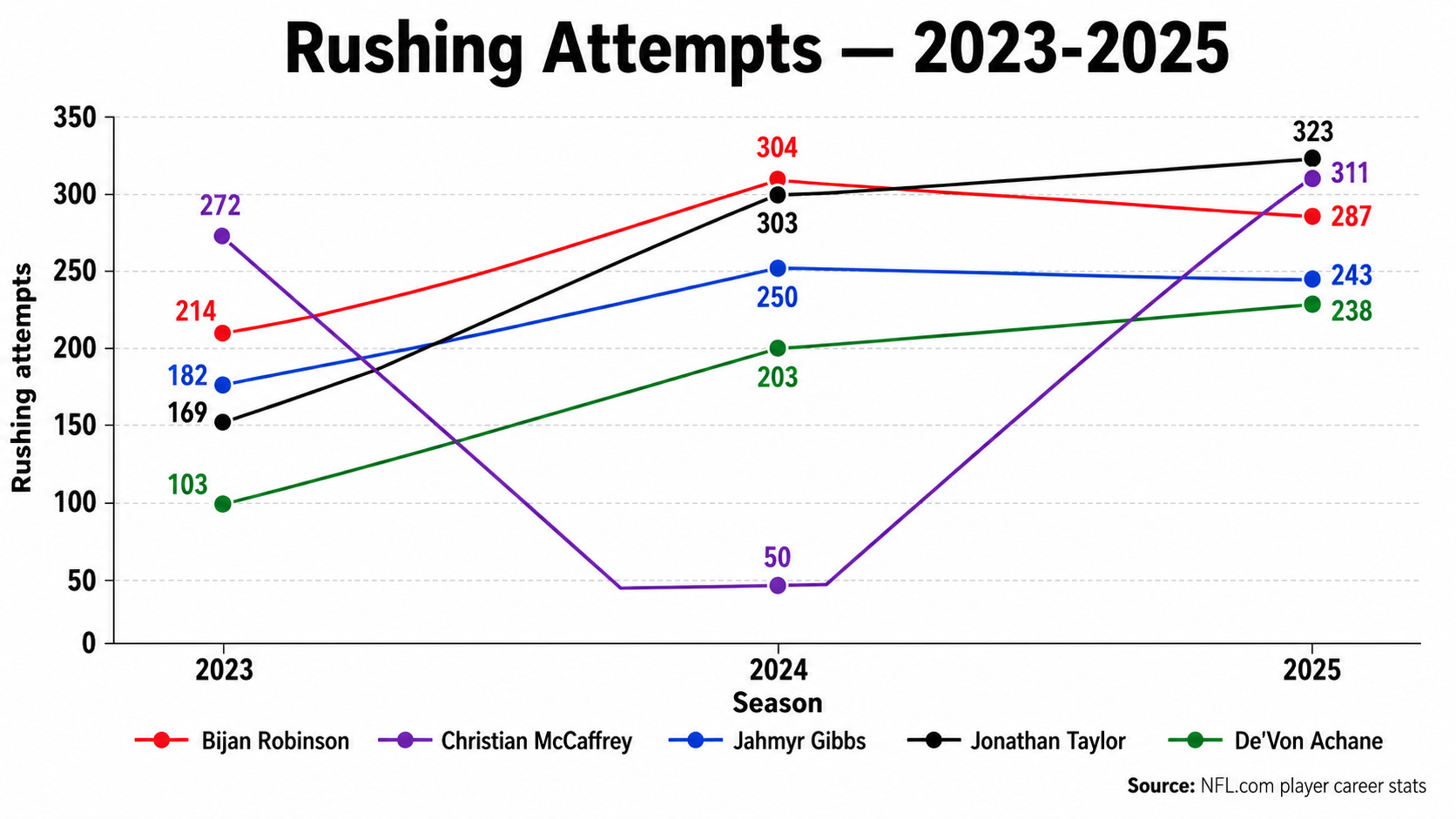
The comparison with the NFL’s other elite backs shows that there is no longer one blueprint for the bell-cow role. Some offenses still rely on a traditional volume runner, while others create the same level of influence through a combination of carries, targets, formations and matchup-driven touches. That diversity can be more effective than relying on the old-school ground-and-pound approach alone.
Jonathan Taylor followed the traditional volume path, rising from 169 carries in 2023 to 303 in 2024 and 323 in 2025.
Bijan Robinson jumped from 214 attempts as a rookie to 304 before finishing with 287 last season.
Christian McCaffrey’s 50 carries in 2024 reflected an injury-shortened season, not a reduced role. He rebounded to 311 attempts in 2025.
De’Von Achane followed a steadier progression, increasing from 103 carries to 203 and then 238.
Players such as Derrick Henry—can still control an offense primarily through rushing volume.
McCaffrey, Robinson, Achane and Gibbs offer a more versatile model, threatening defenses as runners, receivers and movable matchup pieces.
That is where Gibbs separates himself. His value does not decrease when a handoff becomes a target. A reception in space against a linebacker or safety may be more valuable—and less physically punishing—than another carry into a condensed defensive box. Detroit can expand his workload without limiting his impact to the number of times Jared Goff turns and places the football in his hands.
Why Is Detroit’s Structure Different?
Detroit’s backfield is no longer built around two established starters sharing the headline role. David Montgomery was traded to Houston, and the Lions signed Isiah Pacheco as the veteran No. 2. Campbell has publicly said Detroit will “hang its hat” on Gibbs and place a major load on him in both the running and passing games.
Pacheco can still handle meaningful work. His presence allows Detroit to manage specific situations and avoid turning every Gibbs touch into a collision. Sione Vaki also remains part of the room, and the emergence of Jacob Saylors return game last season is a promising development. The vkey difference is that the offense no longer needs to divide its identity between Gibbs and Montgomery.
That creates a clearer hierarchy without eliminating a rotation. This also helps the offense stay disguised in their offense by running more plays with Gibbs on the field while staying in the same formations. The likely change is not that Gibbs suddenly receives every carry. It is that fewer game situations automatically remove him from the plan. He can be the first option on early downs, remain involved on passing downs and stay central when Detroit changes personnel or tempo.
That is a modern primary back: not the only runner, but the player the defense must locate before every snap.
What Is A Realistic Workload In 2026?
A responsible projection should begin with Gibbs’ 320 touches in 2025, not with an arbitrary demand that he reach 300 carries.
A realistic healthy-season range is approximately 255 to 285 carries and 65 to 80 receptions. That would place him between 320 and 365 total touches. At the midpoint - 270 carries and 75 catches - Gibbs would handle 345 touches, or 20.3 per game.
That is a major workload. It would exceed his 2025 total while leaving meaningful opportunities for Pacheco and Vaki, with occasional involvement from Saylors. It also would avoid requiring Detroit to risk Gibbs health and future by copying the 350-to-390-carry seasons shown in the historical graphs.
Reaching 300 carries is possible, but it should be an outcome of game scripts, durability and offensive success rather than the definition of whether Gibbs fulfilled the role. His more meaningful benchmarks are likely to be total touches, snap percentage, targets, red-zone opportunities and sustained efficiency.
If Gibbs remains near his established rushing and receiving efficiency, a workload in that range gives him a realistic path to another 1,800-plus scrimmage-yard season without forcing him into a usage model designed for a different era.
The Analytic Take
The eight figures produce four clear conclusions.
First, the old bell cow was defined by rushing volume. The modern bell cow is defined by offensive control.
Second, the 2024 and 2025 increase in 300-carry seasons represents a selective workhorse return, not a league-wide reversal. Most teams still distribute backfield work.
Third, the resurgence of 1,000-yard rushers shows that rushing production can rise without every top back absorbing historical carry totals.
Finally, Gibbs should be evaluated through total workload. His 243 carries in 2025 ranked outside the top 10, but his 320 touches, 77 receptions, 1,839 scrimmage yards and 18 touchdowns already reflected feature-back responsibility.
ROCK’S READ
The term “bell cow” creates the wrong expectation when it immediately becomes a 300-carry conversation. Detroit does not need Jahmyr Gibbs to imitate the workload of Terrell Davis or Emmitt Smith to prove the backfield belongs to him.
The old-school backs mentioned in these graphs were built into offenses that asked one player to absorb a massive percentage of the offense and rushing volume. Gibbs plays in an offense that can create the same level of influence through carries, targets, motion and alignment. It doesn’t hurt that there are 4 more willing takers of the ball distribution that can dominate when their name is called.
That is the real opportunity in 2026. Detroit can increase Gibbs’ responsibility without flattening the versatility that separates him from traditional runners. Pacheco can preserve the rotation, but the hierarchy is clear: the offense begins with Gibbs.
The best measurement will not be whether he reaches a round number. It will be whether Detroit keeps him central in every game script and whether his explosiveness survives the larger role. If both happen, Gibbs will not resemble the old bell cow. He will represent what the position has become.
💥CHECK OUT OUR LATEST VIDEOS BELOW 💥
Lions Minicamp Turns Up The Heat DAY 1 | The Morning ROAR!

The Morning Roar — your daily Detroit Lions recap covering the latest news, stories, headlines, and updates.
Lions Add A Pair Of Champion Receivers While The Secondary Shines! | The Evening ROAR!

The Evening Roar — your daily Detroit Lions recap covering the latest news, stories, headlines, and updates.
How Anthony Lucas Fits Dan Campbell’s New-Look Edge Rushers | The Morning ROAR!

The Morning Roar — your daily Detroit Lions recap covering the latest news, stories, headlines, and updates.
The Evening Roar: Detroit’s Defensive Conversation Shifts From Stars To Structure

Settle in for the evening with The Evening Roar — a daily Detroit Lions recap covering the latest news, stories, headlines, and updates. Check your inbox every evening by 8 AM to stay informed on everything Detroit Football.
Lions Morning Roar: Roster Depth, Health And A Leader Retires

Start your day with The Morning Roar — a daily Detroit Lions recap covering the latest news, stories, headlines, and updates. Check your inbox every morning by 8 AM to stay informed on everything Detroit Football.


The Blake Miller Pick Reveals Brad Holmes' Crisis: Detroit Lions Offensive Line

The biggest issue facing the Lions in 2025 was not coaching alone; the talent drop-off on the offensive line was larger than expected. Prior to 2025, the offensive line was a wall built on consistency, grit, and toughness — a unit that carried the team forward. This wall didn’t just crack; entire sections collapsed.
Blake Miller Detroit Lions Draft Profile: Right Tackle Stability For The Offensive Line

#17 | OL | Blake Miller | Clemson
💥DFJ SPORTS TOP-36 SMALL BOARD 2026💥

Cashius Howell Scouting Report: DFJ Sports Small Board Ranks The Top-36 Prospects Inside The 2026 NFL Draft Big Board

#35 | Edge/ILB | Cashius Howell | Texas A&M
Caleb Banks | 2026 NFL Draft Profile Snapshot Top-50 Players Post NFL Combine

#36 | DT | Caleb Banks | Florida
💥GET CAUGHT UP ON THE DFJ SPORTS TOP-50💥
Jeremiyah Love | 2026 NFL Draft Profile Snapshot Top-50 Players Post NFL Combine

#1 | RB | Jeremiyah Love | N. Dame

Arvell Reese | 2026 NFL Draft Profile: Post-Combine Top-50 Snapshot

#3 | LB - Arvell Reese | Ohio State | 1st Round Grade
David Bailey | 2026 NFL Draft Profile Snapshot Top-50 Players Post NFL Combine

#4 | EDGE | David Bailey | Texas Tech
Fernando Mendoza | 2026 NFL Draft Profile Snapshot Top-50 Players Post NFL Combine

#5 | QB | Fernando Mendoza | Indiana
Francis Mauigoa | 2026 NFL Draft Profile: Post-Combine Top-50 Snapshot

#6 | OT/G | Francis Mauigoa | Miami
Carnell Tate | 2026 NFL Draft Profile Snapshot Top-50 Players Post NFL Combine

#7 | WR | Carnell Tate | Ohio State
Kenyon Sadiq | 2026 NFL Draft Profile Snapshot Top-50 Players Post NFL Combine

#8 | TE | Kenyon Sadiq | Oregon
Mansoor Delane | 2026 NFL Draft Profile Snapshot Top-50 Players Post NFL Combine

#9 | CB | Mansoor Delane | LSU
Makai Lemon | 2026 NFL Draft Profile Snapshot Top-50 Players Post NFL Combine

#10 | WR | Makai Lemon | USC
Dillion Thieneman | 2026 NFL Draft Profile Snapshot Top-50 Players Post NFL Combine

#11 | Free Safety | Dillion Thieneman | Oregon
Caleb Downs | 2026 NFL Draft Profile: Post-Combine Top-50 Snapshot

#12 | Box Safety | Caleb Downs | Ohio State
Rueben Bain Jr | 2026 NFL Draft Profile: Post-Combine Top-50 Snapshot

#13 | EDGE | Rueben Bain Jr | Miami |
Olaivavega Ioane | 2026 NFL Draft Profile Snapshot Top-50 Players Post NFL Combine

#14 | OL | Olaivavega Ioane | Penn St
Kadyn Proctor | 2026 NFL Draft Profile: Post-Combine Top-50 Snapshot

#15 | OT | Kadyn Proctor | Alabama
Emmanuel McNeil-Warren | 2026 NFL Draft Profile Snapshot Top-50 Players Post NFL Combine

#16 | Strong Safety | Emmanuel McNeil-Warren | Toledo
Jermod McCoy | 2026 NFL Draft Profile Snapshot Top-50 Players Post NFL Combine

#17 | CB | Jermod McCoy | Tennessee
Spencer Fano | 2026 NFL Draft Profile Snapshot Top-50 Players Post NFL Combine

#18 | OT | Spencer Fano | Utah
Denzel Boston | 2026 NFL Draft Profile Snapshot Top-50 Players Post NFL Combine

#19 | WR | Denzel Boston | Washington
Keldric Faulk | 2026 NFL Draft Profile Snapshot Top-50 Players Post NFL Combine

#20 | DE | Keldric Faulk | Auburn
Peter Woods | 2026 NFL Draft Profile Snapshot Top-50 Players Post NFL Combine

#21 | DT | Peter Woods | Clemson
Jordan Tyson | 2026 NFL Draft Profile Snapshot Top-50 Players Post NFL Combine

#22 | WR | Jordyn Tyson | Arizona State
Monroe Freeling | 2026 NFL Draft Profile Snapshot Top-50 Players Post NFL Combine

#23 | OT | Monroe Freeling | Georgia
Avieon Terrell | 2026 NFL Draft Profile Snapshot Top-50 Players Post NFL Combine

#24 | CB | Avieon Terrell | Clemson
Akheem Mesidor | 2026 NFL Draft Profile Snapshot Top-50 Players Post NFL Combine

#25 | DE | Akheem Mesidor | Miami