The Detroit lions are on the clock — this time they are not drafting the next playmaker. Instead, the lions’ decision clock just started winding faster to lock Jahmyr Gibbs into a contract extension. After the news of Breece hall signing a three-year, roughly $46 million deal yesterday — every NFL GM entering a contract year with a running back took notice. Why? The price just went up! With Gibbs and Robinson now locked in a two-man race, the race is on to see which agent pushes the market past $21 million per year first.
This is no longer about whether the lions should pay Gibbs, but whether they can afford to wait..
Lions Made The Smart Move
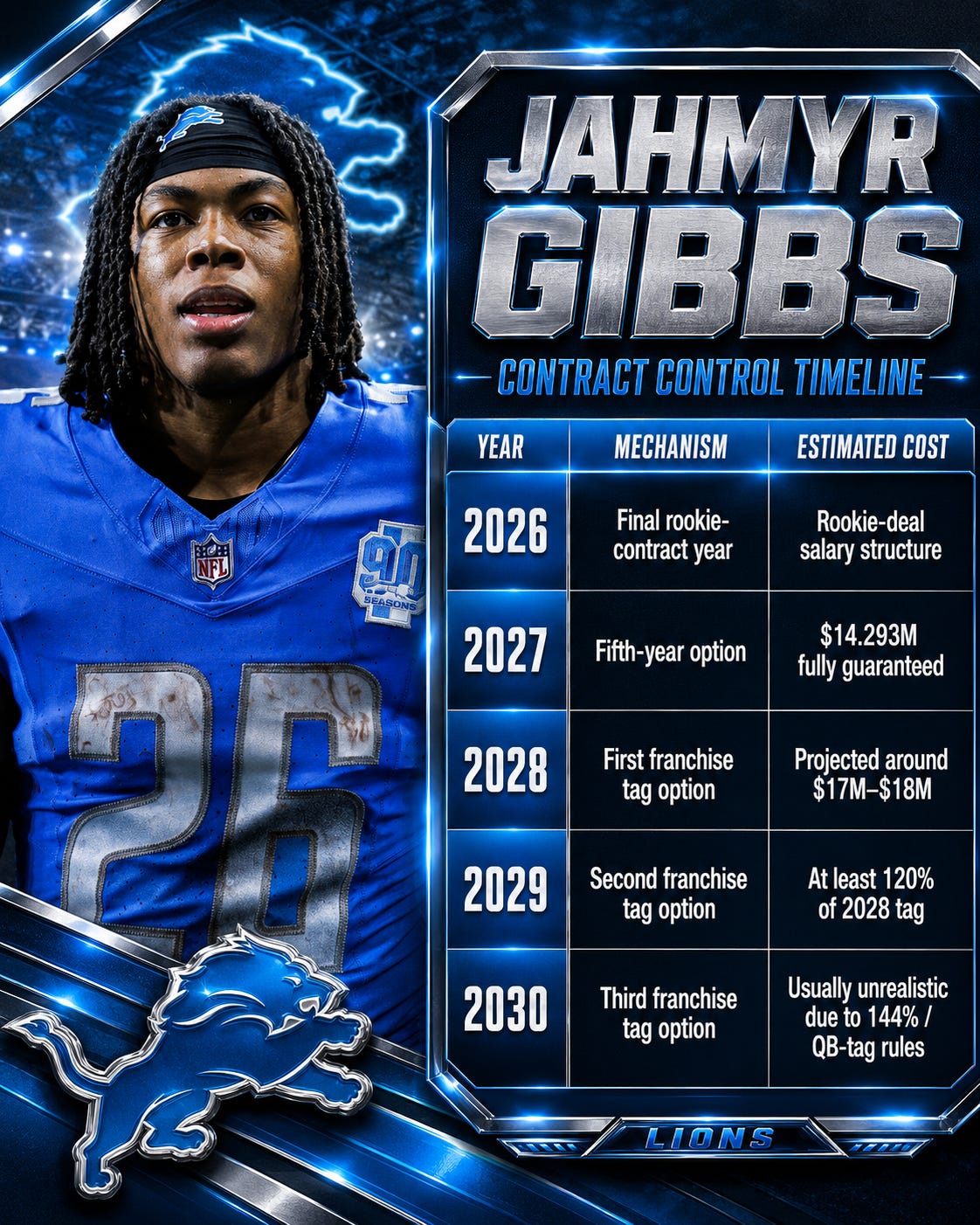
The Lions made the smart move by picking up Jahmyr Gibbs’ fifth-year option. At $14.293 million fully guaranteed, it locks Gibbs under team control through the 2027 season. His 2026 season still sits under the rookie-contract structure, which gives Brad Holmes leverage and a little breathing room before a long-term extension must be finalized.
Breece Hall started the new running backs market conversation. Hall reportedly agreed to a three-year, $45.75 million extension with the Jets, putting him at $15.25 million per year. The deal reportedly includes $29 million guaranteed, and it puts Hall behind only Saquon Barkley and Christian McCaffrey among running backs by annual value.
Hall’s number becomes the first real marker for the next wave of elite running backs. Hall’s contract is not the ceiling — his deal was merely the first card dealt, and he landed a winning hand, setting the new floor for the future of the position. This contract immediately changes how negotiations will be framed for both Jahmyr Gibbs and Bijan Robinson. You can bet neither agent is walking into the room under $16 million, and neither should!
Detroit has to decide whether it wants to set the price before the race gets hotter, or wait and risk paying after Robinson’s camp moves the goalpost even further.
Nuclear Options
Detroit still has a few card tricks left in the deck. Starting in 2028, the Lions could tag Gibbs, with the first franchise tag projected around $17 to $18 million. Depending on how much the running back market inflates, that could create short-term savings for the team compared to a market-setting long-term deal for Gibbs. That path would also net Gibbs roughly $32 million in fully guaranteed money across just the 2027 and 2028 seasons.
The second tag in 2029 would jump to at least 120% of the 2028 tag, pushing it to roughly $21.6 million. That number appears to be in line with where Gibbs’ new annual average could land anyway. The difference is that not all of a long-term deal would be fully guaranteed, while the franchise tag is fully guaranteed.
A third tag in 2030 would become nearly impossible to justify. The NFL’s tag rules force a major escalator of at least 144%, pushing the number to a projected $31 million fully guaranteed — and there’s a catch. NFL rules state the third franchise tag must be the greater of:
The current-year quarterback franchise tag, which could be $55 million-plus
120% of the average of the top five salaries at the player’s position
144% of the player’s second franchise-tag salary
Brad Holmes can delay the extension through 2028 without immediately costing the Lions more money, but he cannot delay the price of the market. Any plan that stretches beyond the first tag becomes dangerous unless Detroit is willing to walk away from Gibbs by 2028, either through a possible trade or by refusing to chase the market once the number gets too high.
Three Way Race To The Finish
Three different backs are resetting the market together, something rarely seen in one offseason. This year’s running back market was never about one player — this was always a three-way market reset race.
Hall tells the league what a very good young feature back costs, resetting the new floor. Robinson shows what a full-volume offensive foundation can demand. Gibbs’ overall production tells the league what the more dynamic scoring version will cost.
Breece Hall
Hall gives the Jets a young, proven, all-purpose back who can handle volume, catch the football, and give New York one of the few stable pieces in an offense that has lived through quarterback changes, staff changes, and weekly inconsistency. The Jets paid for age, production, versatility, and the belief that Hall can be a foundational piece in the next version of their offense.
Bijan Robinson
Robinson gives Atlanta the classic RB1 argument as the workload and total-yardage back. He is the offensive foundation piece with the clearest case that his team can build the run game and passing-game extension through him. Robinson’s three-year production profile is built on volume, durability, rushing production, receiving usage, and total yards from scrimmage.
Jahmyr Gibbs
Gibbs gives Detroit a different kind of argument — and maybe the most dangerous one. Gibbs is not just a running back. He brings rushing production, receiving value, explosive traits, and his separator is scoring. Gibbs is one of the few backs in the league who can change defensive behavior before the ball is even snapped. He creates spacing advantages, becomes a coverage conflict, and finishes in the red zone.
Stat Lines Say A Lot
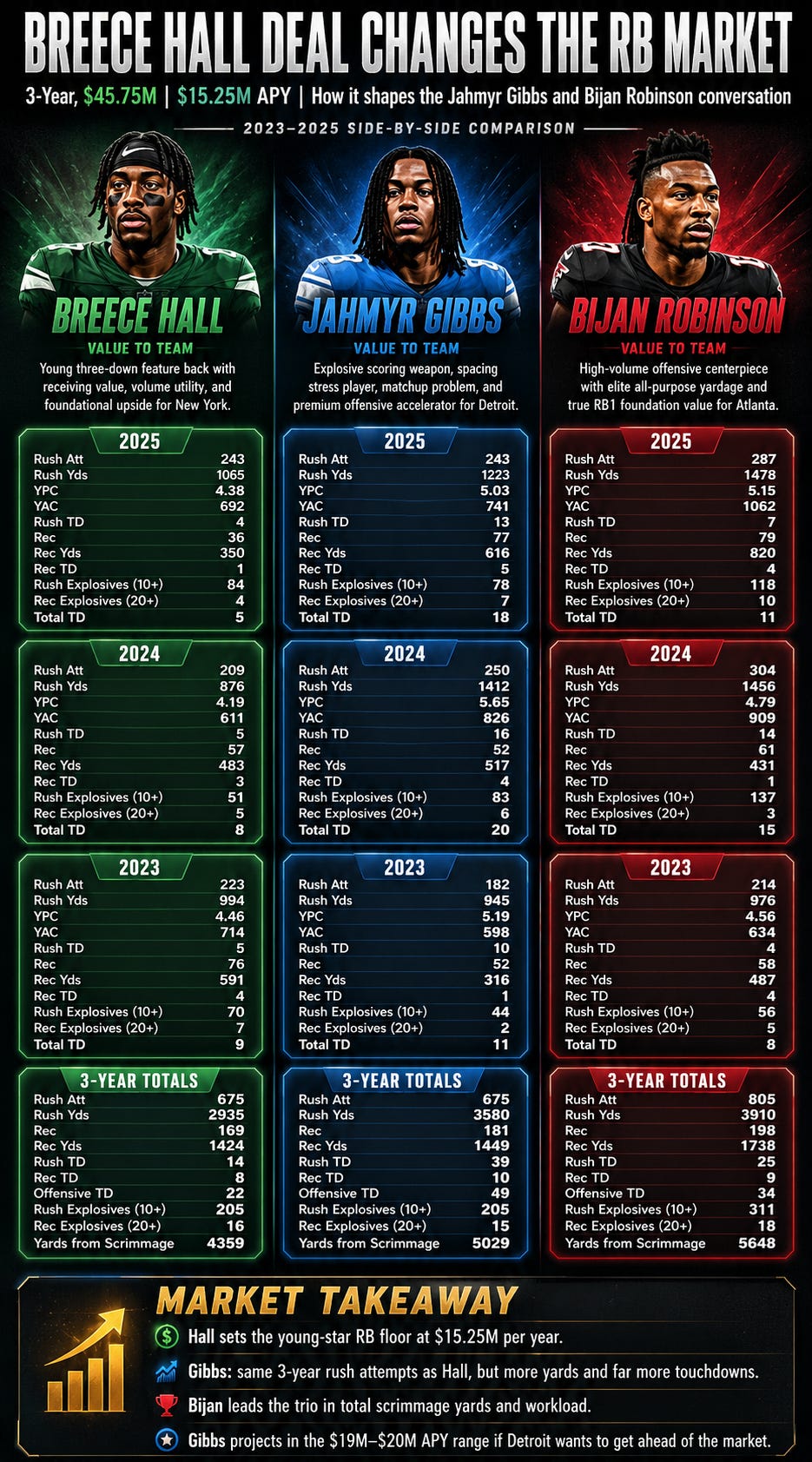
The 2025 comparison explains how each player brings a different argument to the table. That gives each player a different contract lane, but with Hall already paid, the race between Gibbs and Robinson has narrowed. Robinson is the workload and yardage case. Gibbs is the scoring and efficiency weapon.
Hall had 243 carries, 1,065 rushing yards, 36 catches, 350 receiving yards, and five total touchdowns.
Gibbs had the same 243 carries, but turned them into 1,223 rushing yards, 77 catches, 616 receiving yards, and 18 total touchdowns.
Robinson carried the bigger workload with 287 carries, 1,478 rushing yards, 79 catches, 820 receiving yards, and 11 total touchdowns.
The three-year rushing comparison shows the difference in workload and return, and it makes the Gibbs argument even sharper. Hall and Gibbs had the same number of carries, but Gibbs produced 645 more rushing yards. Robinson carried the largest workload, and that volume produced the strongest total rushing yardage case in the group. The issue for Robinson is volume does not equal scoring value, and Gibbs blew the doors off both players’ touchdown totals.
Hall turned 675 carries into 2,935 rushing yards and 14 rushing touchdowns.
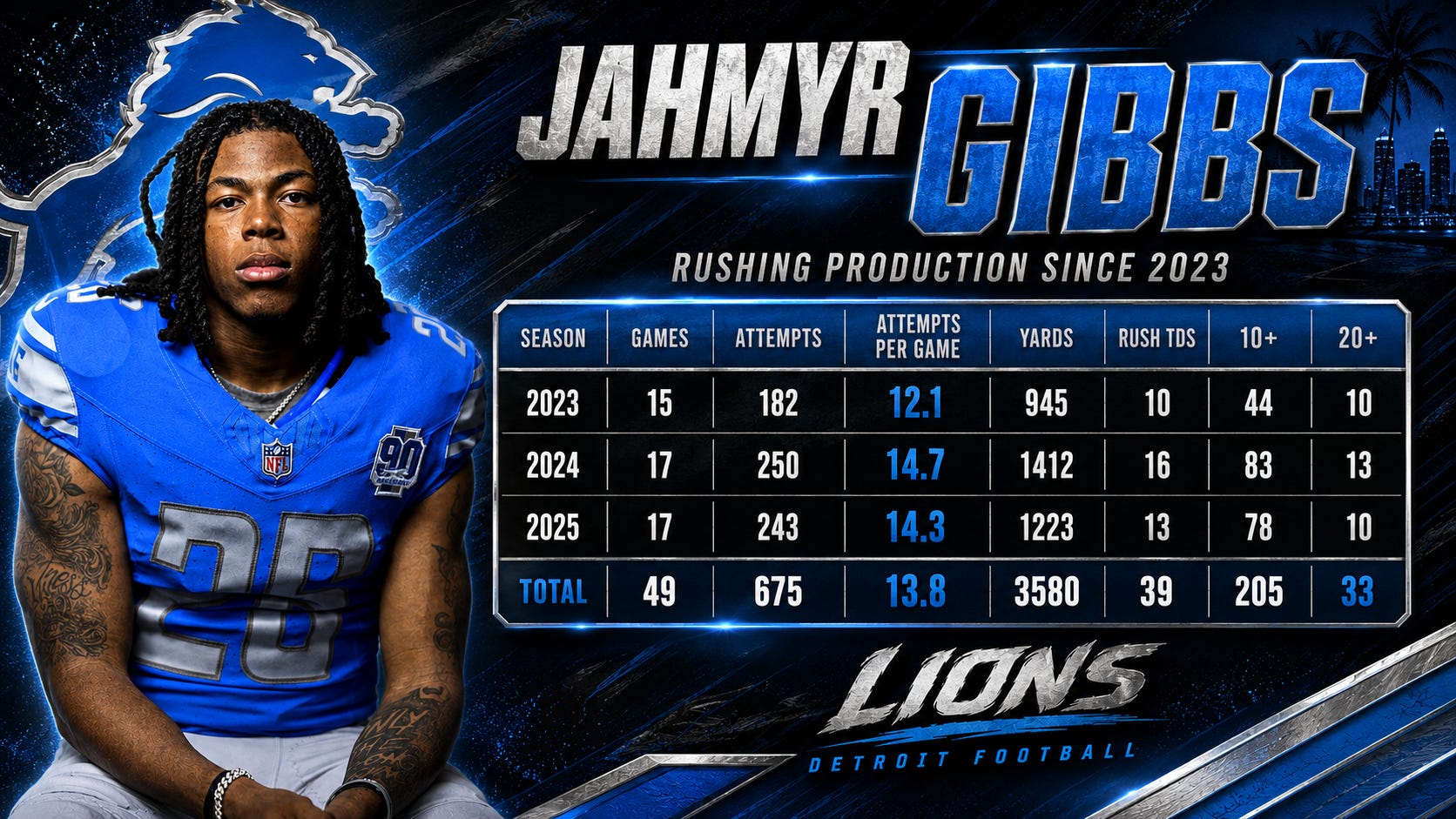
Gibbs turned the same 675 carries as Hall into 3,580 rushing yards and 39 rushing touchdowns.
Robinson carried the larger workload with 805 carries, 3,910 rushing yards, and 25 rushing touchdowns.
Gibbs had 25 more rushing touchdowns than Hall on the exact same carry count.
Robinson carried the ball 130 more times than Gibbs, but Gibbs still scored 14 more rushing touchdowns.
Since 2023, the receiving numbers show just how close the all-purpose value gets. The volume and yardage edge favors Robinson, but the scoring and efficiency edge still leans Gibbs.
Hall had 169 catches for 1,424 yards and eight receiving touchdowns.
Gibbs had 181 catches for 1,449 yards and 10 receiving touchdowns.
Robinson had 198 catches for 1,738 yards and nine receiving touchdowns.
The receiving gap is close. The scoring gap is not.
Hall had 22 total offensive touchdowns since 2023.
Robinson had 34 combined rushing and receiving touchdowns since 2023.
Gibbs had 49 combined rushing and receiving touchdowns since 2023.
Yards create value, but touchdowns create leverage. A back who can tilt the field, finish drives, and turn limited touches into points carries a different price tag than a back who only stacks volume. Gibbs is not just producing yards inside Detroit’s offense — he is converting touches into touchdowns at a rate neither Hall nor Robinson has matched.
Gibbs Case To Be Highest Paid
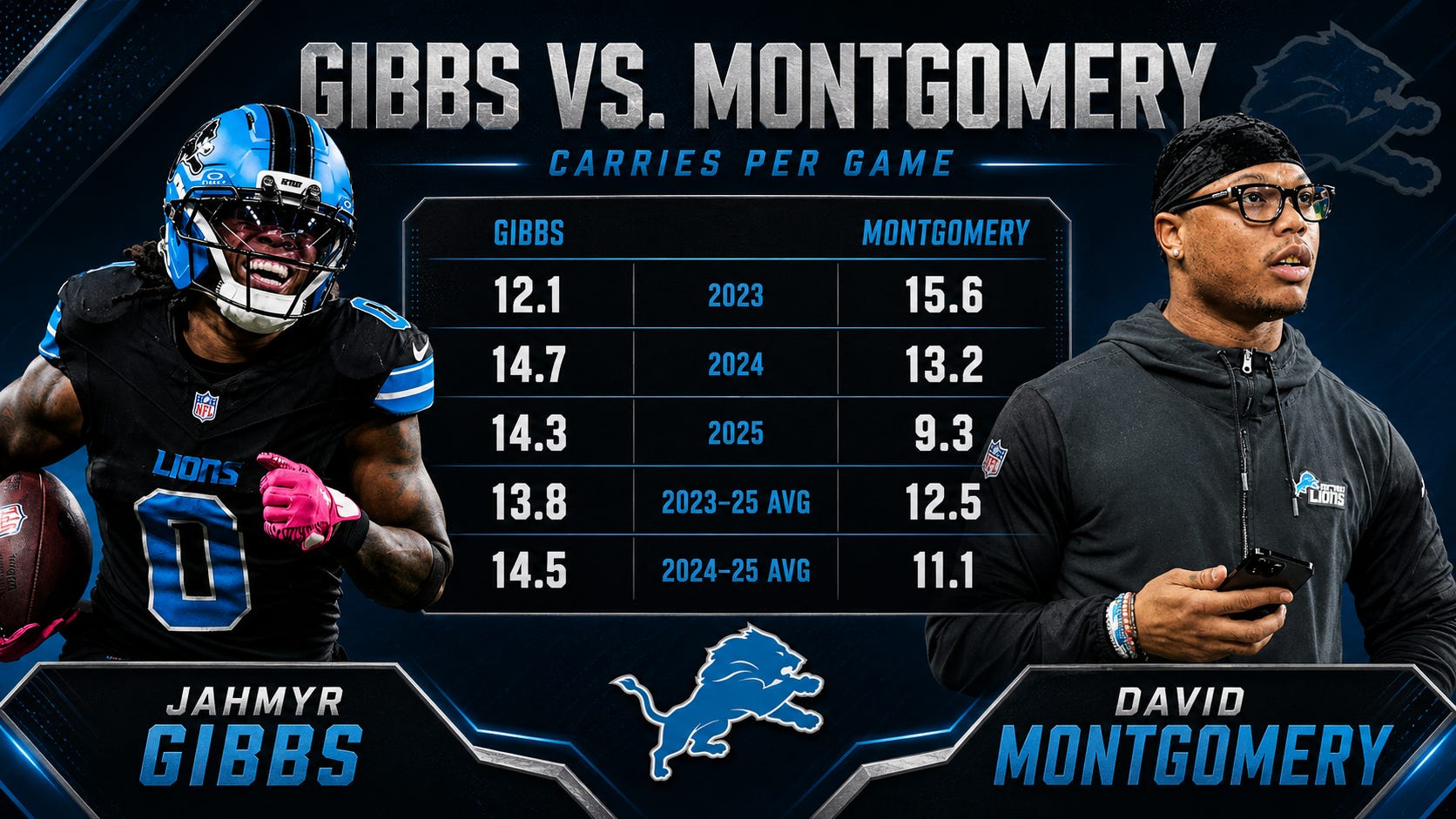
Without getting buried in every stat or analytic, the strongest argument for Gibbs becoming the highest-paid back is simple: he did not build this case as a 25-carry-per-game feature back. Since 2023, Gibbs has averaged just 13.8 attempts per game. He opened his career at 12.1 ATT/G in 2023, jumped to 14.7 ATT/G in 2024, then saw a slight reduction to 14.3 ATT/G in 2025.
In 2023, Gibbs started only three games — then started only four in 2024. In 2025, he became a full-time starter and still kept the same explosive efficiency and scoring punch.
Detroit did not hand him the whole backfield from Day 1 and let raw volume inflate the profile. The Lions developed him inside a split-backfield structure, paired him with a physical complement in David Montgomery, and still watched him produce like one of the most dangerous offensive weapons in football.
The fact that Gibbs has done this in a split-back system should strengthen his contract argument, not weaken it. Since 2023, Gibbs has produced 5,029 yards from scrimmage and 49 total touchdowns, outpacing Saquon Barkley’s 4,938 scrimmage yards and 34 touchdowns over that same window. Robinson has the larger workload with 805 carries, but Gibbs has 14 more rushing touchdowns and 15 more total touchdowns despite 130 fewer carries.
That is the contract argument: Gibbs has not needed feature-back volume to produce top-of-market results. Detroit gave Gibbs high-value touches, and he responded with the production that changes the money: TOUCHDOWNS.
Drew Petzing Effect
Detroit’s next variable is Drew Petzing.
The Lions hired Petzing as offensive coordinator in 2026, and he inherits a back who can become the weekly stress point of the offense. Petzing does not need to reinvent Jahmyr Gibbs. He needs to feature him in ways that force defenses to declare their answers before the snap.
That means motion, space, screens, option routes, light-box runs, empty looks, and mismatches against linebackers. It means touches that do not just feed Gibbs, but force the defense to change how it plays Detroit. If Gibbs gets a bigger role under Petzing and keeps the efficiency, Detroit could be negotiating with one of the most dangerous offensive weapons in the league.
That is the risk in waiting. If Gibbs has a career year, the number can jump well beyond the current data supporting $20 million per year — possibly reaching into the mid-20s.
What Gibbs Should Cost Today
Before Hall signed, the projection for Gibbs was sitting around four years, $72 million, or $18 million per year. After Hall’s deal came in at $15.25 million per year, even $18 million starts to feel light.
If Gibbs signs at $18 million per year, Detroit would only be paying him $2.75 million more per year than Hall. That gap does not match the production gap — not with the same three-year rushing attempts, not with 645 more rushing yards, not with 27 more total offensive touchdowns, and not with Gibbs entering a Petzing offense that should expand his role.
A conservative team win would be four years, $72 million, or $18 million per year.
The practical projection is four years, $78 million, or $19.5 million per year.
The aggressive projection is four years, $84 million, or $21 million per year.
If Detroit waits, Robinson signs first, or Gibbs breaks out in 2026 and the market gets away from them, this contract could exceed $22 million per year.
Rock’s Take
The Lions should not treat Jahmyr Gibbs like a traditional running back contract. That is how teams miss the point. Gibbs is not just a handoff-and-run-the-ball type of player. He is a matchup nightmare and a scoring weapon that changes what defenses do because they have to account for him on every play, and at any spot on the field.
With the fifth-year option picked up, Detroit likely gets this done in one of two ways:
A new four-year deal that replaces the option structure.
A three-year extension stacked on top of the fifth-year option.
If the Lions value Gibbs at four years, $76 million including the fifth-year option, that would essentially work like a three-year, $61 million extension added onto the option year. Gibbs contract may feel expensive today, but if Robinson signed first — or if Petzing turns Gibbs loose in 2026 — that same number may look like a discount by 2027.
The question is no longer whether Gibbs is getting paid. The question is whether Detroit wants to set the number before someone else does.
My prediction: Gibbs becomes the highest-paid running back in the game. Saquon Barkley is the current leader at $20.6 million AAV, with Christian McCaffrey next at $19 million AAV. I do not see Gibbs coming in below Barkley, especially when Gibbs outproduced Barkley last season and over the last three seasons combined.
Barkley had the massive 2024 season that reset the top of the market. Gibbs has the stronger three-year case. He has been more efficient, more productive as a receiver, and more valuable as a touchdown creator.
Gibbs Prediction: 4 Yrs / $85M / $45M Guaranteed-includes 5th year option
New Money = 3Yrs/$70.7M = $23.5M AAV
Total AAV = $21.25M
Will Rock is an independent journalist covering the NFL for the Detroit Football Journal. Contact him at Mailbag@Rockedon.Com, join the chat or Follow him on X. Don’t forget to catch the Rise & Grind Morning Show LIVE Monday-Friday starting at 8am - Here On Rocked On Detroit Lions YouTube channel.
Thank you for reading - please send it to a friend! ~ ~ Will Rock
💥CHECK OUT OUR LATEST VIDEOS BELOW 💥
💥DETROIT LIONS ROOKIE BREAKDOWNS💥

The Blake Miller Pick Reveals Brad Holmes' Crisis: Detroit Lions Offensive Line

The biggest issue facing the Lions in 2025 was not coaching alone; the talent drop-off on the offensive line was larger than expected. Prior to 2025, the offensive line was a wall built on consistency, grit, and toughness — a unit that carried the team forward. This wall didn’t just crack; entire sections collapsed.
Blake Miller Detroit Lions Draft Profile: Right Tackle Stability For The Offensive Line

#17 | OL | Blake Miller | Clemson
💥DFJ SPORTS TOP-36 SMALL BOARD 2026💥

Cashius Howell Scouting Report: DFJ Sports Small Board Ranks The Top-36 Prospects Inside The 2026 NFL Draft Big Board

#35 | Edge/ILB | Cashius Howell | Texas A&M
Caleb Banks | 2026 NFL Draft Profile Snapshot Top-50 Players Post NFL Combine

#36 | DT | Caleb Banks | Florida
💥GET CAUGHT UP ON THE DFJ SPORTS TOP-50💥
Jeremiyah Love | 2026 NFL Draft Profile Snapshot Top-50 Players Post NFL Combine

#1 | RB | Jeremiyah Love | N. Dame

Arvell Reese | 2026 NFL Draft Profile: Post-Combine Top-50 Snapshot

#3 | LB - Arvell Reese | Ohio State | 1st Round Grade
David Bailey | 2026 NFL Draft Profile Snapshot Top-50 Players Post NFL Combine

#4 | EDGE | David Bailey | Texas Tech
Fernando Mendoza | 2026 NFL Draft Profile Snapshot Top-50 Players Post NFL Combine

#5 | QB | Fernando Mendoza | Indiana
Francis Mauigoa | 2026 NFL Draft Profile: Post-Combine Top-50 Snapshot

#6 | OT/G | Francis Mauigoa | Miami
Carnell Tate | 2026 NFL Draft Profile Snapshot Top-50 Players Post NFL Combine

#7 | WR | Carnell Tate | Ohio State
Kenyon Sadiq | 2026 NFL Draft Profile Snapshot Top-50 Players Post NFL Combine

#8 | TE | Kenyon Sadiq | Oregon
Mansoor Delane | 2026 NFL Draft Profile Snapshot Top-50 Players Post NFL Combine

#9 | CB | Mansoor Delane | LSU
Makai Lemon | 2026 NFL Draft Profile Snapshot Top-50 Players Post NFL Combine

#10 | WR | Makai Lemon | USC
Dillion Thieneman | 2026 NFL Draft Profile Snapshot Top-50 Players Post NFL Combine

#11 | Free Safety | Dillion Thieneman | Oregon
Caleb Downs | 2026 NFL Draft Profile: Post-Combine Top-50 Snapshot

#12 | Box Safety | Caleb Downs | Ohio State
Rueben Bain Jr | 2026 NFL Draft Profile: Post-Combine Top-50 Snapshot

#13 | EDGE | Rueben Bain Jr | Miami |
Olaivavega Ioane | 2026 NFL Draft Profile Snapshot Top-50 Players Post NFL Combine

#14 | OL | Olaivavega Ioane | Penn St
Kadyn Proctor | 2026 NFL Draft Profile: Post-Combine Top-50 Snapshot

#15 | OT | Kadyn Proctor | Alabama
Emmanuel McNeil-Warren | 2026 NFL Draft Profile Snapshot Top-50 Players Post NFL Combine

#16 | Strong Safety | Emmanuel McNeil-Warren | Toledo
Jermod McCoy | 2026 NFL Draft Profile Snapshot Top-50 Players Post NFL Combine

#17 | CB | Jermod McCoy | Tennessee
Spencer Fano | 2026 NFL Draft Profile Snapshot Top-50 Players Post NFL Combine

#18 | OT | Spencer Fano | Utah
Denzel Boston | 2026 NFL Draft Profile Snapshot Top-50 Players Post NFL Combine

#19 | WR | Denzel Boston | Washington
Keldric Faulk | 2026 NFL Draft Profile Snapshot Top-50 Players Post NFL Combine

#20 | DE | Keldric Faulk | Auburn
Peter Woods | 2026 NFL Draft Profile Snapshot Top-50 Players Post NFL Combine

#21 | DT | Peter Woods | Clemson
Jordan Tyson | 2026 NFL Draft Profile Snapshot Top-50 Players Post NFL Combine

#22 | WR | Jordyn Tyson | Arizona State
Monroe Freeling | 2026 NFL Draft Profile Snapshot Top-50 Players Post NFL Combine

#23 | OT | Monroe Freeling | Georgia
Avieon Terrell | 2026 NFL Draft Profile Snapshot Top-50 Players Post NFL Combine

#24 | CB | Avieon Terrell | Clemson
Akheem Mesidor | 2026 NFL Draft Profile Snapshot Top-50 Players Post NFL Combine

#25 | DE | Akheem Mesidor | Miami