Bio & Background
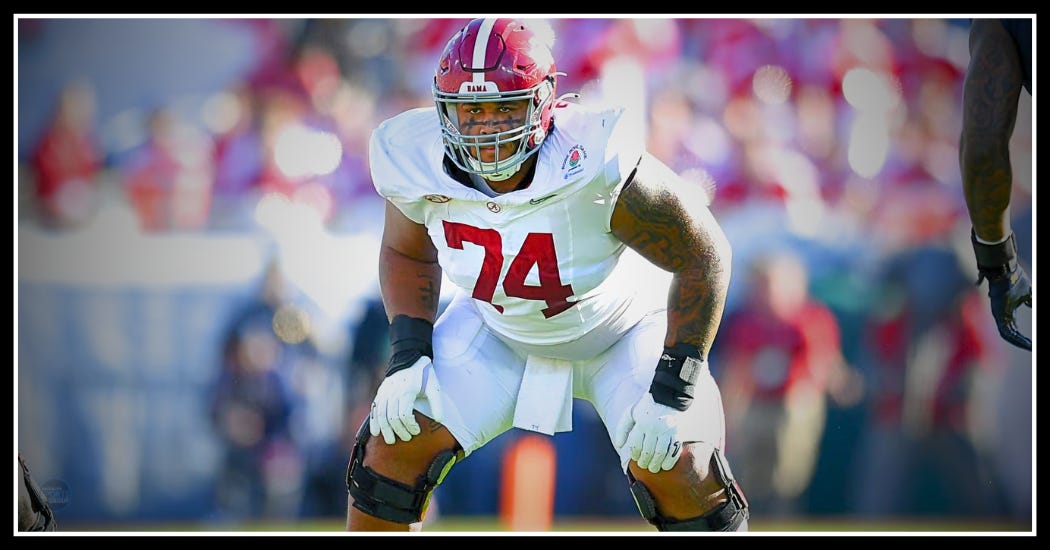
Kadyn Proctor’s path to the top of the 2026 draft board is one of the most unique transfer portal sagas in college football history. A native of Pleasant Hill, Iowa, he was the No. 1 rated offensive tackle in the 2023 recruiting class. On signing day, he famously flipped from his hometown Iowa Hawkeyes to Nick Saban’s Alabama, joining the Tide as an immediate starter.
His freshman season (2023) was a “trial by fire” where he started every game at Left Tackle but struggled with SEC speed, leading to a brief departure. Following Saban’s retirement in January 2024, Proctor transferred back to Iowa, only to realize his mistake during spring ball. In an unprecedented move, he transferred back to Alabama in April 2024. That decision defined his career. Under the new staff, Proctor reshaped his body, dropping from 380 lbs to a leaner 360 lbs. He quietly dominated in 2024 despite playing through a shoulder injury, and in 2025, he fully realized his 5-star potential, earning First-Team All-SEC honors and becoming the highest-graded pass protector in the conference.
The Detroit Lions Fit: Identity-Culture-Scheme
The Lions prize resilience (”Grit”), identity through toughness with players that don’t back down from competition, and culture where players work ethic and attitude make the team what it is. Initially Proctor would be off the Lions radar due to the transfer, however Dan Campbell’s message about the NCAA transfer portal and players with multiple transfers to avoid competition proves that Proctor did it right.
Head Coach Dan Campbell Discusses How The Transfer Portal May Remove You Off The Detroit Lions Draft Board | Credit: TexAgs “The LiucciCast”
Culture & Identity: Proctor’s willingness to own his mistake, return to the SEC cauldron, and fight through the tougher competition, to match the speed and intensity of the SEC is exactly what Dan Campbell and Brad Holmes want to see from a young players mentality and hunger to be the best.
Team First: Proctor also dealt with a torn labrum in his shoulder suffered during pregame warm-ups ahead of the week 1 game to start the 2024 season. Missing only two games and playing out the season speaks to the mental & physical toughness Dan Campbell covets most.
Scheme Fit: Gap/Power/Duo. Proctor is a “people mover,” and Detroit runs a balanced zone/gap/power & Duo run scheme. Proctor shines brightest in Duo and Power concepts where he can use his 360-pound frame to wash defensive tackles down the line—a perfect match for the running styles of Jahmyr Gibbs and David Montgomery.
NFL Comparisons
1. Trent Brown (1x NFL Pro Bowler): This is the most direct comparison. Like Brown, Proctor is a massive human (6’8”, 380 lbs range for Brown) who possesses shocking foot speed for his size. Both players are elite pass protectors because they are simply too big to get around and too strong to go through. Both face questions about weight and conditioning. When Trent Brown is “on,” he is the best tackle in football. Proctor has that same ceiling.
2. Orlando Brown Jr. (4x NFL Pro Bowler): Another massive tackle who overcame “testing” concerns (Proctor tests better) to become a franchise left tackle. Brown relies on length, size, and understanding angles rather than elite footspeed. Proctor shares this “wall” profile but is arguably more explosive.
3. Jordan Mailata (2nd Team All-Pro): A comparison for athleticism at size. Mailata is a former rugby player who is massive but moves like a tight end. Proctor’s rugby-like background isn’t there, but his shot-put explosion gives him a similar kinetic profile.
The Athletic Prototype System: T.A.P.S
In 2023 I began developing and testing a proprietary system for NFl Draft prospects called TAPS, The Athletic Prototype System. This is not a RAS score, it is much different and compares the current draft prospects against the most elite, physically gifted athletes in game today and yesterday. By utilizing the previous 15 seasons as a benchmark, I can keep a current trend on body size and type with the ever-changing landscape of the NFL and todays body transformation sciences.
The combine is a great resource for those that participate, and it does help someone like myself that does not have all the access to player backgrounds and medical reports that NFL teams do. However, film study and production do weigh in heavily. I wanted to bring a more data-driven approach to NFL Draft scouting, and simply see if it would work. The system categorizes the athletes into distinct tiers by establishing a baseline grading scale for measurements, athleticism, speed and strength. It then stacks each season’s draft class against the historical ‘Gold Jacket Standards’ to find a true average value.
By blending these raw physical traits with on-field production, stats and film study, the model has proven highly predictive—correctly identifying the #1 player at their respective position several times in just three draft cycles. As an example, the model allowed me to hit 26/32 correctly called draft prospects in the 1st round of the 2025 NFL draft. Which also included the correct picks called live for Tyleik Williams & Tate Ratledge based on my scale and best available to the Detroit Lions. I also correctly called the 1st five draft picks for the Detroit Lions in the 2023 draft, and the Lions 1st & 3rd round picks in 2024.
What is more important is that the model has also identified the hidden gems in their respective positions in later rounds. Kobie Turner, Byron young, Ruke Orhorhoro, Jalyx Hunt, Moro Ojomo and others. As the system continues to be refined the data should only get better.
I say all of this to let you know that when I evaluate a player and have high hopes now in December that player will be the right choice. That may change when more data is available after the first week of March.
TAPS Snapshot: Offensive Tackle Threshold
Height: 6’5” or taller
Weight: 318 lbs or heavier
Speed: Sub 5.10
Arm Length: 33.75” or longer
Wingspan: 5” Greater than height or more
Hand Size: 10.5”+
Ape Index: 1.06 or higher (wingspan divided by height)
Kadyn Proctor
Height: 6070 (6’7”) - Known
Weight: 360+ lbs - Known
Speed: 5.10 - Known
Expected & Rumored
Arm Length: 35”
Wingspan: 83.5”
Hand Size: 10.5”
Ape Index: 1.06
Analysis:
Proctor’s athletic profile is historically unique, as he is nearly 40 pounds heavier than the average elite NFL rookie, earning him the number two overall spot on Bruce Feldman’s 2025 Freaks List. His raw power is evidenced by an 815-pound squat, a 535-pound bench press, and a 405-pound power clean. Beyond static strength, his explosive metrics are rare for a lineman of his size.
According to the Relative Athletic Score database, Proctor combines 99th-percentile weight with a 99th-percentile broad jump and a 93rd-percentile vertical leap. This blend of mass and movement is further highlighted by an 85th-percentile forty-yard dash time, showcasing elite range and agility for the position. The most impressive stat to me, he is barely 20.5 years old.
Pass Protection: Smooth Footwork
1. The Anchor: Proctor’s anchor is his superpower. Because of his 360+ lb frame and low center of gravity (aided by that elite ankle flexion), he absorbs bull rushes with ease. When a defender attempts to convert speed to power and hits Proctor squarely in the chest, the defender stops, not Proctor. It is simple physics. He does not give ground, preserving the integrity of the pocket’s depth. This trait is invaluable against the NFL’s power rushers (e.g., Myles Garrett, Trey Hendrickson).
2. Footwork and Range: For his size, his kick slide is smooth and covers ground. He does not “gallop” or cross his feet; he slides with a wide base. He has shown the ability to reach the apex of the rush against speed rushers in the SEC. However, his redirection ability is good, not elite. If a defender gets him moving one way and then counters quickly back inside, Proctor’s momentum (mass x velocity) makes it hard to stop and change direction instantly. This “drift” is a minor weakness that elite NFL technicians might exploit. Said another way, Proctor is susceptible to inside counters.
3. Hand Usage: His hands are violent. His initial punch can stun a defender, knocking them off their rush arc. He has improved his independent hand usage, using a “flash” hand to bait the defender before clamping down. His grip strength is immense; once he latches on, the rep is usually over. The criticism remains that under panic, he can revert to “hugging” or grabbing outside the frame, though his low penalty count in 2025 suggests he has disciplined this habit.
4. Processing: Proctor’s football IQ has grown significantly. In 2025, he showed excellent awareness of stunts and twists (T-E games). He passes off defenders to his guard smoothly and picks up the looper. This mental processing is critical for avoiding “free runners” at the quarterback.
Run Blocking: The Road Grader
1. Gap and Power Schemes: This is where Proctor is a generational talent. In “Duo” or “Power” concepts, where his job is to double-team a defensive tackle with the guard or block down on a 3-technique, he is devastating. He generates vertical displacement, moving defenders 3-5 yards off the ball against their will. He creates “truck-sized lanes” for running backs.
2. Zone Blocking Limitations: The “red flag” in his profile appears in Zone concepts, specifically Outside Zone. While he has the burst to reach a defender initially, he struggles to sustain blocks in space or climb to the second level effectively. Scouting reports note that he can look “lost” when trying to locate a linebacker in space or on screen plays. He sometimes takes poor angles to the second level, relying on his size to screen off defenders rather than locking onto them. This suggests he is not a universal scheme fit.
3. Finishing: Proctor plays with a “nasty” demeanor. He looks to bury defenders. He does not stop at the whistle; he plays through it. This psychological edge sets the tone for the entire offensive line. He is a “mauler” who demoralizes opponents over four quarters.
The 2025 Season: Game Analysis
To truly understand Proctor’s readiness for the NFL, I examined his 2025 junior campaign in granular detail. This was a 14-game sample size against the best competition in college football.
The Early Season: Establishing Dominance (Weeks 1-4)
@ Florida State (L 17-31): Despite a team loss in the opener, Proctor held his own against a fast, athletic ACC defensive front. He allowed zero sacks and only one pressure, setting the tone for his personal season.
vs. ULM (W 73-0) & vs. Wisconsin (W 38-14): In these non-conference matchups, Proctor was physically overwhelming. Against Wisconsin, a Big Ten team known for disciplined rushers, he was a brick wall. The game logs show zero sacks allowed and a dominant run-blocking grade.
The Signature Performance: Georgia (Week 5)
@ Georgia (W 24-21): This was the game that defined his draft stock. Facing a Georgia defensive front that is essentially an NFL factory, Proctor played 43/79 pass-blocking snaps and allowed zero pressures. He graded out at 75.8 in pass blocking against one of the most sophisticated defensive schemes in the country. The 75.8 grade by PFF is a joke, should have been in the upper 80’s, this was an elite performance.
The Highlight: Late in the second quarter, Alabama ran a play where Proctor became an eligible receiver/runner. He caught a pass and rumbled for 11 yards, trucking defenders and showcasing his athleticism in space. This play demonstrated not just mobility, but football IQ and coordination. With the Lions using offensive tackles as eligible often, having a 6’7” 360 lb weapon that can move and catch is always a great option.
The Impact: He earned Outland Trophy National Player of the Week honors for this performance. It proved he could neutralize elite SEC speed and power on the road in a hostile environment.
The SEC Gauntlet (Weeks 6-12)
vs. Tennessee (W 37-20): Tennessee employs a wide-9 alignment with hyper-athletic edge rushers (reminiscent of the James Pearce Jr. profile). Proctor handled the width of the rush exceptionally well, using his kick slide to cut off angles. He earned a PFF grade of 84.5 in this contest, one of his highest of the season.
vs. Missouri (W 27-24) & @ South Carolina (W 29-22): These tight conference games tested his consistency. Against Missouri, he helped the offense grind out a win on the ground. Against South Carolina, facing a formidable pass rush, he kept the pocket clean on key third downs.
vs. LSU (W 20-9): A “road-grading” performance. Alabama committed to the run, and Proctor was the tip of the spear. He displaced LSU’s defensive tackles consistently, creating lanes for the running backs. This game highlighted his fit for a power-run scheme.
The Postseason Tests (SEC Championship & CFP)
vs. Georgia (SEC Championship - L 7-28): The rematch was a humbling experience for the entire team. Reports indicate Proctor “struggled at times” in this game. Whether due to fatigue or Georgia’s defensive adjustments (stunts/blitzes targeting the B-gap), he was not as imperious as in Week 5. This game serves as a reminder that even elite prospects have variance.
@ Oklahoma (CFP First Round - W 34-24): In the playoffs, Alabama faced an Oklahoma team that jumped out to a 17-0 lead. Proctor helped steady the ship. He allowed one sack in this game—his first significant blemish in months—but rebounded to protect Ty Simpson during the comeback. The line allowed 5 sacks total, but Proctor’s individual play was largely stable outside of the one error.
Statistical Summary of 2025
Total Snaps: 823 (61st among Tackles)
Pass Block Snaps: 492
Run Block Snaps: 328
Sacks Allowed: 1 (Ranked 95th percentile, meaning top tier)
Penalties: 1 (Elite discipline)
PFF Overall Grade: 85.5 (9th among all Tackles nationally)
Pass Block Grade: 80.5
Run Block Grade: 81.8
Advanced Metrics:
Pressures Allowed: 1 Sack | 4 Hit | 12 Hurries (17 Total)
Pass Blocking Efficiency: 97.9%
True Pass Set Grade: 88.0 (Measures performance on pure dropbacks without play-action help)
Zone Run Grade: 85.5 | Gap Run Grade: 81.0
Trait Grading (1-9 Scale)
Anchor: 9.0 (Elite - Rare to see him moved backward)
Foot Speed: 7.0 (Above Average for size)
Hand Usage: 7.0 (Good punch, occasionally wide)
Run Power: 9.0 (Elite - Displaces defenders 3-5 yards)
Reactive Athleticism: 6.5 (Struggles slightly vs. late stunts & counters)
Mental Processing: 7.5 (Greatly improved vs. blitz pickup)
Overall Grade: 7.67 / 9.0 (High-Level Starter / Pro Bowl Upside)
Scouting Report: Strengths
Immovable Anchor: Once Proctor sinks his hips, the rep is over. He absorbs bull rushes from powerful defensive ends with zero displacement, effectively ending the rush before it begins.
Length & Radius: With estimated 35-inch arms, he keeps defenders outside the “red area.” He can engage contact before the defender can get into his chest.
Torque in Run Game: In the run game, he doesn’t just wall off defenders; he torques them. He has numerous “highlight reel” pancakes where he rotates his hips and throws 280-pound ends into the turf.
Screen Game Utility: surprisingly effective in space. For a 365-pounder, he locates second-level targets well on screens, acting as a lead convoy.
Scouting Report: Weaknesses
Waist Bending: When fatigued, he tends to lean forward at the waist rather than bending at the knees. This makes him susceptible to the “push-pull” move by savvy veterans.
Recovery Speed: He is not a recovery athlete. If he over-sets to the outside, he lacks the elite twitch to redirect back inside against a quick counter-move. He must win with initial positioning.
Pad Level: Due to his 6’7” height, he naturally plays high. Leverage will always be a battle against shorter, stockier power rushers.
Quotes & Analysis: What Are They Saying?
“He’s the prototype for the modern NFL tackle—a road grader in the run game who creates a clean pocket simply by existing. You can’t teach 6’7, 360 with feet like that.”
— Daniel Jeremiah, NFL Network
“The growth from his freshman year to now is night and day. He went from a kid relying on size to a technician relying on leverage. He’s a plug-and-play starter for the next decade.”
— Senior Bowl Scout (Anonymous)
Rock’s Take
The Lions are in a fascinating window regarding their offensive line. The Lions have the best right tackle in football right now with Penei Sewell. The right guard spot is set for the next 4 seasons with Tate Ratledge. Should the Lions push Ratledge to center as opposed to drafting one, Christian Mahogany and Miles Frazier become the immediate guard options. It is too early to tell if Giovanni Manu will be ready to man the left tackle position in 2026. My honest opinion is to not make the mistake by missing out on a generational talent that Proctor may become. That leaves Manu or Frazier as the immediate backups at left tackle.
The offensive line in 2026 could look like this in 2026.
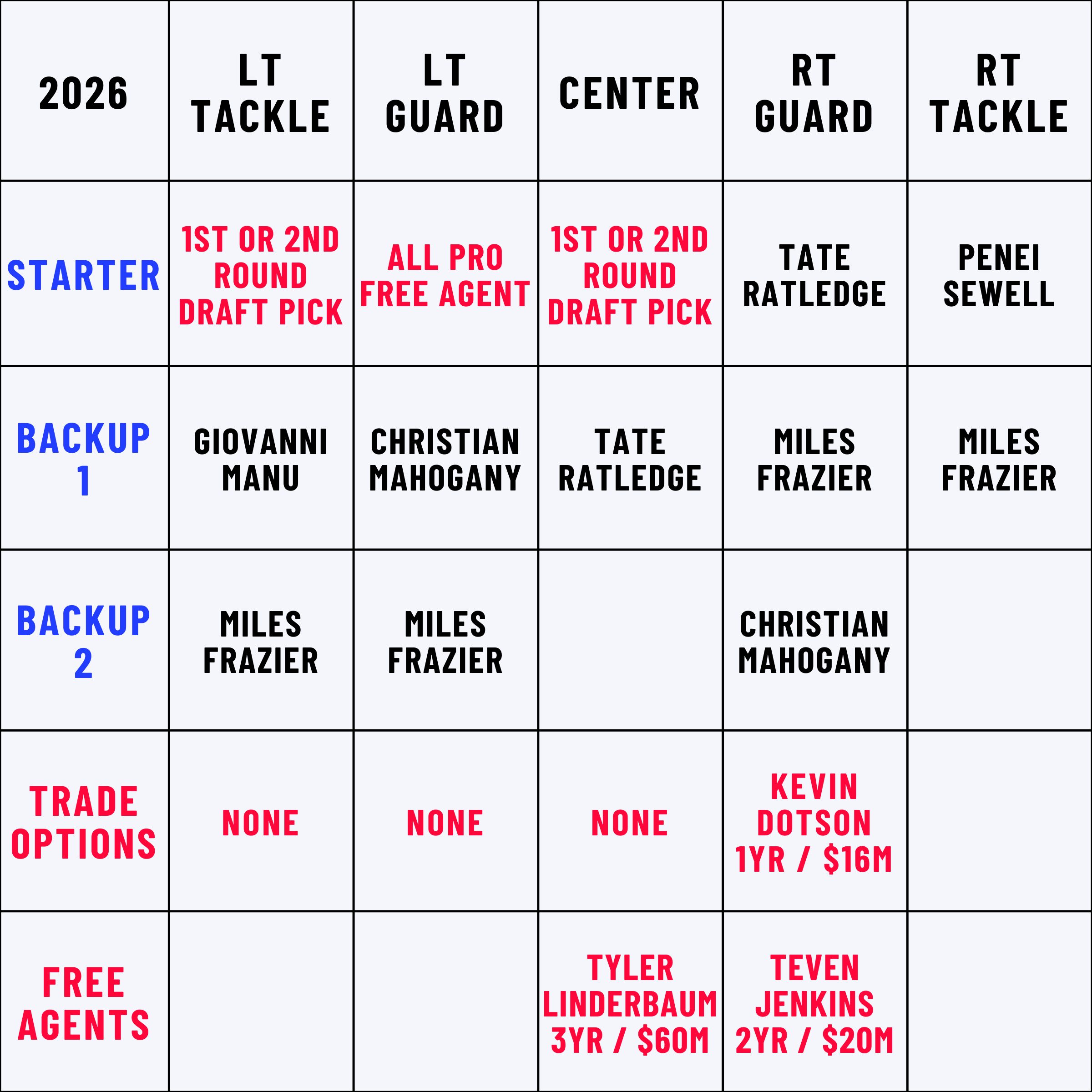
Miles Frazier is a bit of a wild card still. He primarily played right guard with a brief stint at right tackle at LSU. Should Tate Ratledge move to center, Frazier is the natural fit here at right guard. Some intriguing free agent and trade options may be available. Kevin Dotson is entering his final season without any guaranteed money in 2026. A premium price of $16 million for a one year rental on a 29 year old right guard is a bit rich with Frazier in line. Dotson is one of the best run blocking guards in the league with better than average pass protection. With very few sacks and pressures allowed his presence would be welcomed next to Ratledge & Sewell. Jenkins could be a free agent target should the Lions make the move with Ratledge and look to add a veteran in his place.
Should the Lions opt to go all in on the best free agent center Tyler Linderbaum. Tate Ratledge would likely remain at right guard. This gives the Lions the option to find their left tackle for the future in the draft and allow Frazier and Mahogany to battle it out for the final left guard spot.
Proctor is a pure Left Tackle that fits the “Dan Campbell DNA” of physicality and size, but the roster fit is clumsy unless a major veteran move precedes it. The clock is ticking on Decker. Should Decker not retire after this season, the Lions could opt to release Decker. Should the Lions designate his release post June 1st, 2026 - $15.05 million will be saved with a dead cap hit of $3.15M with another $6.3M in 2027. Decker is under contract through 2027, but he will be 33 years old in 2026 without any guaranteed money left on his deal after 2025. The release or retirement of Taylor Decker frees up salary cap needed to make the moves in free agency. The good news is the Lions will have a few options at their disposal.
NFL Draft Projection
Projection: Top 10-17 Pick (1st Round)
Rationale: Left Tackles with this mass and SEC pedigree rarely escape the Top 17.
Team Need: Teams like the Detroit Lions (15), Kansas City Chiefs (9), Cleveland Browns (6), New Orleans Saints (8), Miami Dolphins (11), Baltimore Ravens (16) or Minnesota Vikings (17) will view him as a foundational piece to start building with or to protect their franchise QBs. Each team has a varying degree of age, need or expense at the position currently that make the most sense. The Rams & Steelers are both in demand with picks currently north of 20th overall that could move up.
Likely Landing Spot: Detroit Lions - I expect the Lions to select a center or left tackle in the first round of the 2026 draft. Should Proctor fall back in the draft, the Lions may opt to move back into the first round securing the offensive line future for the next 5-8 seasons.

Join The Detroit Football Journal Daily Podcasts Below
LATEST STORIES



Lions’ Thrilling Victory Over Cowboys Marred By The Emergence Of A Structural Crisis

DETROIT —Thursday Night Football between the Detroit Lions and the Dallas Cowboys delivered one of the most exhilarating spectacles for Thursday Night Football in a long time. For Lions fans, the eventual 44–30 dismantling of the Cowboys—a critical “must-win”
NFL Week 11: Eagles Exposed - What The Detroit Lions Learned From MNF

What’s up, Lions Nation! Will Rock here with Rocked On Detroit Lions and Detroit Football Journal. Bringing you the most comprehensive breakdown of the Lions vs. Eagles matchup you’ll find anywhere. This weeks keys to the game submission will be three separate pieces with a bonus feature.
HANK FRALEY: THE PERFECT INTERNAL SOLUTION FOR DETROIT LIONS' OFFENSIVE COORDINATOR

While the Detroit Lions could chase big-name offensive coordinator candidates like Brian Daboll, the perfect solution to their play-calling crisis might already be in the building. Hank Fraley—the architect of the NFL’s most dominant offensive line and a coach who turned down the Seattle Seahawks to stay in Detroit—represents the safest, most seamless path forward for a Lions team in their Super Bowl window.

Why Brian Daboll Could Be Detroit's Next Offensive Coordinator

The New York Giants just fired Brian Daboll after a catastrophic 2-8 start, and the Detroit Lions are facing their own offensive coordinator crisis with Dan Campbell stripping play-calling duties from John Morton. Could the former NFL Coach of the Year be the answer to Detroit’s offensive struggles? An in-depth analysis reveals why Daboll’s track record with Josh Allen and the Buffalo Bills makes him an intriguing—but complicated—candidate for the Lions’ OC position should it open up in 2026.