DETROIT — In a league addicted to fast movement, bright lights and the big splash plays—Brad Holmes chooses sustained momentum through balance, patience and calculated strikes. Other teams may bet the franchise on a single chess move, or the all in poker play; but not Detroit, and not Brad Holmes. The Lions’ way is planning their moves 5 steps ahead, banking on the depth of the roster, development of players and coaches—to be the winning strategy. The argument for restraint isn’t theoretical anymore; it’s playing out in real time.
There is a stark difference between the two philosophies; one team will keep humming with a diversified portfolio of talent, while the other is hoping that going all in on that blue chip penny stock, the one Jordan from Stratton Oakmont sold you, will hit before the bottom falls out.
The real question is: how do you sell this philosophy to a desperate fanbase, greedy stakeholders, and the locker room? Will they embrace the long game, or start doubting every move the moment the momentum dips?
Buckle up—this is going to be a long one
Rewriting The Roster Equation In Detroit
Detroit’s front office has been rewriting the roster equation for both sides of the ball since the regime change in 2021. Holmes’ resource allocation is unmistakably simple—so simple in fact, it makes too much sense. Follow the blueprint of every successful Super Bowl winning franchise the previous 20 seasons.
Is it a fair statement that what Brad Holmes is doing may not be understood or respected by the Lions faithful—for simply not knowing how to deal with success, and what feels like a failure is actually success?
Defense Playbook: Build the foundation starting with interior run‑stuffing disruptors, then add rangy linebackers who can thump downhill against the run and flow sideline‑to‑sideline in coverage to control the second level, then balance the front seven out with versatile playmakers in the secondary. Use the draft to secure young cost‑controlled talent, supplement with targeted free‑agent veterans for leadership and stability, and emphasize rotational depth across the defense. Layering your playmakers at multiple levels and positions for a deep rotation is key to building a special teams unit, extending the overall impact in all three phases.
The coordinator’s job: maximize matchups, mix & blend styles with coverages, find what your players do well, use every ounce of talent, develop every player to be ready at a moments notice, and keep the defense unpredictable.The result is a complete defense, built to sustain the pressure of adversity that comes in waves during a long season. A defense that holds firm to the standard when the injuries begin to mount. When successful, you get impact players and a rotation that doesn’t let up. Most importantly, it can be accomplished without forcing your salary cap into deficit with big signings or leveraging the future draft capital with splash trades.
Draft Or Buy A Super Bowl?
I think most fans agree that drafting an developing is the best way to field a team for sustained success. Especially in today’s economic climate with six positions expected to make $30 million APY or more per season. The price tag is for one “elite” play maker, and with three positions on each side of the ball and eight more starters left to pay, the salary cap runs out fast. Below are the six most expensive positions in 2025, and their respective APY expected for 2026.
Offense: Quarterback $55M APY | WR $33M APY | OT $30M APY
Defense: EDGE $35M APY | DT $30M APY | CB $30M APY
Keeping the resources required to build and maintain elite players of the future on the roster with the hope of winning a Super Bowl is not easy. The teams that draft well and reinvest in their own players have the upper hand. Below is a snapshot of a few teams that won the Lombardi between 2004-2024, proving the concept that drafting, developing & re-signing your own works. Buying a team and paying for high priced free agents is not conducive to long-term success.
2011 New York Giants | Total drafted starters: 15/22 - 68.2%
Offense: Eli Manning (QB), Ahmad Bradshaw (RB), Hakeem Nicks (WR), Mario Manningham (WR), Jake Ballard (TE), David Diehl (LT), Chris Snee (RG), Will Beatty (LG) — 8 drafted (72.7%)
Defense: Justin Tuck (DE), Linval Joseph (DT), Jason Pierre-Paul (DE), Mathias Kiwanuka (LB), Corey Webster (CB), Aaron Ross (CB), Kenny Phillips (S) — 7 drafted (63.6%)
Free agent or traded starters: David Baas (C), Kareem McKenzie (RT), Michael Boley (LB), Antrel Rolle (S), Deon Grant (S)
2012 Baltimore Ravens | Total drafted starters: 18/22 - 81.8%
Offense: Joe Flacco (QB), Ray Rice (RB), Torrey Smith (WR), Ed Dickson (TE), Dennis Pitta (TE), Michael Oher (T), Kelechi Osemele (T), Marshal Yanda (G), Matt Birk (C) — 9 drafted (81.8%)
Defense: Haloti Ngata (DE), Arthur Jones (DE), Pernell McPhee (DE), Courtney Upshaw (OLB), Ray Lewis (MLB), Terrell Suggs (OLB), Ed Reed (FS), Cary Williams (CB), Lardarius Webb (CB) — 9 drafted (81.8%)
Free agent or traded starters: Anquan Boldin (WR - trade), Vonta Leach (FB - free agent), Bryant McKinnie (T - free agent), Bernard Pollard (SS - free agent)
2014 New England Patriots | Drafted starters: 16/22 - 72.7%
Offense: Tom Brady (QB), Julian Edelman (WR), Rob Gronkowski (TE), Nate Solder (LT), Dan Connolly (LG), Bryan Stork (C), Ryan Wendell (RG), Sebastian Vollmer (RT), Shane Vereen (RB), James Develin (FB), Michael Hoomanawanui (TE) — 9 drafted (81.8%)
Defense: Chandler Jones (DE), Vince Wilfork (NT), Rob Ninkovich (DE), Dont’a Hightower (LB), Jamie Collins (LB), Devin McCourty (FS), Patrick Chung (SS) — 7 drafted (63.6%)
Free agent or traded starters: Brandon LaFell (WR), Darrelle Revis (CB), Brandon Browner (CB), Kyle Arrington (CB)
2017 Philadelphia Eagles | Total drafted starters: 15/22 - 68.2%
Offense: Carson Wentz (QB), Nelson Agholor (WR), Zach Ertz (TE), Jason Kelce (C), Lane Johnson (RT), Halapoulivaati Vaitai (LT), Isaac Seumalo (LG), Brandon Brooks (RG) — 8 drafted (72.7%)
Defense: Fletcher Cox (DT), Brandon Graham (DE), Vinny Curry (DE), Mychal Kendricks (LB), Jordan Hicks (LB), Jalen Mills (CB), Ronald Darby (CB), Malcolm Jenkins (S), Rodney McLeod (S), Nigel Bradham (LB), Timmy Jernigan (DT) — 7 drafted (63.6%)
Free agent or traded starters: Alshon Jeffery (WR), Torrey Smith (WR), LeGarrette Blount (RB), Stefen Wisniewski (LG), Patrick Robinson (CB), Chris Long (DE), Corey Graham (S)
2020 Tampa Bay Buccaneers | Total drafted starters: 17/22 - 77.3%
Offense: Tristan Wirfs (RT), Donovan Smith (LT), Ali Marpet (LG), Alex Cappa (RG), Ronald Jones II (RB), Mike Evans (WR), Chris Godwin (WR), Cameron Brate (TE) — 8 drafted (72.7%)
Defense: Lavonte David (LB), Devin White (LB), Carlton Davis (CB), Sean Murphy-Bunting (CB), Jamel Dean (CB), Jordan Whitehead (S), Antoine Winfield Jr. (S), William Gholston (DE), Vita Vea (DT) — 9 drafted (81.8%)
Free agent or traded starters: Tom Brady (QB), Rob Gronkowski (TE), Leonard Fournette (RB), Antonio Brown (WR), Ndamukong Suh (DT), Jason Pierre-Paul (DE), Shaquil Barrett (OLB), Rakeem Nunez-Roches (DT)
2021 Los Angeles Rams | Total drafted starters: 13/22 - 59.1%
Offense: Cooper Kupp (WR), Van Jefferson (WR), Tyler Higbee (TE), Brian Allen (C), David Edwards (LG), Rob Havenstein (RT), Cam Akers (RB) — 7 drafted (63.6%)
Defense: Aaron Donald (DT), Greg Gaines (DT), Ernest Jones (LB), Taylor Rapp (S), Nick Scott (S), Jordan Fuller (S) — 6 drafted (54.5%)
Free agent or traded starters: Matthew Stafford (QB), Andrew Whitworth (LT), Odell Beckham Jr. (WR), Sony Michel (RB), Leonard Floyd (OLB), Von Miller (OLB), Jalen Ramsey (CB), Darious Williams (CB), A’Shawn Robinson (DT)
2024 Kansas City Chiefs | Drafted Starters: 15/22 → 68.2%
Offense: Patrick Mahomes (QB), Xavier Worthy (WR), Creed Humphrey (C), Trey Smith (RG), Wanya Morris (LT) — 5 drafted (45.5%)
Defense: George Karlaftis (DE), Chris Jones (DT), Tershawn Wharton (DT), Michael Danna (DE), Nick Bolton (LB), Leo Chenal (LB), Trent McDuffie (CB), Jaylen Watson (CB), Justin Reid (S), Bryan Cook (S) — 10 drafted (90.9%)
Free Agent / Traded Starters: Kareem Hunt (RB), Justin Watson (WR), Noah Gray (TE), Jawaan Taylor (RT), Drue Tranquill (LB)
Holmes’ Style Vs The Backlash
Holmes’ draft and roster-building approach since 2021 has been clear: build the trenches, add key playmakers, depth is just as valuable as the starters, value flexibility & versatility above all else, and don’t chase headlines. Holmes’ has publicly cautioned against drafting for “need or right now,” emphasizing patience and future investments over short-term need-chasing. That stance set the expectations—and invited heavy criticism when he declined to add another top-dollar edge defender opposite Aidan Hutchinson.
Fans wanted a big splash in free agency or the trade deadline the last three seasons at edge; Holmes kept the focus on the interior, secondary, and rotation pieces that sustain a defense without sacrificing the salary cap or future draft capital. The Lions’ roster is built with continuity, targeted upgrades, and the latitude to pivot when the board and market align.
Question: Is the payoff visible yet in 2025?
As results accumulate, earlier backlash feels less like stubborn criticism and more like the growing pains of a fan base learning how to live with success. For decades, Lions fans never experienced the luxury of a modern, process-driven front office—adjustment is real and never easy. Coming from the gutter of the league to the top of the league in 2.5 short seasons requires organizational growth, but also a certain level of learning and growth for everyone, including the fanbase.
Unfortunately, for Detroit, the growing pains are instead met with anger, resentment, and hate spewing toward players, coaches, the GM and even ourselves—instead of recognizing all the great things this team has accomplished so quickly, the talent accumulated and the sheer number of amazing players under contract offering a future filled with sustained success.
Has The New Equation Worked In Detroit?
The bones of Holmes’ philosophy are clear: protect the spine of the defense, accept targeted tradeoffs in splash categories, and trust the development process to unlock value without the fragility of mega-deals. His blueprint prizes conviction in scouting, patience in roster construction, and a refusal to chase “right now” splashes that erode future value. Since 2021, Holmes has put that model to work, empowering Aaron Glenn and Kelvin Sheppard to build a resilient defense that when healthy or not stacks up against the best in the league.
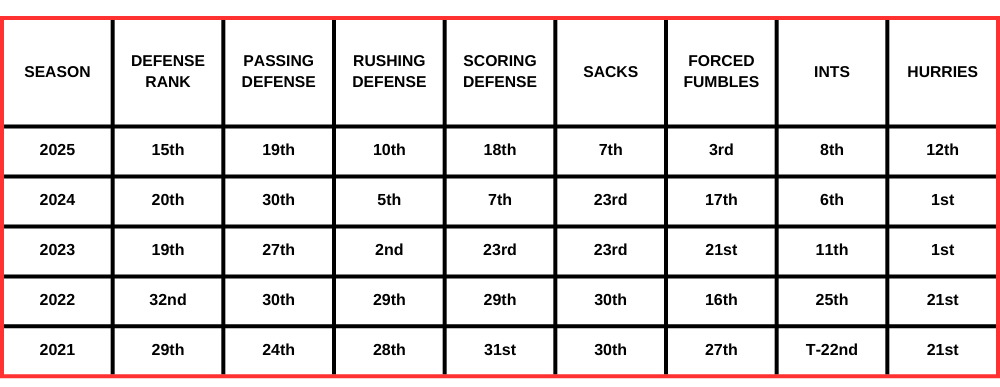
2025—Kelvin Sheppard has managed well, even after injuries once again putting this team against the wall. Even with the midseason dip, Sheppard’s defense still sits inside the Top 15 overall. The numbers tell the story: strong against the run (13th), disruptive in the pass rush (7th in sacks | 12th in hurries), and opportunistic in turnover creation (3rd in forced fumbles, 10th in interceptions). The dip—post the bye-week reflects attrition in the secondary, and even after four major statistical let down games—this unit has already proven it can perform at a Top 5 level.
TAKE NOTE: the Lions’ are one of two teams with two defensive ends in the top 12 for sack leaders. Aidan Hutchinson (9.5 per ESPN) & Al-Quadin Muhammad (9.0 per ESPN). Depending on which site you use will depend on who’s counting halfs or who’s rounding up. My sack count has both players with nine on the season. Aidan’s sack vs the Rams should have been split with Alex Anzalone.
Consistent Improvement Is Not Easy
I think it is pretty clear the defense has improved in all areas year over year. As the Brad Holmes’ philosophy ages, this defense gets better every season. With targeted resources and flexibility intact for future drafts and free agency, those Holmes’ principles look like foresight, not caution in 2025 and beyond.
Year Over Year Defense Snapshot
Hutchinson’s Snapshot: Production, Usage & Context
Hutchinson’s 2025 ledger—through Week 15—PFF shows a productive, disruptive edge doing exactly what a franchise cornerstone should: 11 sacks (ESPN 9.5), 21 total tackles, four forced fumbles, and a pick, with impact sequences across multiple games. His game logs include multi-sack performances and steady weeks with pressures each game. The expected variance per game is typical of the position and opponent quality.
There’s a familiar critique in any season—the quality of opposing tackles and protection plans—and that’s fair evaluation terrain for film review (come back on 12.017.2025 for the tape review). But the bigger picture is the role he plays within Detroit’s defensive architecture: draw protection attention, win his share, and enable rotational waves that produce team-level efficiency. The key term here being “Team-Level.”
The Muhammad Efficiency Factor
If Brad Holmes needed proof that depth and rotation can rival splash signings, Al-Quadin Muhammad has delivered it in 2025. Despite playing less than half the snaps of Aidan Hutchinson (393 vs. 849), Muhammad has (9) sacks to Hutchinson’s (9.5), has generated 46 pressures compared to Hutchinson’s 85. Remember the key here is, “Team-Level,” and Muhammad has outperformed that metric when you factor in efficiency vs snap load. Stats per Fox Sports
Snap To Sack & Pressure Ratio | Double-Triple-Chip
Aidan Hutchinson: 849 snaps vs 9.5 sacks = 1.1% snap to sack ratio, 10% pressure to snap ratio. Double team rate 42.09% — triple team rate 6.68% — chip rate 22.72%
Al-Quadin Muhammad: 393 snaps, 2.3% snap to sack ratio, 11.7% pressure to snap ratio. Double team rate 43.53% — triple team rate 5.49% — chip rate 9.02%
That efficiency—with nearly identical production on half the workload—illustrates why Holmes resisted the urge to chase another $180M edge. Muhammad’s role epitomizes the Lions’ philosophy: maximize rotational value, keep legs fresh, and spread resources across the roster.
Al-Quadin Muhammad is the quiet proof-of-concept, he’s delivering pass-rush value on targeted usage—exactly how rotational investments are supposed to work. It’s not just box score juice; it’s that his production arrives without consuming a superstar snap share or superstar dollars, letting Detroit double down on interior and coverage to sharpen the entire unit’s efficiency. Muhammad’s year underscores Holmes’ scouting thesis: efficient role players who can spike high-leverage snaps are worth more than a second financial anchor—especially when the schedule and game scripts demand adjustments week to week.
The overwhelming hype that Aidan needs “HELP” and the hate the Detroit fan base has poured into Brad Holmes or anyone lined up on the opposite of Aidan Hutchinson is sad and almost laughable at this point. Muhammad has proven he is active, durable, and central to Detroit’s identity up front, even as the team declines to overexpose its salary cap.
Risks & The Fragility Of Single-Point Bets
The edge market has detonated over the past few years, pushing elite APY into the mid–$30Ms and beyond. That’s fine when the player stays healthy and the roster absorbs the cost—but opportunity cost is brutal when injuries hit. The Packers just paid the ultimate price to take the risk—after a blockbuster trade and mega extension, Micah Parsons’ ACL tear in Green Bay—illustrates the systemic risk; one play can invert a season and a teams future.
Micah Parsons was as advertised — 12.5 sacks, league-leading pressures—and then the ACL cut the fuse in Week 15. The cost wasn’t just the player; it was the draft capital, the cap flexibility and Kenny Clark an elite interior defender all surrendered to make the roster singular. Their path forward now depends on the collective of players left behind. However, void of time and resources to re-architect on the fly, the Packers are sunk. Holmes built the Lions explicitly to avoid that cliff, and 2025 offers the contrast in its sharpest form.
This Brad Holmes’ strategy isn’t new nor is it anti-superstar. It’s pro-portfolio, pro-team, pro-future, pro-sustainability. When the cap lives at the edge of the envelope and draft capital is leveraged to secure one more pass rusher, you limit the adjustments available when the injury lottery comes due. The Lions have paid through the nose with injuries, why would they want to take the ultimate risk by leveraging the entire future too? Holmes’ method spreads risk across interior, edge rotation, and coverage, preserving flexibility for late-season pivots.
Rock’s Take: Where Overspenders land In 2025
Zooming out, the league’s top defenses skew toward strong interiors, coherent coverage, and balanced pressure. Houston, Cleveland, Denver, and the Chargers all sit top-five in total defense; Green Bay, before Parsons’ injury, had been top-five in yardage allowed as well. Detroit slots mid-table overall and top-ten against the run, a profile that suggests the pass rush is “good enough” within their resource budget—and more importantly, survivable if injuries strike. In aggregate, the overspenders gain ceiling; the portfolio defenses gain survivability. Holmes picked survivability for a reason.
As we can see from the numbers, the Lions do not need another “elite” edge rusher opposite of Aidan Hutchinson. In fact, I would make the argument that Muhammad is more efficient, takes on double & triple teams just as much and has been more productive than Hutchinson this season even with limited snap load. If Sheppard were to give Muhammad more snaps, the numbers would continue to rise and based on the facts, potentially better.
My focus to given you the facts, with the links and the data, to hopefully once and for all provide the transparency into your team. There should be no more misunderstanding about the facts any longer when it comes to Aidan’s production vs any other starting edge on this team. Quite simply, if you value Hutchinson as an elite edge defender, you will have to place Al-Quadin Muhammad in that same conversation this season.
The message is not that big-money edges don’t work; it’s that their risks scale with their cost, and you need the rest of the defense to be sturdy when the star is out. That’s exactly the contingency Detroit built.
Go Lions!

Join The Detroit Football Journal Daily Podcasts Below
LATEST STORIES



Lions’ Thrilling Victory Over Cowboys Marred By The Emergence Of A Structural Crisis

DETROIT —Thursday Night Football between the Detroit Lions and the Dallas Cowboys delivered one of the most exhilarating spectacles for Thursday Night Football in a long time. For Lions fans, the eventual 44–30 dismantling of the Cowboys—a critical “must-win”
NFL Week 11: Eagles Exposed - What The Detroit Lions Learned From MNF

What’s up, Lions Nation! Will Rock here with Rocked On Detroit Lions and Detroit Football Journal. Bringing you the most comprehensive breakdown of the Lions vs. Eagles matchup you’ll find anywhere. This weeks keys to the game submission will be three separate pieces with a bonus feature.
HANK FRALEY: THE PERFECT INTERNAL SOLUTION FOR DETROIT LIONS' OFFENSIVE COORDINATOR

While the Detroit Lions could chase big-name offensive coordinator candidates like Brian Daboll, the perfect solution to their play-calling crisis might already be in the building. Hank Fraley—the architect of the NFL’s most dominant offensive line and a coach who turned down the Seattle Seahawks to stay in Detroit—represents the safest, most seamless path forward for a Lions team in their Super Bowl window.

Why Brian Daboll Could Be Detroit's Next Offensive Coordinator

The New York Giants just fired Brian Daboll after a catastrophic 2-8 start, and the Detroit Lions are facing their own offensive coordinator crisis with Dan Campbell stripping play-calling duties from John Morton. Could the former NFL Coach of the Year be the answer to Detroit’s offensive struggles? An in-depth analysis reveals why Daboll’s track record with Josh Allen and the Buffalo Bills makes him an intriguing—but complicated—candidate for the Lions’ OC position should it open up in 2026.