


In the immediate aftermath of “Black Monday,” the Detroit Lions wasted no time severing ties with Offensive Coordinator John Morton. The move, while expected after Head Coach Dan Campbell assumed play-calling duties mid-season, has signaled a clear shift in philosophy at Allen Park. The Lions don’t just need a play-caller; they need an innovator who can merge the team’s gritty identity with modern passing concepts.
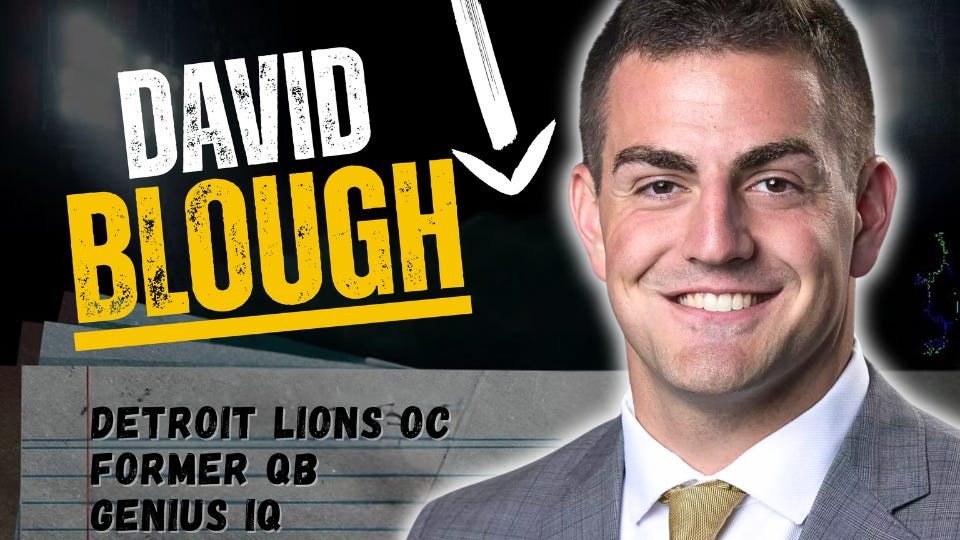
Enter: David Blough.
While the 30-year-old’s résumé is light on years, it is heavy on impact. Currently the Assistant Quarterbacks Coach for the Washington Commanders, Blough has rapidly ascended from “journeyman backup” to one of the most intriguing young minds in football. With the Washington staff in flux following Kliff Kingsbury’s departure yesterday, Blough is a prime target for a promotion.
The Archetype: “Sean McVay / Kellen Moore”
Blough fits the mold of the modern “boy genius” coach—a former cerebral backup quarterback who transitions seamlessly to the headset, skipping typical rung-climbing steps like Quality Control or positional assistant roles. His trajectory mirrors that of Kellen Moore, who went from backup QB to Offensive Coordinator in a single offseason. He represents the “Quarterback-to-Coach” pipeline that prioritizes processing speed and relatability over decades of sideline tenure.
The Case For: Rapid & Proven Development
Blough retired from playing in 2023 and immediately joined Dan Quinn’s staff in Washington. In just two seasons, he has generated substantial buzz in league circles for two primary reasons:
The “Jayden Daniels” Effect: Blough’s fingerprints are all over the rapid development of Washington QB Jayden Daniels. After helping Daniels secure Offensive Rookie of the Year honors in 2024, Blough navigated a chaotic 2025 campaign. When Daniels was limited to just 7 starts due to injury, Blough was tasked with preparing a carousel of backups (including veteran Josh Johnson). Despite the 5-12 finish, the quarterback operation remained professional and prepared, a testament to Blough’s teaching ability during a crisis.
The “Genius” Label: During his playing days, Blough was often described as a coach in a helmet. Kliff Kingsbury, his Offensive Coordinator in Washington (and former Head Coach in Arizona), famously remarked that Blough “knew the offense better than I did” after being in the building for only two weeks. He is viewed not as a former backup, but as a Head Coach in waiting.
The Case Against: Inexperience
The resume is undeniably thin. Blough has never called plays in a regular-season NFL game. Promoting a positional coach with only two years of experience to Offensive Coordinator for a Super Bowl contender is a massive projection.
Lack of Play-Calling Reps: While he likely called plays in practice or preseason, doing it live against defensive masterminds like Steve Spagnuolo or Brian Flores is a different beast.
Authority Issues: Can a 30-year-old former teammate of Jared Goff command the room effectively? While they were peers recently, shifting to a “Coach/Player” dynamic requires a delicate touch.
The Risks
The “Peter Principle”: Is he rising too fast? There is a risk that he is an elite Quarterbacks Coach who isn’t ready to manage an entire offense, run game, and protection plan simultaneously.
Schematic Overload: Young coaches sometimes try to do too much, too soon. The risk is that Blough tries to install a “Greatest Hits” offense from all his mentors (Bevell, Kingsbury, Johnson) without a cohesive identity, leading to a disjointed attack.
Strengths As A Coordinator
For a Lions team that needs to evolve beyond the established norms, Blough offers a fresh schematic perspective.
Modern Scheme Hybrid: Blough sits at a unique intersection of offensive philosophies. He played under Darrell Bevell (West Coast) and Ben Johnson (Modern Pro-Style) in Detroit, and coached under Kliff Kingsbury (Air Raid) in Washington.
The Result: A playbook that blends the “easy buttons” of the Air Raid—getting athletes in space quickly—with the complex protection schemes and under-center play-action of the pro game.
Relatability & Communication: Speaking the same language as the modern player is a non-negotiable trait for young coordinators. At just 30 years old, Blough connects with players on a peer level. Having coached the dual-threat Daniels and played as a pocket passer himself, he possesses the rare ability to coach both styles effectively.
Why He Fits
Blough fits because he bridges the gap between the “Grit” culture of Dan Campbell and the “Finesse” requirements of a modern passing game.
Schematic Continuity: He knows the core of what Jared Goff likes (having sat in the room with him for years) but brings the “Air Raid” concepts from Washington that Goff needs to evolve his game.
Collaborative Mindset: With Dan Campbell likely retaining play-calling duties, the Lions need a brilliant architect to build the weekly game plan, not a dictator. Blough fits this collaborative role perfectly.
Ideal Landing Spots
Detroit Lions: This is the clear primary fit. It is a homecoming that makes too much sense to ignore given his history with the staff and roster.
Los Angeles Rams: If Sean McVay were to lose staff members, he often looks for “mini-mes”—young, smart QBs who process the game like he does.
Arizona Cardinals: With a head coaching vacancy, a new defensive-minded head coach might look to pair with a young offensive mind like Blough to revitalize Kyler Murray (whom Blough knows from his playing days).
The Cognitive Edge: QB Processing Translates
The primary argument for David Blough’s potential as a play-caller lies in the concept of “live-fire processing.”
While many coaches learn football from the “top down” (looking at All-22 film and X’s and O’s on a whiteboard), a quarterback learns it from the “inside out.” Blough spent his entire career in the pocket, meaning his brain is wired to process defensive structures in milliseconds while under physical threat. This translates to the sideline in three specific ways:
Pattern Recognition vs. Theory: A standard coach sees a defense and thinks, “That looks like Cover 3.” A former quarterback like Blough sees the safety rotate, feels the leverage of the linebacker, and instinctively knows, “They are disguising Cover 3, but the weak-side seam is about to open up.” Because he has physically rep’d these reads thousands of times, he doesn’t have to “think” about the counter-move; he simply recognizes the pattern and reacts. On the headset, this allows Blough to give the quarterback real information before the snap, rather than correcting them after the drive.
The “OODA Loop” Speed: In military and sports strategy, the OODA Loop (Observe, Orient, Decide, Act) determines who wins. The person who cycles through this loop faster controls the engagement. Quarterbacks are trained to cycle through this loop in under 2.5 seconds. As a play-caller, Blough would naturally operate at this tempo. He won’t just be reacting to the previous play; he will be anticipating the Defensive Coordinator’s next adjustment based on the flow of the game, calling plays that attack a weakness before the defense can even shore it up.
Feeling The Game Flow: Non-QB play-callers sometimes get stuck in a script—calling plays that should work mathematically but fail because they ignore the “feel” of the game (e.g., a nervous QB, a tired left tackle). A former QB understands the rhythm of the position. Blough knows exactly what a quarterback hates to see and what makes them comfortable. He can process the emotional and physical state of his offense instantly, adjusting the play-calling aggression to match the quarterback’s current rhythm.
Best & Recent Case Study: John Morton
In Short: David Blough wouldn’t just be calling plays; he would be playing the game vicariously through the headset. His processing speed allows him to see the game in slow motion, keeping him one step ahead of a Defensive Coordinator who is still trying to diagnose the formation.
Final Take: The Verdict & Ideal Fit
Verdict: Hire him. This isn’t just a fit; it’s a homecoming that makes too much sense to ignore.
The Connection: Blough spent significant time in the Lions’ quarterback room with Jared Goff and Dan Campbell (2019-2021, 2023). Campbell has a documented affinity for “former players” who are smart, gritty, and process information quickly. Campbell once said losing Blough on waivers was “the worst thing that could have happened,” highlighting the immense respect he holds for him.
The Campbell Factor: With reports confirming that Dan Campbell intends to retain play-calling duties in 2026, the Lions do not need an autocrat to run the offense. They need a bright, collaborative mind to build the game plans during the week and design the architecture of the attack.
In a copycat league, the next trend isn’t finding the next Kyle Shanahan or Ben Johnson before anyone else does. It’s finding the next “GAME CHANGER” For Detroit, and that answer is likely the guy who used to hold the clipboard on their own sideline. David Blough is the high-upside swing that keeps the Lions ahead of the curve.

Detroit Football Journal Daily Podcasts Below


The “QB Whisperer” Option: Why Brian Daboll Is Detroit's Most Coveted Coordinator

In the modern NFL, where franchise fortunes are inextricably tied to quarterback play, few coaches possess a résumé as compelling as Brian Daboll. Fresh off his tenure as Head Coach of the New York Giants, Daboll re-enters the coordinator market not as a failed experiment, but as one of the most proven offensive architects in the league. For franchises desperate to unlock the potential of a young signal-caller, Daboll represents the “Gold Standard” of quarterback development.


2026 NFL Draft Profile: EDGE David Bailey (Texas Tech)

Now that the Lions are firmly out of the playoffs. The expected 2026 1st round draft pick will end up somewhere between picks 14-17. Exactly where the way too early projections have David Bailey slotted to be picked at the moment.


Lions’ Thrilling Victory Over Cowboys Marred By The Emergence Of A Structural Crisis

DETROIT —Thursday Night Football between the Detroit Lions and the Dallas Cowboys delivered one of the most exhilarating spectacles for Thursday Night Football in a long time. For Lions fans, the eventual 44–30 dismantling of the Cowboys—a critical “must-win”
NFL Week 11: Eagles Exposed - What The Detroit Lions Learned From MNF

What’s up, Lions Nation! Will Rock here with Rocked On Detroit Lions and Detroit Football Journal. Bringing you the most comprehensive breakdown of the Lions vs. Eagles matchup you’ll find anywhere. This weeks keys to the game submission will be three separate pieces with a bonus feature.
HANK FRALEY: THE PERFECT INTERNAL SOLUTION FOR DETROIT LIONS' OFFENSIVE COORDINATOR

While the Detroit Lions could chase big-name offensive coordinator candidates like Brian Daboll, the perfect solution to their play-calling crisis might already be in the building. Hank Fraley—the architect of the NFL’s most dominant offensive line and a coach who turned down the Seattle Seahawks to stay in Detroit—represents the safest, most seamless path forward for a Lions team in their Super Bowl window.

Why Brian Daboll Could Be Detroit's Next Offensive Coordinator

The New York Giants just fired Brian Daboll after a catastrophic 2-8 start, and the Detroit Lions are facing their own offensive coordinator crisis with Dan Campbell stripping play-calling duties from John Morton. Could the former NFL Coach of the Year be the answer to Detroit’s offensive struggles? An in-depth analysis reveals why Daboll’s track record with Josh Allen and the Buffalo Bills makes him an intriguing—but complicated—candidate for the Lions’ OC position should it open up in 2026.


Will, I really enjoyed reading this post — it’s in-depth, informative, and really well written. I wanted to share my perspective on David Blough as a candidate, and more broadly, what I think the Lions need in their next OC.
For me, the priority is finding a coordinator who can design plays that consistently stress and confuse opposing defenses while maximizing the strengths of the personnel. That didn’t happen this year.
For example, using Gibbs primarily as a pass blocker without allowing him to disengage and work into space felt like a missed opportunity. If a back is asked to block, they should also have the option to release and serve as a check-down — that’s a huge element of keeping defenses honest. With players like Gibbs or even Montgomery, a well-designed screen or quick release could easily turn into big yards after the catch.
Beyond schematic creativity, the OC also needs to be able to adjust in game — something that’s been a real weakness for MCDC and the offensive staff this year.
I think you make a really strong case for Blough — especially your point about how his experience could bridge the gap between Campbell’s “grit” culture and a more nuanced passing game. I agree he’s a fascinating high-upside option, and since Campbell plans to keep play-calling duties, that setup mitigates a lot of the risk that comes with Blough’s inexperience.
That said, I’d also love to see the team seriously consider Scotty Montgomery. He’s had success developing both RBs and WRs in Detroit and could bring fresh, creative energy to the offense. Compared to someone like Stefanski — whose units have struggled to stay dynamic — Blough or Montgomery would both offer the kind of innovative, player-driven approach the Lions need.
Ultimately, it comes down to how well Campbell vets and mentors whoever he hires. Asking tough questions about how the candidate plans to handle the challenges of limited play-calling experience will be key. If MCDC truly believes Blough is ready and fits the direction he wants to take, then taking that swing could make sense.