Fantasy Football— One of the simplest ways to build an advantage in fantasy football is to stop drafting strictly by ADP. Average draft position tells you where players are being selected. It does not tell you whether that price is correct.
Draft Sharks’ ADP Market Index compares its player rankings against consensus ADP, identifying players it’s projections believe are being selected too late. You do not need to draft all 10 names on this list. The goal is to consistently find players who can return a round or two more production than the price you paid.
Here are 10 of the strongest 2026 values.
Brock Purdy, QB, San Francisco 49ers
ADP Market Index: +37
Purdy is being drafted around QB15 despite finishing QB7, QB9 and QB5 in fantasy points per game over the last three seasons. Draft Sharks ranks him QB9.
The efficiency supports that ranking. Among 37 quarterbacks with at least 500 pass attempts over the last three seasons, Purdy ranks first in yards per attempt, second in touchdown rate and sixth in completion percentage. He and Jalen Hurts are also the only quarterbacks to post a completion percentage over expected of at least 3% in each of those seasons.
Purdy has added more rushing production as well, moving from 9.0 rushing yards per game in 2023 to 21.5 and 16.3 over the last two seasons.
Kyle Shanahan remains the play caller, while Christian McCaffrey, Mike Evans, Deebo Samuel and rookie De’Zhaun Stribling give Purdy enough weapons to continue producing even with George Kittle recovering from an Achilles injury and Ricky Pearsall out for the year.
Purdy at QB15 is below the level he has beaten three consecutive seasons.
Kyler Murray, QB, Minnesota Vikings
ADP Market Index: +54
Murray may be the biggest quarterback bargain on the board.
His ADP sits around QB18 after winning Minnesota’s starting job over J.J. McCarthy, while Draft Sharks ranks him QB11 with top-six upside.
Murray ranks seventh among active quarterbacks in career fantasy points per game. Before an injury limited him to five games last season, he had never finished worse than QB12 in fantasy points per game.
Now he enters Kevin O’Connell’s offense with Justin Jefferson, Jordan Addison, Jauan Jennings and T.J. Hockenson.
The rushing floor remains the separator. Murray has averaged at least 30 rushing yards per game in every NFL season, with a career average of 36.7.
You are paying for QB18 while drafting a quarterback with a long history of QB1 production.
D’Andre Swift, RB, Chicago Bears
ADP Market Index: +3
Swift’s price has moved up to RB19, but that still places him slightly below the Draft Sharks projection.
He finished RB15 in PPR points per game last season and 18th in expected fantasy points per game. Even after rookie Kyle Monangai received a larger role beginning in Week 7, Swift remained RB17 in actual PPR scoring and RB18 in expected scoring. His rushing efficiency also remained better than Monangai’s.
Swift averaged 4.9 yards per carry to Monangai’s 4.6, produced 3.01 yards after contact per attempt to 2.95, forced missed tackles at a 0.17 rate compared with 0.15 and generated +0.58 rushing yards over expected per attempt compared with +0.29. Monangai has also been dealing with a hyperextended knee since Aug. 16.
Ben Johnson’s offenses ranked first, third and first in total running back PPR scoring from 2022 through 2024 before slipping to 14th last season. Swift remains a strong RB2 target in Rounds 5 or 6.
Rhamondre Stevenson, RB, New England Patriots
ADP Market Index: +2
Stevenson is going around RB26 despite Draft Sharks ranking him RB22.
TreVeyon Henderson averaged 5.1 yards per carry last season compared with Stevenson’s 4.6, but the deeper efficiency numbers favored Stevenson.
He beat Henderson in rushing yards over expected per attempt, 1.36 to 0.85; yards after contact, 3.83 to 3.45; and missed tackles forced per attempt, 0.25 to 0.17. Stevenson ranked among the top five NFL running backs in all three categories among 51 backs with at least 90 carries.
He was also more efficient as a receiver, averaging 9.3 yards per target and 1.41 yards per route compared with Henderson’s 5.3 and 0.98. Pass protection could keep Stevenson on the field as well. Henderson surrendered three sacks on 48 pass-blocking snaps last season, while Stevenson allowed none across 112.
Henderson remains a talented Year 2 player, but Stevenson has already earned enough work to make RB26 look cheap.
Nico Collins, WR, Houston Texans
ADP Market Index: +6
Collins is one of the NFL’s most productive receivers but can still be drafted in the late second or early third round. He is one of only three receivers to average at least 2.4 yards per route across 200 or more routes in each of the last three seasons. The others are Amon-Ra St. Brown and Puka Nacua.
His PPR points-per-game finishes have been eighth, 10th and 11th over that span. The concerns are durability and Houston’s potential commitment to its defense and running game. Collins has missed 19 games during five NFL seasons.
Those risks are already reflected in the projection. Draft Sharks still ranks him WR9 and 17th overall, while its Injury Predictor classifies him as only a medium risk. You are getting elite per-route production without paying an elite first-round price.
Zay Flowers, WR, Baltimore Ravens
ADP Market Index: +5
Flowers finished WR11 in PPR points per game last season despite Baltimore playing only 57.3 offensive snaps per game, ranking 29th, and losing Lamar Jackson for four games. He is currently being drafted around WR15. Flowers’ underlying usage has improved every season.
His target share climbed from 23.2% in 2023 to 25.6% in 2024 and 28.0% last season. Targets per route increased from .199 to .238 to .244, while yards per route jumped from 1.64 to 2.25 to 2.53. Baltimore also signed Flowers to a four-year, $140 million extension.
Touchdowns remain the obvious limitation. He has scored five, four and five receiving touchdowns during his first three seasons. Draft Sharks projects only 5.4 this year and still ranks him WR14. He does not need a touchdown explosion to beat his current price.
Tee Higgins, WR, Cincinnati Bengals
ADP Market Index: +7
Higgins continues to slide because fantasy managers worry about injuries and his position behind Ja’Marr Chase. When Higgins and Joe Burrow are healthy, the production says otherwise.
Higgins has averaged 15.3 PPR points per game with Burrow during his career, which would have ranked 10th among wide receivers last season. In 2024, when Burrow played the full season, Higgins finished WR6 in PPR points per game.
Cincinnati has also ranked among the NFL’s top six in pass attempts, overall pass rate and neutral-situation pass rate for four straight seasons. That volume can support two premium receivers. The injury risk is legitimate. That risk is also why Higgins remains available around Round 4 instead of costing significantly more.
Christian Watson, WR, Green Bay Packers
ADP Market Index: +18
Watson may be one of the most attractive receiver values in this group. He is being drafted around WR28 while Draft Sharks projects him at WR19. Among 88 receivers with at least 100 catches during the last four seasons, Watson ranks second in yards per reception and first in touchdown rate.
When Watson has run a route on at least 70% of Green Bay’s pass plays, he has averaged 15.1 PPR points across 19 career games. That scoring rate would have ranked WR11 last season. He finished WR17 in PPR points per game last year despite returning from an ACL injury and posting only a 68% route rate.
Now opportunity is opening—Romeo Doubs and Dontayvion Wicks departed after combining for 26.8% of Green Bay’s targets, including 21 red-zone targets and 11 end-zone targets. Watson has averaged 0.77 end-zone targets per game over the past three seasons.
Green Bay has also emphasized playing faster after ranking 20th or worse in seconds per play and offensive plays in each of the last three seasons. More routes, more available targets and Watson’s established big-play efficiency make WR28 difficult to justify.
Davante Adams, WR, Los Angeles Rams
ADP Market Index: +7
Adams finished ninth among wide receivers in PPR points per game last season. He is being drafted as WR24. Yes, Adams is 33. Yes, his touchdown total will probably decline after averaging one per game last season. But his usage near the goal line was elite.
Adams scored 14 touchdowns against 14.9 expected touchdowns and led the position in high-value scoring opportunities, receiving five more red-zone targets and 12 more end-zone targets than any other receiver despite missing three games.
His route-running indicators also remained strong. Adams led all 84 receivers with at least 250 routes in Fantasy Points’ Separation Score and Win Rate and ranked 17th in yards per route.
There is even room for his catch efficiency to improve. Adams caught a career-low 52.6% of his targets, while only 65% were deemed catchable. His 12.6-yard average target depth was also the highest of his career. Some touchdown regression is already baked into WR24. The market may be discounting everything else too aggressively.
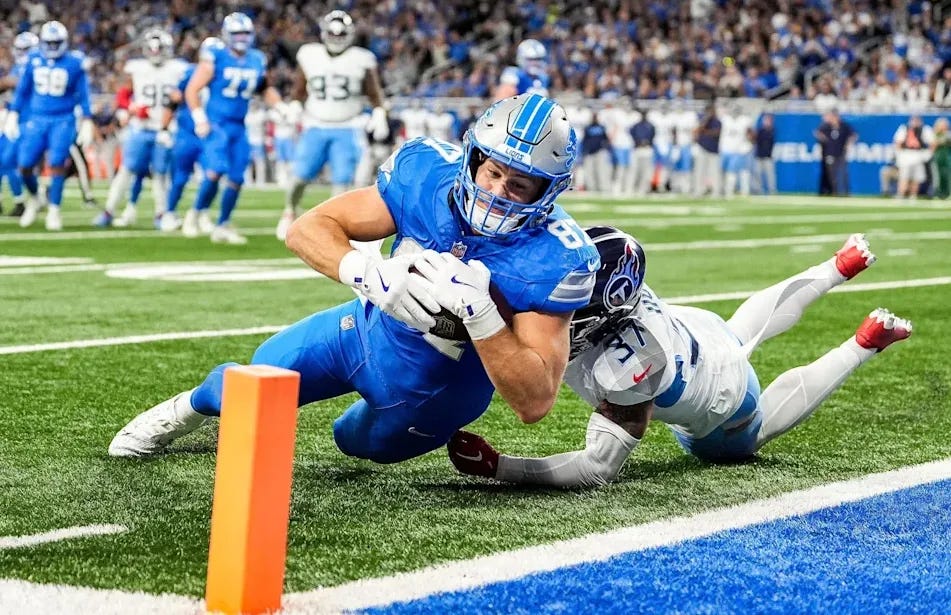
Sam LaPorta, TE, Detroit Lions
ADP Market Index: +7
LaPorta’s 2025 season ended with a back injury, and that appears to have pushed him too far down 2026 draft boards. Before the injury, LaPorta ranked seventh among tight ends in PPR points per game while setting career highs with an 82% route rate and 2.00 yards per route.
He also set career highs in ESPN’s receiver score and PFF receiving grade and ranked fifth among 49 qualifying tight ends in yards per route and receiving grade. That followed a TE3 rookie season and TE9 finish in 2024.
Now LaPorta is healthy and remains attached to one of the NFL’s highest-scoring environments with Jared Goff, Amon-Ra St. Brown, Jameson Williams and Jahmyr Gibbs.
New Lions offensive coordinator Drew Petzing also arrives from Arizona, where Trey McBride became one of fantasy football’s premier tight ends. Petzing’s 2023 Cardinals finished fifth in total tight end PPR points between McBride and Zach Ertz.
LaPorta has already shown a top-three fantasy ceiling. Getting him around Round 7 gives you another chance to buy proven production at a discounted price.
ROCK’S READ
The common thread with these 10 players is not that all of them are guaranteed league winners. Their prices simply appear lower than their established production, usage or projected opportunity.
Purdy and Murray offer QB1 histories at mid-QB2 prices. Swift and Stevenson provide workloads the market is treating too cautiously. Collins, Flowers, Higgins, Watson and Adams all have paths to outperform their receiver ADPs without requiring unrealistic projections.
And LaPorta gives fantasy managers a chance to buy a healthy, proven TE1 after one injury-shortened season pushed his price into Round 7.
You win fantasy drafts by finding production before the rest of the room prices it correctly. These are 10 places to start.
About Will Rock
Will Rock Is The Founder Of Detroit Football Journal And DFJ Sports, Providing Independent NFL Coverage With Credentialed Access Since 2024. His Work Focuses On Detroit Lions News, NFL Draft Scouting, Roster Analysis And Film Study.