January 19, 2026 | 4:55 PM
In a league currently obsessed with bazooka arms and 4.4 speed, the West Coast Offense remains the great equalizer. It is the philosophy that proves you don’t need to be a superhero to destroy a defense; you just need to be a surgeon. It relies on the belief that a perfectly timed 5-yard throw can be just as devastating as a deep bomb if the rhythm is perfect. For a quarterback like Jared Goff—who wins with his mind and feet rather than raw athleticism—this system isn't just a playbook. It is oxygen.
Let’s dive into what this offense is designed to do, and how this offense will fit the Lions current situation. Hopefully this piece helps you gain some insight and knowledge into the situation. If it did, please share it, like and subscribe to the Detroit Football Journal and receive a free 6-months paywall free!
WHAT IS THE WEST COAST OFFENSE?
The “West Coast Offense” (WCO) is arguably the most influential philosophy in modern NFL history. Originally popularized by Bill Walsh with the San Francisco 49ers in the 1980s, it completely changed how football was played.
Traditionally, football was “run to set up the pass.” The West Coast Offense flipped this on its head.
The Core Philosophy: “Pass to Set Up the Run”
The fundamental idea of the traditional WCO is to use the short passing game as an extension of the run game.
Instead of handing the ball off for a 3-yard gain, you throw a quick 3-yard pass to the flat or a slant.
Goal: Force the defense to defend the entire width of the field (sideline to sideline) rather than just the box. By spreading the defense out horizontally, you eventually open up running lanes up the middle later in the game.
The 3 Pillars of the System
Timing and Rhythm (The “Drop”)
This is the most critical element. In the WCO, the Quarterback is not “reacting” to the receiver; he is throwing to a spot based on footwork.
The entire offense is timed to the QB’s feet:
3-Step Drop: Ball comes out immediately (Slants, Hitches).
5-Step Drop: Intermediate routes (Digs, Outs).
7-Step Drop: Deeper routes (Posts, Corners).
The Rule: The ball must leave the QB’s hand before the receiver makes his break. If the QB holds the ball, the play is dead. This relies on “Trust” and “Anticipation.”
One of the biggest reasons why receivers are slow to develop in Detroit under Jared Goff is this exact scenario. Goff must trust you know your landmark and your timing is crisp, otherwise it leads to interceptions, batted balls and missed opportunities.
Horizontal Stretch
Old-school offenses tried to stretch the field vertically (deep bombs). The WCO stretches the field horizontally.
It floods zones with multiple receivers (e.g., the “Triangle” read).
It forces linebackers to chase running backs and tight ends to the sidelines, which tires them out and creates gaps in the middle of the defense.
YAC (Yards After Catch)
Because the passes are short (often 5-8 yards in the air), the burden is on the receiver to create big plays.
WCO receivers are drafted for their ability to run with the ball after the catch. They catch the ball in stride on a slant or crossing route and turn a 5-yard pass into a 20-yard gain.
Why It Matters for Detroit (and Jared Goff)
Jared Goff is the prototypical West Coast Quarterback.
He does not have the strongest arm in the league (like Josh Allen), nor is he a runner (like Lamar Jackson).
However, he is elite at processing, reading the defense, timing and accuracy.
The WCO protects the QB because the ball comes out fast (negating the pass rush).
When Goff has to hold the ball this usually means receivers are covered or the play has broken down.
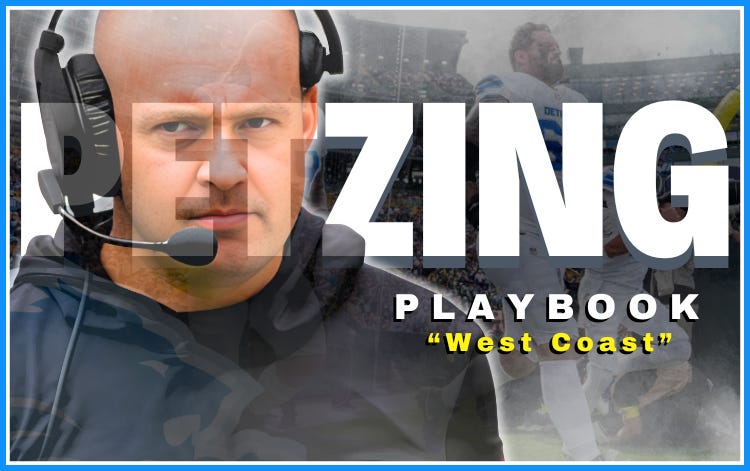
Drew Petzing’s Version:
While Bill Walsh ran the “Pure” WCO, modern coaches like Petzing (and Ben Johnson) run the “Shanahan” variation. This marries the West Coast passing concepts (short, timed throws) with the Zone Run scheme (moving the offensive line in unison). This is why Petzing is considered such a strong fit—he keeps the “timing” elements Goff loves but adds the “power run” elements Campbell loves!
THE RISE & GRIND MORNING SHOW | 1.20.26

Detroit Football Journal Daily Podcasts Below


The “Schematic Architect” Option: Is Jake Peetz The Next Detroit Lions OC?

January 9, 2026 | 5:24 PM
The “Modern Hybrid” Option: Why Josh Grizzard Fits the Lions’ Evolution

In the wake of “Black Monday,” the coaching carousel has spun wildly, spitting out names both expected and surprising. Among the most intriguing and now available candidates is Josh Grizzard, who was relieved of his duties as the Tampa Bay Buccaneers Offensive Coordinator this morning (January 8th, 2026 - reported prior to 11AM EST).
The “Rising Star” Option: Why David Blough is the Gamble Detroit Needs to Take

In the immediate aftermath of “Black Monday,” the Detroit Lions wasted no time severing ties with Offensive Coordinator John Morton. The move, while expected after Head Coach Dan Campbell assumed play-calling duties mid-season, has signaled a clear shift in philosophy at Allen Park. The Lions don’t just need a play-caller; they need an innovator who can merge the team’s gritty identity with modern passing concepts.

The “QB Whisperer” Option: Why Brian Daboll Is Detroit's Most Coveted Coordinator

In the modern NFL, where franchise fortunes are inextricably tied to quarterback play, few coaches possess a résumé as compelling as Brian Daboll. Fresh off his tenure as Head Coach of the New York Giants, Daboll re-enters the coordinator market not as a failed experiment, but as one of the most proven offensive architects in the league. For franchises desperate to unlock the potential of a young signal-caller, Daboll represents the “Gold Standard” of quarterback development.

2026 NFL Draft Profile: EDGE David Bailey (Texas Tech)

Now that the Lions are firmly out of the playoffs. The expected 2026 1st round draft pick will end up somewhere between picks 14-17. Exactly where the way too early projections have David Bailey slotted to be picked at the moment.


Lions’ Thrilling Victory Over Cowboys Marred By The Emergence Of A Structural Crisis

DETROIT —Thursday Night Football between the Detroit Lions and the Dallas Cowboys delivered one of the most exhilarating spectacles for Thursday Night Football in a long time. For Lions fans, the eventual 44–30 dismantling of the Cowboys—a critical “must-win”
NFL Week 11: Eagles Exposed - What The Detroit Lions Learned From MNF

What’s up, Lions Nation! Will Rock here with Rocked On Detroit Lions and Detroit Football Journal. Bringing you the most comprehensive breakdown of the Lions vs. Eagles matchup you’ll find anywhere. This weeks keys to the game submission will be three separate pieces with a bonus feature.
HANK FRALEY: THE PERFECT INTERNAL SOLUTION FOR DETROIT LIONS' OFFENSIVE COORDINATOR

While the Detroit Lions could chase big-name offensive coordinator candidates like Brian Daboll, the perfect solution to their play-calling crisis might already be in the building. Hank Fraley—the architect of the NFL’s most dominant offensive line and a coach who turned down the Seattle Seahawks to stay in Detroit—represents the safest, most seamless path forward for a Lions team in their Super Bowl window.

Why Brian Daboll Could Be Detroit's Next Offensive Coordinator

The New York Giants just fired Brian Daboll after a catastrophic 2-8 start, and the Detroit Lions are facing their own offensive coordinator crisis with Dan Campbell stripping play-calling duties from John Morton. Could the former NFL Coach of the Year be the answer to Detroit’s offensive struggles? An in-depth analysis reveals why Daboll’s track record with Josh Allen and the Buffalo Bills makes him an intriguing—but complicated—candidate for the Lions’ OC position should it open up in 2026.