

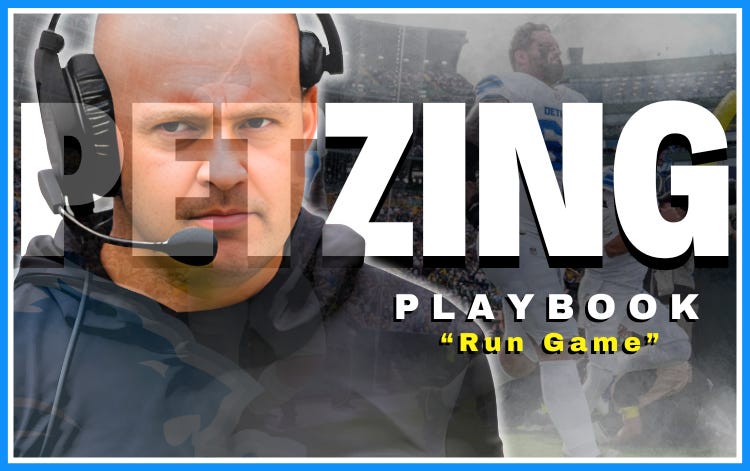
On Sundays, most fans watch the ball on TV. Next season, the smartest fans in Detroit will be watching the guards. If you want to understand the 2026 Lions, you have to stop speaking in clichés. “Run the damn ball” is no longer a strategy; it’s a slogan. By the end of this article you will start asking the right questions in 2026, “why aren’t we running more Gap schemes?”
The reality of what Drew Petzing brings to Detroit is far more sophisticated—a complex, violent dialect of football that changes the geometry of the field. To truly understand why this hire works, you have to learn the language of the system. Here is your glossary for the new era of Lions football.
The Fit: Why Petzing Is The Perfect Choice
Drew Petzing is the right coach for Detroit not because he brings a “new” offense, but because he brings the correct offense for the assets Brad Holmes has hoarded. This roster was built for violence, but specifically for “Gap” violence.
You don’t draft Penei Sewell just to have him stand in front of a pass rusher; you draft him to pull across the formation and erase a linebacker from existence. You don’t draft road-grading guards like Tate Ratledge to dance in a zone scheme; you draft them to displace 300-pound tackles against their will.
Petzing’s “Gap-Scheme” philosophy doesn’t ask this roster to change—it simply unleashes the bullies Brad Holmes has already assembled. It is the perfect marriage of “West Coast” precision for Jared Goff and a “Phone Booth” style of brutality for the offensive line.
The “Gap Scheme” (The Foundation)
Most NFL teams run “Zone” schemes, where offensive linemen step in unison to an area and the running back finds a hole. Petzing prefers “Gap Schemes.”
The Concept: Instead of blocking an area, linemen block down to create specific angles (”Gaps”). To make this work, you almost always pull a lineman from the backside to the frontside to lead the way.
Why Detroit Fits: This system requires athletic linemen who can move in space. Penei Sewell is the best athlete at the tackle position in football. Petzing will use him as a weapon, pulling him across the formation to annihilate cornerbacks and linebackers.
The “Big Three” Gap Runs
“Power” (The Staple): The concept is simple: The backside Guard pulls around to lead through the hole. Everyone else blocks down to create a “wall.” It is the most physical play in football.
“Counter” (The Misdirection): The offense steps one way (faking a zone run), but two players (usually a Guard and a Tackle/Tight End) pull back the other way. This forces linebackers to freeze, creating massive lanes for Jahmyr Gibbs to explode through.
“Duo” (The ‘Bully’ Play): This is “Power” without the puller. The offensive line creates massive double-teams on the defensive tackles, physically moving them backward into the linebackers. It forces the running back to read the Middle Linebacker. If the Mike LB steps left, the back cuts right. It is pure brute force—a Dan Campbell favorite.
“Pin-Pull” (The Space Creator)
You will hear this term often with Jahmyr Gibbs.
The Concept: If a defender is lined up directly over an offensive lineman, that lineman blocks him (”Pins” him). If the defender is in a gap, the lineman “Pulls” around him.
The Result: It gets your big men like Sewell out on the edge running full speed against 190-pound defensive backs. It is a mismatch nightmare.
Side Note: Frank Ragnow was one of the most gifted athletes and centers this game has seen in the pin-pull concept. The Lions next choice at center MUST be athletic to run this scheme.
“Marrying The Run To The Pass”
This is the phrase you will hear every broadcaster use. In the Petzing system, it isn’t just a buzzword; it is a geometrical requirement.
The Illusion: In a bad offense, the run plays look like runs and the pass plays look like passes. In Petzing’s system, the first 1.5 seconds of a “Play-Action” pass must look identical to a “Duo” or “Power” run. The linemen fire out with the same low pad level; the quarterback uses the exact same footwork.
The Conflict: This puts the Linebacker in “conflict.” He sees the Guard pull (signaling a run), so he steps up to fill the hole. By the time he realizes the Guard is actually pass-blocking, the Tight End (Sam LaPorta) has already slipped behind him for an easy 15-yard catch. This is how you “manufacture” open receivers for Jared Goff.
The “Modern” West Coast Offense
Finally, how does this all tie into the “West Coast” label?
Traditional West Coast: Relied on short, horizontal passes (slants, flats) to replace the run game. It was finesse-based.
The Petzing/Shanahan Hybrid: This system keeps the “West Coast” passing concepts (timing, rhythm, horizontal stretch) but pairs them with the violent “Gap” run game described above.
Why It Matters for Goff: It simplifies the quarterback’s world. The heavy run game forces defenses to play “single-high” safety looks (to stop the run). This gives Goff clear, defined reads: “If the Corner stays low, throw the deeper route. If he bails deep, throw the short route.” It turns the QB into a distributor rather than a magician—exactly where Jared Goff thrives.
The Trenches: Assessing The Personnel Fit
Does Detroit actually have the bodies to run this “Gap-Heavy” system? The short answer is yes—but the torch is being passed.
The Old Guard: A Transition Looming
We must acknowledge the reality of the calendar. Taylor Decker (LT) and Graham Glasgow (LG/C) have been the heartbeat of this line, but 2026 feels like the pivot point. Decker’s game has always been about technical consistency, but as “Gap” schemes require linemen to pull and move laterally more often, his age becomes a factor. Glasgow, a pure phone-booth brawler, fits the “Duo” calls perfectly but may lack the explosive foot speed Petzing prefers for those “Pin-Pull” sweeps.
The Young Core: Built For Violence
This is where Brad Holmes’ recent draft strategy looks prophetic. He didn’t just draft linemen; he drafted “Petzing-style” maulers.
Tate Ratledge (RG - Georgia):
The Fit: Ratledge is a “Gap” scheme native. At Georgia, he played in a pro-style offense that majored in “Counter” and “Power.” His scouting profile was defined by his “anchor” and ability to “maul” in tight spaces. He isn’t a finesse zone blocker; he is a road grader designed to down-block on a 3-tech defensive tackle—exactly what Petzing’s “Duo” plays require.
Christian Mahogany (G - Boston College):
The Fit: If you built a guard in a lab for Drew Petzing, it would be Mahogany. His college tape at Boston College was filled with “Gap” runs. He was described by scouts as a “bouncer outside a club”—a player who thrives on pulling around the edge and burying linebackers in space. He is the ideal “puller” for the “Power-O” plays that will define this new offense.
Miles Frazier (G - LSU):
The Fit: Frazier is the depth piece who fits the physical profile. At LSU, he excelled in “tight spaces” and showed the ability to execute “short pulls.” While he may not be the elite athlete Sewell is, his heavy hands and ability to displace defenders make him a natural fit for the “Duo” concept where moving a man from Point A to Point B is the only requirement.
Giovanni Manu (T - UBC): The “Sleeping Giant” of the Petzing Hire
The Fit: If you are looking for a roster-specific reason why this hire matters, look no further than the 6’7”, 352-pound mountain from British Columbia. For two years, Giovanni Manu has been a “project.” Under Drew Petzing, he becomes a weapon.
The “Gap Scheme” Is Unmatched With Manu
In the previous 'Zone' heavy world, linemen relied on elite lateral agility to chase down fast defenders. While Manu is a freak athlete (4.96 speed), his technique in space has often been labeled as raw. Petzing’s system solves this by simplifying the geometry. The new scheme prioritizes vertical displacement over lateral finesse—refining Manu's role to maximize his massive strength and length, allowing him to focus on moving defenders against their will rather than mirroring them.
The Petzing Shift: Petzing’s “Gap” scheme (Power, Duo) simplifies the assignment. It asks the tackle to block down (wash the defensive end inside) or pull around the edge.
The Fit: Manu is a road-grader. In a “Duo” call, you are asking him to double-team a defensive tackle and drive him into the lap of a linebacker. This utilizes his 350-pound frame to generate vertical displacement rather than asking him to dance laterally. He doesn’t have to “catch” defenders anymore; he gets to attack them.
The “Jumbo” Tight End (The 6th OL)
This is where it gets fun. As noted in the breakdown, Petzing used “13 Personnel” (3 TEs) more than any coach in the NFL (28% of snaps).
The Problem: The Lions might not always want to carry 4 active tight ends on gameday.
The Solution: Giovanni Manu is the “Jumbo” Tight End. Because he runs a sub-5.0 forty, he is athletic enough to report as “Number 59 is Eligible,” line up at Tight End, and effectively function as a third blocking TE. Expect a pass to Manu in 2026.
The Nightmare: Imagine a “Pin-Pull” sweep where Penei Sewell pulls from the right and Giovanni Manu pulls from the left. You have 700 pounds of offensive linemen running full speed at a 190-pound cornerback. That is the definition of the “violence” Dan Campbell demands.
Bottom Line: Giovanni Manu was drafted for his traits. Drew Petzing was hired to maximize them. This system stops asking Manu to be a “finesse” blocker and finally lets him be what he truly is: a bouncer.
The Verdict:
The transition from the “Zone-heavy” days of the past to Petzing’s “Gap” scheme is already solved on the roster. While the potential loss in leadership with Decker or Glasgow would hurt, the physical skill sets of Sewell (the ultimate weapon), Ratledge, and Mahogany are actually better suited for this violent, downhill style of play than the previous regime’s preference for lateral movement.
Addressing the offensive line isn't just an option for Detroit this offseason; it is a necessity. As I’ve broken down on the Rise & Grind Morning Show, players like Mahogany, Frazier, and Manu are solid assets, but they should be viewed as high-end insurance, not guaranteed answers.
The true goal is finding a blue-chip Center and a cornerstone Left Tackle to succeed Taylor Decker. I want to see Frazier and Mahogany battling for the Left Guard spot because they have to, not because they are the only options. To truly fit this scheme, Holmes needs to add another premium tackle and guard to the mix. Do this and the Lions would easily have a top 5 offensive line to start camp—with the best backup depth in the league.
THE RISE & GRIND MORNING SHOW | 1.20.26

Detroit Football Journal Daily Podcasts Below


The “Schematic Architect” Option: Is Jake Peetz The Next Detroit Lions OC?

January 9, 2026 | 5:24 PM
The “Modern Hybrid” Option: Why Josh Grizzard Fits the Lions’ Evolution

In the wake of “Black Monday,” the coaching carousel has spun wildly, spitting out names both expected and surprising. Among the most intriguing and now available candidates is Josh Grizzard, who was relieved of his duties as the Tampa Bay Buccaneers Offensive Coordinator this morning (January 8th, 2026 - reported prior to 11AM EST).
The “Rising Star” Option: Why David Blough is the Gamble Detroit Needs to Take

In the immediate aftermath of “Black Monday,” the Detroit Lions wasted no time severing ties with Offensive Coordinator John Morton. The move, while expected after Head Coach Dan Campbell assumed play-calling duties mid-season, has signaled a clear shift in philosophy at Allen Park. The Lions don’t just need a play-caller; they need an innovator who can merge the team’s gritty identity with modern passing concepts.

The “QB Whisperer” Option: Why Brian Daboll Is Detroit's Most Coveted Coordinator

In the modern NFL, where franchise fortunes are inextricably tied to quarterback play, few coaches possess a résumé as compelling as Brian Daboll. Fresh off his tenure as Head Coach of the New York Giants, Daboll re-enters the coordinator market not as a failed experiment, but as one of the most proven offensive architects in the league. For franchises desperate to unlock the potential of a young signal-caller, Daboll represents the “Gold Standard” of quarterback development.

2026 NFL Draft Profile: EDGE David Bailey (Texas Tech)

Now that the Lions are firmly out of the playoffs. The expected 2026 1st round draft pick will end up somewhere between picks 14-17. Exactly where the way too early projections have David Bailey slotted to be picked at the moment.


Lions’ Thrilling Victory Over Cowboys Marred By The Emergence Of A Structural Crisis

DETROIT —Thursday Night Football between the Detroit Lions and the Dallas Cowboys delivered one of the most exhilarating spectacles for Thursday Night Football in a long time. For Lions fans, the eventual 44–30 dismantling of the Cowboys—a critical “must-win”
NFL Week 11: Eagles Exposed - What The Detroit Lions Learned From MNF

What’s up, Lions Nation! Will Rock here with Rocked On Detroit Lions and Detroit Football Journal. Bringing you the most comprehensive breakdown of the Lions vs. Eagles matchup you’ll find anywhere. This weeks keys to the game submission will be three separate pieces with a bonus feature.
HANK FRALEY: THE PERFECT INTERNAL SOLUTION FOR DETROIT LIONS' OFFENSIVE COORDINATOR

While the Detroit Lions could chase big-name offensive coordinator candidates like Brian Daboll, the perfect solution to their play-calling crisis might already be in the building. Hank Fraley—the architect of the NFL’s most dominant offensive line and a coach who turned down the Seattle Seahawks to stay in Detroit—represents the safest, most seamless path forward for a Lions team in their Super Bowl window.

Why Brian Daboll Could Be Detroit's Next Offensive Coordinator

The New York Giants just fired Brian Daboll after a catastrophic 2-8 start, and the Detroit Lions are facing their own offensive coordinator crisis with Dan Campbell stripping play-calling duties from John Morton. Could the former NFL Coach of the Year be the answer to Detroit’s offensive struggles? An in-depth analysis reveals why Daboll’s track record with Josh Allen and the Buffalo Bills makes him an intriguing—but complicated—candidate for the Lions’ OC position should it open up in 2026.


Good analysis, Will. I like the idea of not being predictable on whether the play will be a run or a pass off of the actions of your linemen. If you run every time the line pushes forward (or pass every time your linemen back up), that doesn’t require guess work. But if you pass periodically when the line pushes forward (or run periodically when the line backs up), that’s where the conflict comes in for the defense. It’s the same with formations. Defenses shouldn’t be able to predict whether a play will be a run or a pass off of a formation. So I hope that happens.
May sound strange but it is a reach back to the past , Green Bay Power Run Game! With some tweaking! You May remember how the mauling guards would just wipe out the man in his way!!!