


October 31, 2026 | 7:44 PM ET
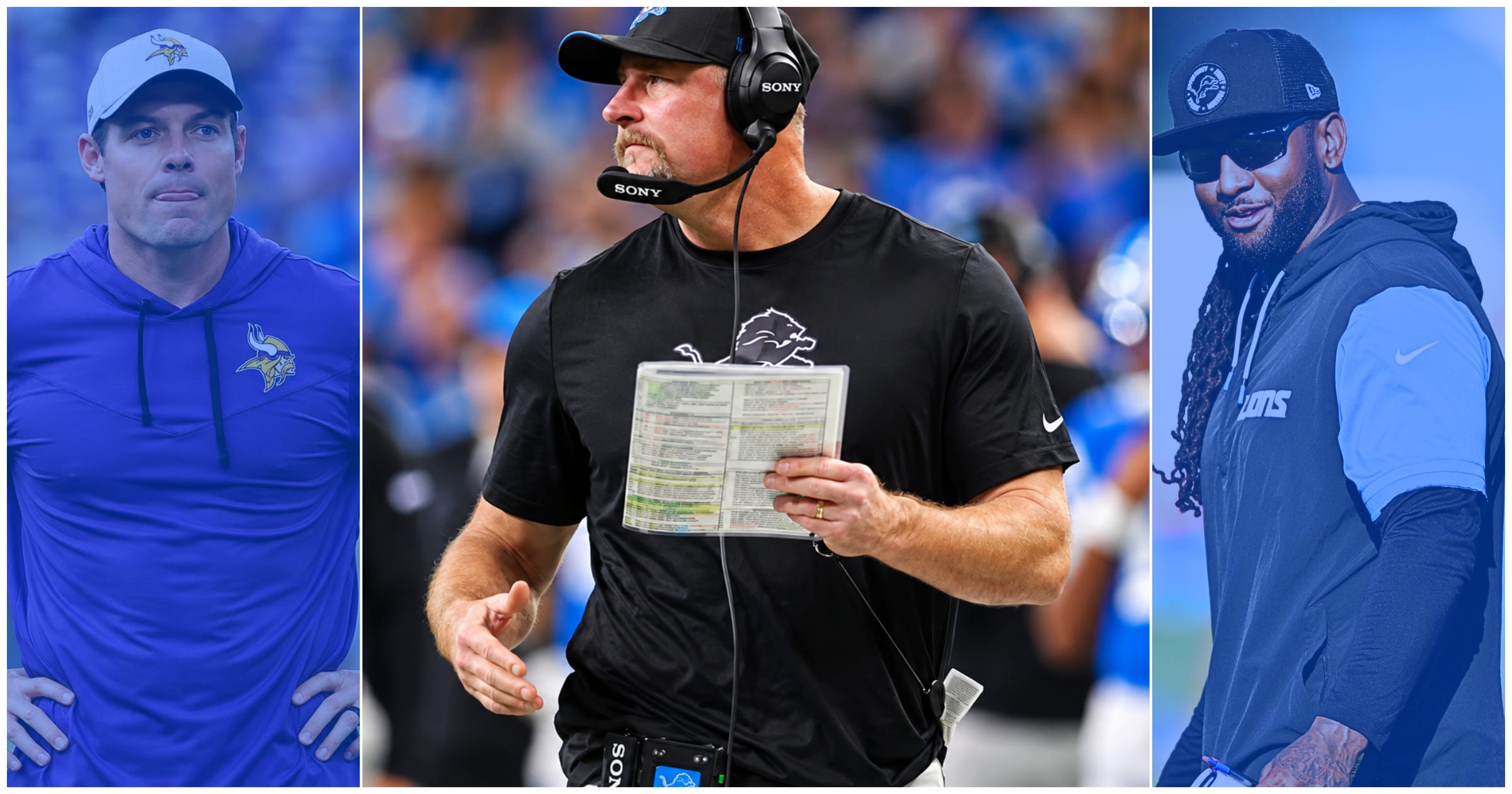
DETROIT LIONS — The NFL’s last unbeaten team comes to Ford Field Sunday at 1 p.m. ET with a defense has overwhelmed nearly everybody it has faced. Minnesota is 6-0, Detroit is 4-2, and a Lions win would tighten an NFC North race the Vikings currently control while ending Minnesota’s 11-game regular-season winning streak.
Question: didn’t the Lions have 11 wins in a row at one point after the Packers win in 2024?
Detroit scores 30.7 points per game and owns one of the league’s most efficient passing offenses, while Minnesota allows 12.3 points and ranks first in defensive EPA per play. Brian Flores is blitzing at a rate no other defense is approaching, but the challenge for Jared Goff is not simply beating extra rushers—it is recognizing when the pressure is real and when Minnesota is bluffing before dropping defenders into coverage.
Detroit has more answers than most of Minnesota’s previous opponents. Jared Goff is playing efficient, mistake-free football, Jahmyr Gibbs can punish pressure as both a runner and receiver, and Amon-Ra St. Brown has consistently produced against Flores’ defense. The Lions also have a defensive-front advantage against a Minnesota offense that has struggled to create points and explosive passes, giving Detroit a legitimate path to win this game without needing Goff to solve every landmine Flores’ sets for four quarters.
INJURY REPORT AND PERSONNEL
Detroit will again be without Kerby Joseph, who returned to practice this week but was ruled out as the Lions continue easing him back from the knee injury that has kept him out since last season. Starting corner Roger McCreary is questionable with a foot injury that appeared on Friday’s report, while Ennis Rakestraw Jr. practiced fully and would become even more important if McCreary cannot play.
Gibbs and St. Brown both missed Wednesday’s practice but returned to full participation Thursday and Friday with no game designation. Penei Sewell, Aidan Hutchinson, Alim McNeill, Tyleik Williams and DJ Wonnum are also cleared, giving Detroit its primary offensive and defensive fronts against the most complicated defense it has faced this season.
Minnesota enters relatively healthy. Aaron Jones, Brian O’Neill, Joe Huber and Gavin Bartholomew all finished the week without game designations, while safety Jay Ward is questionable; starting left guard Donovan Jackson remains on injured reserve, leaving Huber in an important interior matchup against McNeill and Detroit’s defensive tackles.
MATCHUP BY THE NUMBERS
DETROIT WITH THE BALL
Detroit averages 397.3 yards and 30.7 points per game, while Goff has completed 67.3 percent of his passes for 1,788 yards, 14 touchdowns and no interceptions. The Lions rank near the top of the league in offensive EPA, dropback EPA and early-down success, but they now face a Minnesota defense allowing only 4.5 yards per play, 252.8 yards and 12.3 points per game.
MINNESOTA WITH THE BALL
The Vikings have won all six games despite averaging only 281.7 yards and 20.8 points. Minnesota ranks near the bottom of the league in offensive EPA and passing production, while Kyler Murray has thrown for 812 yards with three touchdowns and two interceptions in five starts; Detroit’s problem is that its own defense has allowed 391 yards per game and 291.8 through the air. But this is not the same defense that started the 1st four weeks. When the game ends, we will find out which defense is still here.
WHERE THE GAME TURNS
Minnesota has allowed touchdowns on only 23.1 percent of opponent red-zone possessions and gives up 1.05 points per drive, both league-best marks. Detroit converts 70.4 percent of its red-zone trips into touchdowns, so moving the ball between the 20s will mean very little if the Lions cannot finish drives against a defense that has forced offenses to settle for field goals or leave empty-handed.
THE KEYS TO THE GAME
TEMPO WITH A PURPOSE
A faster pace can help Detroit prevent Flores from changing personnel and constructing a new pressure picture after every play, particularly after first downs when the Lions already have a favorable grouping on the field. NFL analysis has specifically identified tempo, no-huddle and quick huddles as ways to reduce the time Minnesota has to disguise its pressure structure, but the Lions should not confuse faster with automatically better.
Opponents have actually struggled when going no-huddle against Minnesota, completing only eight of 24 passes for 63 yards with three interceptions and two sacks in the available sample. The value is therefore tactical: get Flores stuck with the same defenders, make Minnesota communicate quickly and then let Goff decide whether to snap the ball immediately or use the extra information to change the play. Hurry up without substitutions can gas a defense early, especially if the offense finds a way to run the ball effectively and throw on 1st down with precision routes.
WIN BEFORE THIRD DOWN
Minnesota blitzes on 84.8 percent of first downs, 68.1 percent of second downs and 61.9 percent of third downs, but third down remains where the defense becomes hardest to beat. Opponents average only 4.4 yards per pass attempt with a 39.0 passer rating on third down, while Detroit generates 74.6 percent of its first downs and touchdowns before third down even arrives. Advantage Detroit
Petzing should be willing to throw on early downs rather than repeatedly running into Minnesota’s strength simply to create artificial balance. The trap is long developing plays against this defense and so far this season, the Lions offense has had issues with holding the ball. Quick throws and shotgun runs can keep Goff out of obvious third-and-long situations.
MAKE MINNESOTA STOP GIBBS
Gibbs cannot spend the afternoon functioning primarily as an extra offensive lineman. Minnesota’s pressure forces running backs to account for linebackers Blake Cashman and Andrew Van Ginkel, but every snap Gibbs stays in protection removes Detroit’s best open-field mismatch from the route.
Detroit needs enough variety that Flores cannot know whether Gibbs is protecting, releasing, motioning out or taking a handoff simply from his alignment. Sione Vaki can absorb some protection responsibility, while formations with Brock Wright attached can give Detroit another blocker without automatically removing LaPorta from the passing game.
LIONS PASS GAME VS. MINNESOTA’S DEFENSE
The most important FTN data is not the 71-percent blitz rate by itself. Minnesota has rushed five defenders on 51 percent of charted dropbacks and six or more on another 20 percent, but the sack-or-hit rate changes only slightly—from 23.1 percent with four rushers to 26.4 with five and 26.8 with six or more. More important, Minnesota has allowed minus-0.266 EPA per dropback when rushing only four, better than its results when sending six or more, because Flores can threaten pressure and still flood Goff’s throwing lanes after the snap.
That is why Detroit cannot build the entire plan around keeping six or seven blockers in. Opposing quarterbacks are averaging only 3.6 yards per attempt when Minnesota rushes four or fewer, evidence that offenses have often protected against pressure that never arrives and then asked two or three receivers to beat seven or eight coverage defenders. Goff has been excellent against actual blitzes—70 percent completions, 605 yards, six touchdowns, no interceptions and a 123.3 passer rating—but his harder problem Sunday will be identifying when Minnesota has changed the answer after he already changed the protection.
The target progression should change with Minnesota’s response. St. Brown has 16 catches for 204 yards and three touchdowns against the blitz this season; if Flores brackets him or squeezes the middle, Jameson Williams should get more isolated routes outside and across the field. If Minnesota also keeps safety help over Williams, LaPorta becomes the natural answer—especially from 12 personnel when Wright can handle more of the protection work and allow LaPorta to release instead of becoming another blocker.
LIONS RUN GAME AND PASS PROTECTION
Minnesota’s overall run-defense numbers look intimidating: first in rushing EPA allowed and first in rushing success rate allowed. The split changes dramatically from shotgun, however, where opponents have averaged 6.35 yards per carry with a 58.8 percent success rate; Gibbs has gained 89 yards on 17 shotgun runs and 49 yards on seven man-scheme attempts from that alignment.
The run-location data makes the plan more specific. Minnesota has allowed 8.6 yards per carry and positive EPA on 22 runs into the left B-gap, while holding runs outside left to 2.8 per carry, outside right to 1.3 and right B-gap runs to 2.6. Wide zone therefore should not simply mean trying to beat the Vikings around the corner; Detroit can use the horizontal stretch to make Minnesota’s linebackers and edge players flow, then give Gibbs the cutback into the tackle-guard area where the defense has been most vulnerable.
The opponents that ran most effectively provide another clue. Indianapolis produced 154 yards on 33 carries, Chicago gained 134 on 31 and Miami averaged 6.7 per carry behind Ollie Gordon’s 100-yard game, including a 53-yard shotgun run off left tackle; Green Bay, Tampa Bay and New Orleans combined to average barely three yards per carry. Detroit should not abandon the run because Minnesota is ranked first—it should avoid pounding repeatedly into the portions of the front Minnesota has consistently controlled.
VIKINGS: PASS GAME VS. LIONS DEFENSE
Murray’s mobility is more dangerous than his current passing production. He has averaged 162.4 passing yards in five starts with three touchdowns and two interceptions, and Minnesota ranks near the bottom of the league in passing EPA, but he can turn a clean coverage snap into a first down if Detroit’s edge rushers fly past him and open the escape lane.
Justin Jefferson remains the receiver who can change that profile quickly, even though he enters with only 23 catches for 302 yards in five games. Jordan Addison provides the vertical complement and T.J. Hockenson leads Minnesota with 27 receptions, so Joseph’s absence and McCreary’s uncertain status make communication across Detroit’s secondary especially important.
Detroit does not need to chase Murray with constant extra pressure. Opponents already blitz Minnesota on 36.3 percent of its dropbacks, and Murray has produced minus-0.31 EPA per dropback against it, but Hutchinson and McNeill give the Lions a chance to generate pressure with four while keeping enough defenders available for Jefferson, Addison and Hockenson.
VIKINGS: RUN GAME VS. LIONS DEFENSE
Minnesota wants the running game to keep the offense out of situations where Murray has to carry it. Aaron Jones has 436 yards on 105 carries, and Jordan Mason returned against Indianapolis with 68 yards on 15 attempts, giving O’Connell a second back capable of handling interior carries while Jones works back from the knee injury.
The Vikings remain a wide-zone offense at their core, asking the offensive line to stretch the front laterally while the back chooses the crease. Detroit has allowed 99.2 rushing yards per game and just held Green Bay to 60, so McNeill, Tyleik Williams and Jack Campbell should not need an extra safety near the line on every early down if the front continues playing at its recent level.
That matters because Minnesota’s passing game becomes more dangerous when Detroit overreacts to the run. If the Lions control Jones and Mason with the front seven, Branch and the rest of the secondary can devote more attention to Jefferson without giving Hockenson and Addison free access behind linebackers stepping toward play action.
INDIVIDUAL PLAYER BATTLES
PENEI SEWELL VS. DALLAS TURNER
Turner leads Minnesota with 36 pressures and six sacks, while Sewell has allowed only two pressures across his last four games. Flores will move Turner around rather than leave him across from Sewell all afternoon, but every snap Detroit’s left tackle handles him without help keeps Gibbs and LaPorta available as receivers instead of protection pieces.
AMON-RA ST. BROWN VS. BYRON MURPHY JR.
St. Brown enters with 46 catches for 525 yards and has averaged more than 100 receiving yards across his last six games against Minnesota. Murphy has three interceptions, but this matchup extends beyond pure man coverage because Flores can bracket St. Brown, pass him through zones or use pressure to force the ball out before his route fully develops.
AIDAN HUTCHINSON VS. BRIAN O’NEILL
Hutchinson has generated 42 charted pressures and owns one of the league’s best pass-rush win rates, but O’Neill has been one of Minnesota’s most dependable offensive linemen. Detroit should still move Hutchinson across the front, forcing Minnesota to account for him against Huber and other interior blockers instead of allowing its best tackle to control the matchup every passing down.
D.J. REED VS. JUSTIN JEFFERSON
Jefferson has repeatedly hurt Detroit and remains capable of taking over a game even if Minnesota’s overall passing production has been limited. O’Connell will move him through motions, stacks and reduced splits, so Reed’s assignment is not following Jefferson everywhere—it is surviving the isolated snaps Detroit inevitably gets while the safeties remain disciplined enough to prevent the explosive ball.
SPECIAL TEAMS AND FIELD POSITION
Minnesota has built part of its unbeaten record without relying on offensive touchdowns. Myles Price has 552 kickoff-return yards and 250 punt-return yards, including an 86-yard punt-return touchdown, while Will Reichard has made 18 of 19 field goals and gives O’Connell scoring range even when the offense stalls outside the red zone.
Detroit counters with Jake Bates, who has yet to miss a field goal this season, and DeAndre Carter showed immediate return value against Green Bay. The Lions cannot give Minnesota short fields or a return touchdown because the Vikings are perfectly comfortable winning games in which their defense, kicker and return units do more damage than the offense.
THE PLAYER TO WATCH
SAM LAPORTA
Sam LaPorta could become Detroit’s best answer to Minnesota’s pressure structure because the Vikings repeatedly remove second-level defenders from traditional coverage positions. FTN charting shows Minnesota rushing five on 51 percent of opponent dropbacks and six or more on another 20 percent. When five come, only six defenders remain in coverage; when Flores sends six, that drops to five, creating opportunities for LaPorta on quick stick routes, option routes, shallow crossers and seams behind a linebacker who has vacated the middle to rush. Minnesota has produced a sack or quarterback hit on 26.4 percent of five-man rushes and 26.8 percent when sending six or more, so Goff cannot wait for long-developing routes.
The coverage allocation can favor LaPorta even more. If Minnesota brackets Amon-Ra St. Brown inside and shades a safety toward Jameson Williams’ vertical routes, Flores is already committing extra coverage resources to Detroit’s two primary wideouts. Detaching LaPorta from the formation forces Minnesota to reveal whether a linebacker, safety or defensive back will account for him; from there, Goff can attack the defender’s leverage with an option route or hit LaPorta immediately in the space created by the blitz. If Detroit uses 12 personnel, Brock Wright can remain attached for protection while LaPorta releases, preserving a receiving threat without leaving Goff exposed.
Projected output:
5–8 receptions
60–90 receiving yards
7–10 targets
0–1 touchdowns
REALISTIC PLAYER PROJECTIONS
DETROIT LIONS OFFENSE
JARED GOFF
Minnesota’s opposing starting quarterbacks have averaged approximately 172 passing yards, but that group includes Malik Willis, Tyler Shough and Daniel Jones over the Vikings’ last three games. Jordan Love threw for 387 yards and two touchdowns against Minnesota, showing that Flores’ defense can surrender passing production even while creating sacks, turnovers and stalled drives.
Goff enters with 1,788 yards, 14 touchdowns and no interceptions. Detroit should help him by throwing on early downs and selectively using tempo after positive plays, reducing the number of obvious passing situations where Minnesota can crowd the line, force a protection adjustment and change the coverage after the snap.
Projected output:
23–27 completions
34–39 attempts
245–275 passing yards
1–2 passing touchdowns
0–1 interceptions
1–3 sacks taken
JAHMYR GIBBS
The primary running backs Minnesota has faced have averaged roughly 59 rushing yards, but several opponents found considerably more success. Indianapolis rushed for 154 yards, Chicago produced 134 and Miami got 100 yards from Ollie Gordon, showing that the Vikings can be moved when an offense attacks the right portions of the front.
Detroit’s best opportunity comes from shotgun runs and wide-zone action that stretches Minnesota horizontally before Gibbs makes his cut. The Vikings have been far stronger against runs reaching the perimeter than runs attacking certain interior lanes, so Detroit can use the threat of Gibbs outside to create opportunities back inside rather than repeatedly asking him to outrun the defense around the corner.
Projected output:
18–22 carries
80–105 rushing yards
4–6 receptions
30–45 receiving yards
110–145 scrimmage yards
0–1 touchdowns
AMON-RA ST. BROWN
Minnesota’s leading opposing wide receivers have averaged approximately four catches and 66 yards, with Christian Watson’s 147-yard, two-touchdown game representing the largest performance. St. Brown enters with 46 catches for 525 yards and has been one of Goff’s best answers when defenses send extra rushers.
Flores should devote additional coverage toward him. If Minnesota brackets St. Brown or consistently places another defender into his route area, Detroit should take the coverage for what it is and use the space it creates elsewhere instead of forcing Goff to throw into multiple defenders.
Projected output:
7–9 receptions
75–95 receiving yards
9–12 targets
0–1 touchdowns
JAMESON WILLIAMS
Williams has produced seven catches for 138 yards and four touchdowns over Detroit’s last two games. His speed gives the Lions their clearest counter if Minnesota starts using additional coverage to remove St. Brown from the middle of the field.
If St. Brown draws a bracket, Williams should receive more isolated opportunities outside and across the field. If Minnesota responds by keeping safety help over Williams too, Flores is committing multiple defenders to Detroit’s top two wideouts and creating more room underneath for LaPorta and Gibbs.
Projected output:
3–5 receptions
55–80 receiving yards
5–7 targets
0–1 touchdowns
At least one reception of 20-plus yards
SAM LAPORTA
LaPorta’s opportunities should increase if Minnesota spends additional coverage resources on St. Brown and Williams. The middle of the field becomes more accessible when safeties widen toward Williams or another defender joins the coverage around St. Brown.
Detroit can also use more 12 personnel without automatically turning LaPorta into an extra offensive lineman. If Brock Wright handles more of the protection work, LaPorta can release into routes against linebackers and safeties while still giving Detroit the heavier personnel needed to handle Minnesota’s pressure looks.
Projected output:
4–6 receptions
45–70 receiving yards
5–8 targets
0–1 touchdowns
DETROIT LIONS DEFENSE
AIDAN HUTCHINSON
Minnesota’s offensive line has allowed pressure at a high rate, but Brian O’Neill gives the Vikings a strong individual blocker on Hutchinson’s side. Detroit should move Hutchinson across the formation rather than asking him to attack O’Neill from the same alignment throughout the game.
That can create snaps against Minnesota’s interior protection and force Murray to identify Hutchinson before the snap instead of knowing where Detroit’s best pass rusher will attack. Murray’s mobility may turn some potential sacks into scrambles, but Hutchinson should still generate consistent disruption.
Projected output:
3–5 tackles
4–7 quarterback pressures
1–2 quarterback hits
0–2 sacks
0–1 forced fumbles
ALIM MCNEILL
Minnesota remains without starting left guard Donovan Jackson, giving McNeill a favorable opportunity against the interior of the Vikings’ offensive line. His ability to push the pocket backward can prevent Murray from stepping forward when Detroit’s edge rush forces him off his original spot.
McNeill can influence the game without producing multiple sacks. Interior pressure can shorten Murray’s throwing window, force earlier releases toward Jefferson and Hockenson and push the quarterback toward Hutchinson or another edge defender.
Projected output:
3–5 tackles
2–4 quarterback pressures
0–1 sacks
1–2 tackles for loss
MINNESOTA VIKINGS OFFENSE
KYLER MURRAY
Minnesota’s passing game has struggled to generate consistent production, while Detroit has continued to allow substantial yardage through the air. Murray therefore has opportunities if the Vikings protect him long enough to attack a Lions secondary missing Kerby Joseph.
Detroit’s pass rush creates the larger problem. Hutchinson and McNeill can shorten the pocket without Sheppard sending extra rushers, while Murray’s legs remain his best answer when the initial play breaks down.
Projected output:
19–24 completions
29–34 attempts
190–230 passing yards
1–2 passing touchdowns
0–1 interceptions
25–45 rushing yards
2–4 sacks taken
JUSTIN JEFFERSON
Jefferson’s current production is below his usual standard, but Detroit cannot treat those numbers as evidence that the matchup is under control. Joseph is out, Roger McCreary’s availability remains uncertain and Murray’s mobility can extend plays beyond the original coverage call.
O’Connell should move Jefferson with motion, stacks and reduced splits to create favorable releases and prevent Detroit from settling into the same coverage answer. If Minnesota protects Murray, Jefferson has the strongest chance of any Vikings skill player to outperform his recent numbers.
Projected output:
6–8 receptions
75–105 receiving yards
8–11 targets
0–1 touchdowns
AARON JONES
Jones returns from the knee injury with Jordan Mason also available, reducing the likelihood of a full workload. Detroit has improved against the run and held Green Bay to 60 rushing yards, making it difficult to project a high-volume rushing performance from Jones.
His receiving role gives Minnesota another option against Detroit’s pass rush. Screens, checkdowns and designed releases can get Jones away from the defensive front and force Detroit’s linebackers to tackle him in space.
Projected output:
11–15 carries
45–65 rushing yards
2–4 receptions
15–25 receiving yards
60–90 scrimmage yards
0–1 touchdowns
MINNESOTA VIKINGS DEFENSE
DALLAS TURNER
Turner has generated 36 pressures and six sacks, giving Minnesota a pass rusher who can win without Flores manufacturing a free path to the quarterback. Sewell presents a difficult matchup, so Minnesota should move Turner rather than leave him against Detroit’s best tackle all afternoon.
His best opportunities may come against Blake Miller or from alignments that force Detroit’s interior linemen to sort through Minnesota’s pressure movement. Detroit can reduce those chances by staying ahead of the chains and avoiding the third-and-long situations where Turner can attack without respecting the run.
Projected output:
3–5 tackles
3–5 quarterback pressures
0–1 sacks
0–1 forced fumbles
BLAKE CASHMAN
Cashman helps create the uncertainty at the center of Minnesota’s defense. He can threaten either A-gap, rush from depth or show pressure before dropping underneath LaPorta or Gibbs, forcing Detroit to identify his responsibility after the snap instead of relying entirely on the pre-snap look.
Early-down passing and selective tempo can reduce the number of situations where Flores has time to create those pressure presentations. Cashman should still be heavily involved because Detroit’s use of Gibbs, LaPorta and the quick passing game consistently brings the football into his area.
Projected output:
7–10 tackles
2–4 quarterback pressures
0–1 sacks
0–1 passes defended
ROCK’S READ AND GAME PREDICTION
Minnesota is 6-0 because its defense has been legitimately great, not because opponents have simply handed games away. Flores has built a unit that wins before the snap by making quarterbacks and offensive lines prepare for pressure on nearly every play, then punishes them when they overprotect against rushers who never actually come.
Detroit has the personnel to make that strategy work harder than it has against Minnesota’s first six opponents. The answer is not to “beat the blitz” with one magic concept—it is to change the picture with selective tempo, throw before third down, use shotgun runs into the portions of Minnesota’s front that have actually leaked yards and make Flores decide whether St. Brown, Williams, LaPorta or Gibbs is the player he is willing to leave with the favorable matchup.
Minnesota’s offensive limitations ultimately give Detroit the edge. If the Lions protect the football, turn red-zone possessions into touchdowns and prevent Murray from escaping the pass rush, Detroit should create enough offense to make Minnesota play a game its defense and special teams have largely prevented all season: one in which the Vikings offense has to chase points.
Rock’s Prediction: Detroit Lions 23, Minnesota Vikings 17
About Will Rock
Will Rock Is The Founder Of Detroit Football Journal And DFJ Sports, Providing Independent NFL Coverage With Credentialed Access Since 2024. His Work Focuses On Detroit Lions News, NFL Draft Scouting, Roster Analysis And Film Study.