


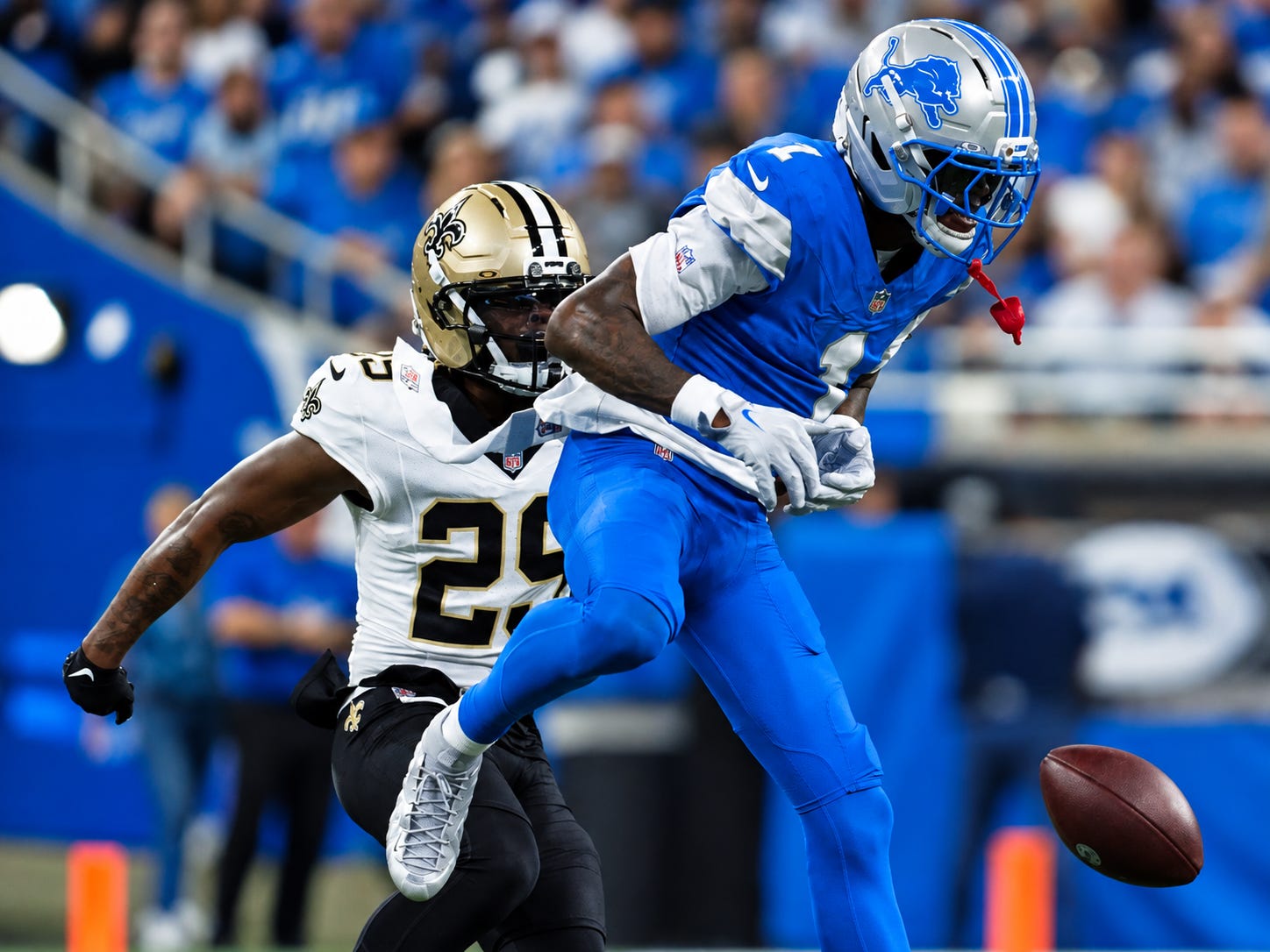
DETROIT LIONS—Jameson Williams described the opening month of his fifth NFL season Thursday as “probably one of my worst starts to my career,” an unusually severe assessment from a receiver who just produced his first 100-yard game of 2026. His six catches for 102 yards against Carolina came with two missed opportunities, including a first-quarter deep ball that could have produced an 89-yard touchdown. Detroit lost 32-26, and Williams remains without a touchdown through four games despite his established role as the offense’s primary vertical threat.
The concern extends beyond the drops that dominated his postgame evaluation. Williams’ weekly receiver-separation measurements have not consistently matched the advantages his exceptional speed is expected to create, even as another Detroit receiver has produced stronger separation figures. His improved production against Carolina complicates the evaluation, leaving offensive coordinator Drew Petzing to determine whether the underlying issues involve execution, deployment or both.
THE NUMBERS REVEAL PROBLEMS
Pro Football Focus credits Williams with 16 receptions on 24 targets for 229 yards, zero touchdowns and four drops, producing a 20% drop rate through four games. His 62.3 receiving grade ranks 61st among 85 qualified receivers, while 162 routes have generated just 1.41 yards per route run. His 14.5-yard average depth of target establishes substantial downfield involvement without comparable consistency in receiving efficiency.
Against Carolina, Williams demonstrated his explosive ability with 102 yards and a 49-yard reception, but his two missed opportunities exposed the difference between statistical production and maximizing scoring chances. Receivers coach Scottie Montgomery identified ball tracking and consistency as areas requiring correction, particularly after Williams lost a potential long touchdown in the stadium lights. A receiver can produce impressive yardage while simultaneously leaving consequential plays unfinished, and Detroit experienced both outcomes during its six-point loss.
THE SEPARATION NUMBERS EXPOSE THE GAP
The supplied NFL Pro receiving charts establish a revealing four-game pattern. Williams averaged 2.41 yards of separation in Week 1, 2.77 in Week 2 and 2.83 in Week 3, all below the displayed league benchmark of 2.99 yards, before improving to 3.58 against Carolina. Isaac TeSlaa recorded 3.86, 3.20, 3.53 and 4.96 yards across those same four weeks, surpassing Williams in every individual comparison.
Williams has played 202 of his 251 offensive snaps aligned wide, compared with 49 in the slot, while carrying a 14.5-yard average target depth. That predominantly outside, downfield assignment affects the separation opportunities he encounters, making direct comparisons dependent on route type, coverage and statistical sample. The charts do not establish who separates better on every route, but they reveal a legitimate developmental concern. Petzing must determine whether alignment adjustments, reduced splits and intermediate route combinations can create more consistent throwing windows without sacrificing Williams’ vertical influence.
TESLAA’S PRODUCTION EXPECTED
Williams’ 2025 production established a considerably higher performance standard: 65 receptions, 1,117 yards, seven touchdowns and 17.2 yards per catch. However, he also finished with an NFL-leading 12 drops, a weakness he specifically emphasized improving during the offseason. His four PFF-charted drops through the opening month of 2026 demonstrate that the reliability problem has carried into another season despite visible improvements during training camp.
TeSlaa provides an increasingly interesting personnel alternative, producing nine receptions for 187 yards on 14 targets without a PFF-charted drop. His 95-yard performance against Carolina reinforced the value of his downfield receiving ability, while his superior weekly separation measurements add another consideration for Detroit’s coaching staff.
Those numbers do not automatically establish TeSlaa as the better overall receiver, particularly given their different assignments and opportunities. They do establish a legitimate competition for selected targets within an offense already distributing opportunities among Amon-Ra St. Brown, Sam LaPorta and Jahmyr Gibbs.
RELIABILITY MUST IMPROVE
Sunday’s matchup against Arizona presents Williams with a significant opportunity to change the direction of his season. The Cardinals rank 31st in receiving yards allowed to outside receivers, making Detroit’s vertical passing attack an appealing offensive option. Defensive coordinator Nick Rallis also spent three seasons working alongside Petzing in Arizona, creating additional familiarity between the opposing schemes and their potential adjustments.
Petzing can challenge the Cardinals with Williams’ vertical stems while incorporating motion, reduced splits and intermediate breaking routes to create more favorable releases. The evaluation should extend beyond whether Williams scores his first touchdown: catchable-target conversion, intermediate separation and yards produced per route provide more complete evidence of progress.
Detroit’s Week 6 bye creates a natural evaluation point before consecutive NFC North games against Green Bay and Minnesota. If Williams sustains his Week 4 separation improvement while reducing drops, his production can move closer to the consistency expected from a two-time 1,000-yard receiver.
If those problems persist, Petzing has legitimate reason to reconsider how selected high-value targets are distributed. Williams’ exceptional speed should preserve his role stretching the field, but it cannot exempt him from the receiving responsibilities required to finish possessions and convert scoring opportunities.
ROCK’S READ
TeSlaa’s ability to separate from coverage gives the Lions reason to expand his role in the passing game without automatically moving him up the depth chart.
The coaching staff needs to identify which alignments give Williams cleaner releases. Williams has the speed to threaten coverage vertically, but his effectiveness depends on how he attacks a defender’s leverage, defeats press coverage and creates separation at the top of his routes. His timing with Goff, ability to maintain speed through route breaks and adjustments to downfield throws require separate evaluations.
Williams has the speed to threaten coverage vertically, but his effectiveness depends on how he attacks a defender’s leverage, defeats press coverage and creates separation at the top of his routes. His timing with Goff, ability to maintain speed through route breaks and adjustments to downfield throws require separate evaluations.
Separation statistics measure the distance between receiver and defender; they do not independently establish whether the problem is route execution, coverage, quarterback timing or ball placement. Williams’ 20% drop rate through four games, combined with film showing inconsistent route discipline, places responsibility squarely on him to improve his route execution and finish catches consistently.
The more consequential issue is quarterback trust. Goff needs confidence that Williams will finish catchable opportunities when explosive plays and scoring chances are available. A receiver capable of changing defensive spacing is valuable; one who consistently converts those advantages becomes indispensable.