


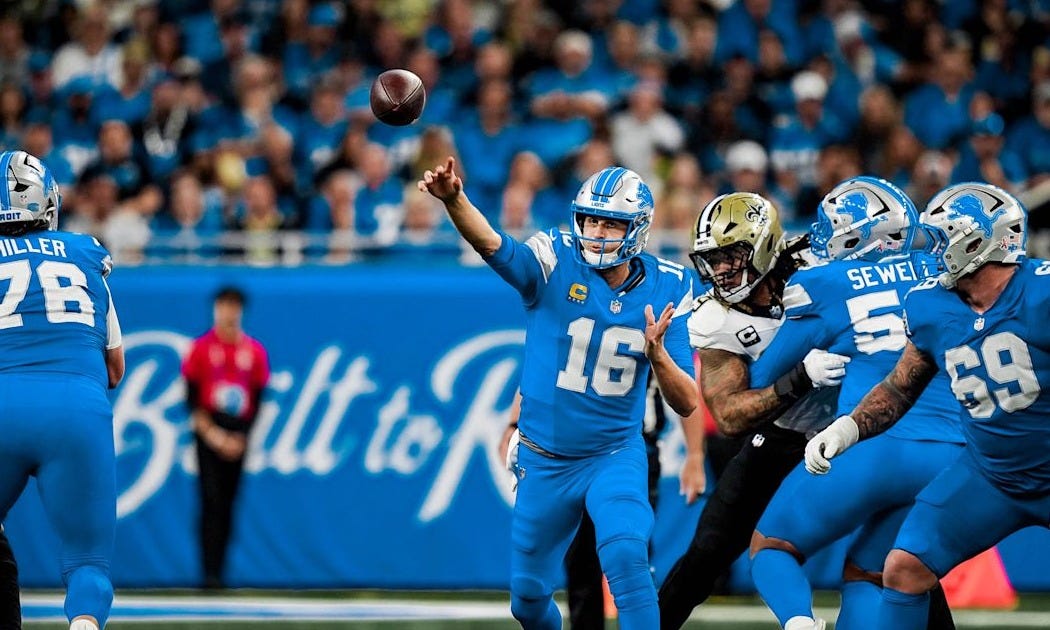
Final OT: Lions 31-30 Saints | Record: 1-0
Ford Field - The Lions opened the 2026 season with a 31-30 overtime win, but there was nothing comfortable about the finish. Detroit built a 21-0 lead with 8:54 remaining in the third quarter, using the run game and three takeaways to control the first half and the opening part of the second.
From that point forward, New Orleans scored on five of its final six possessions. The one possession that did not produce points still ended with a 62-yard field-goal attempt to win the game at the end of regulation. The Saints then answered Detroit’s overtime touchdown with an 80-yard scoring drive before failing on the two-point conversion.
Detroit leaves Week 1 at 1-0, but the game exposed clear problems in the passing offense and secondary that have to be corrected before Thursday night’s game in Buffalo.
By The Numbers
Total offense: Saints 469, Lions 369
First downs: Saints 29, Lions 26
Offensive plays: Saints 86, Lions 73
Yards per play: Saints 5.5, Lions 5.1
Rushing: Lions 165, Saints 91
Net passing: Saints 378, Lions 204
Third down: Saints 8-of-17, Lions 5-of-13
Turnovers: Saints 3, Lions 1
Penalties: Lions 8-61, Saints 6-53
Time of possession: Lions 36:51, Saints 31:35
Punts: Lions 7, Saints 5
Detroit won the areas that kept the game from getting away: turnovers and the run game. The Lions finished plus-two in turnover margin and outrushed New Orleans by 74 yards, averaging exactly five yards per carry.
The Saints controlled the passing matchup. They generated 378 net passing yards compared with Detroit’s 204 and finished with three more first downs despite turning the football over three times. Once New Orleans stopped giving Detroit short fields, the Lions had trouble getting the Saints off the field.
Gibbs Carried The Offense
Gibbs handled 34 touches for 186 yards from scrimmage, rushing 29 times for 156 yards and two touchdowns while catching all five of his targets for another 30 yards.
The 29 carries were a career high, and the production wasn’t built around one explosive run. His longest gain was 21 yards, but Gibbs consistently produced five-, six- and seven-yard carries that kept Detroit out of long-yardage situations. Both rushing touchdowns came from the one-yard line, including the score following Derrick Barnes’ interception early in the third quarter.
His second-quarter fumble after a reception was the one significant mistake. New Orleans recovered, but Chuck Clark intercepted Tyler Shough before the Saints could turn the turnover into points.
Detroit talked throughout the offseason about increasing Gibbs’ workload. Week 1 showed exactly what that looks like when the offense leans on him for 30-plus touches.
Passing Game Needs More
Goff completed 26-of-39 passes for 206 yards, two touchdowns and no interceptions, finishing with a 96.7 passer rating.
His decision-making was not the problem. Detroit averaged only 5.3 yards per pass attempt and finished with 204 net passing yards despite playing overtime. Amon-Ra St. Brown, Sam LaPorta, Jameson Williams and Gibbs accounted for 36 of Goff’s 39 targets, and the offense generated very little outside those four players.
Goff’s best work came when Detroit needed a touchdown in overtime. The Lions went 70 yards in 10 plays, with completions to LaPorta and Williams helping move the offense into scoring position before Goff found St. Brown from four yards out.
Goff protected the football and delivered on the overtime possession. The passing game still needs more explosive production.
St. Brown Finished Drives
St. Brown caught 10 of 14 targets for 67 yards and two touchdowns. The yardage was modest, but both scores came in important situations.
His 19-yard touchdown followed Roger McCreary’s strip sack and D.J. Wonnum’s recovery, pushing Detroit’s lead to 21-0. His second touchdown came from four yards in overtime after New Orleans had erased the entire three-score advantage.
St. Brown caught 71.4 percent of his targets and continued doing what the Lions expect from him on money downs and near the goal line. Ten receptions and two touchdowns was a productive opener even without a 100-yard receiving day.
Bad Day For Jameson Williams
Williams was targeted nine times and caught only four passes for 45 yards, producing a 44.4 percent catch rate and 5.0 yards per target.
One incompletion was an overthrow by Goff. Williams failed to finish at least four other catchable passes, leaving him with as many drops as receptions.
The timing made the mistakes worse. One drop ended a third-quarter possession after New Orleans had started cutting into the lead. Another came late in regulation on short yardage when Detroit had an opportunity to extend the drive, burn more clock and potentially keep the Saints from getting another possession. Instead, the Lions punted and New Orleans moved into position for a 62-yard field-goal attempt.
Williams did make an important 22-yard reception during Detroit’s overtime touchdown drive, but nine targets need to produce more than 45 yards. The speed and separation were there. The problem was finishing the catch.
O-Line Won But Lost Mahogany
Detroit rushed 33 times for 165 yards, averaging exactly five yards per carry, even after Christian Mahogany left with a knee injury during the first quarter.
Ben Bartch replaced him at left guard, and the run game continued to produce. The line consistently gave Gibbs enough space to get downhill and allowed Detroit to control the football for almost 37 minutes.
The costly mistake came late in the fourth quarter. Detroit had first-and-goal from the Saints’ two while leading 21-17 and had a chance to restore a two-score lead. Bartch was called for holding, Goff was later sacked and the Lions settled for a 23-yard Jake Bates field goal.
That sequence left New Orleans within one touchdown instead of forcing the Saints to overcome a possible 11-point deficit.
Mahogany did not return, and there was no confirmed diagnosis or timetable immediately after the game.
Defense Stopped Making Plays
The Lions controlled the first half and early third quarter because the defense created turnovers and negative plays.
Clark intercepted Shough after Gibbs’ fumble. Barnes intercepted him on the first snap of the second half, then recorded a sack on the next Saints possession. McCreary followed with a strip sack that Wonnum recovered.
Those two third-quarter takeaways became 14 Detroit points and turned a 7-0 halftime lead into 21-0.
Once New Orleans stopped turning the football over, the game changed. The Saints’ final six possessions ended with touchdown, touchdown, field goal, touchdown, missed field goal and touchdown.
Detroit’s season benchmark is 19 points allowed per game. New Orleans scored 30, and the bigger concern was that the Saints moved the football consistently once they began attacking Detroit through the air.

DFJ SINCERELY APPRECIATES ALL THE AMAZING SUPPORT! ENJOY 30% OR 50% OFF FOR LIFE WHEN YOU PURCHASE A SINGLE OR GIFT PACKAGE SUBSCRIPTION TODAY - AS LOW AS $25/YEAR
Hutch Disapears
Aidan Hutchinson finished with five tackles and two sacks for 18 yards.
His most important sack came with 2:23 remaining in the fourth quarter and Detroit protecting a 24-17 lead. New Orleans faced second-and-2 at its own 33 when Hutchinson dropped Shough for a 10-yard loss, pushing the Saints back to their own 23.
After the two-minute warning, Shough threw incomplete on third-and-12. That left New Orleans facing fourth-and-12 from its own 23.
Shough completed a 15-yard pass to Bryce Lance for the first down. New Orleans continued the drive, eventually hit Chris Olave for another explosive gain and finished it with Juwan Johnson’s nine-yard touchdown to tie the game with 1:07 remaining.
Hutchinson’s sack turned second-and-short into fourth-and-long. The defense had the situation it wanted and still could not finish the possession.
Hutchinson seems to show up early in the downs, but not enough when it counts. I know a lot of you won’t agree.
Barnes & McCreary Come Up Big
Barnes finished with five tackles, one sack and one interception, and his biggest plays came on consecutive New Orleans possessions.
His interception on the first snap of the third quarter gave Detroit a short field that Gibbs turned into a touchdown. On the next Saints possession, Barnes recorded a six-yard sack before McCreary forced another turnover.
McCreary finished with four tackles, one sack and one forced fumble. His pressure knocked the ball out of Shough’s hands, Wonnum recovered and Detroit scored three plays later.
Those two defensive possessions took the Lions from a 7-0 halftime lead to a 21-0 advantage. Barnes’ ability to affect the game in coverage and as a rusher was one of Detroit’s strongest defensive performances, while McCreary showed why Kelvin Sheppard can use him as part of the pressure package from the secondary.
Big Plays & Big Problems
Shough completed 35-of-56 passes for 410 yards, three touchdowns and two interceptions, finishing with an 87.6 passer rating. Even after sack yardage was removed, New Orleans still produced 378 net passing yards.
Chris Olave caused most of the damage, catching 10 of 13 targets for 182 yards and averaging 18.2 yards per reception. His longest gain went for 47 yards. Devaughn Vele added seven catches for 69 yards and a touchdown, Juwan Johnson finished with 54 yards and another score, and Noah Fant caught the overtime touchdown.
Detroit also extended drives with coverage penalties. Rock Ya-Sin was flagged multiple times, including a pass-interference penalty near the goal line.
D.J. Reed led the Lions with 10 tackles, while Ya-Sin, Jack Campbell and Avonte Maddox each finished with seven. Those numbers need an explanation.
High tackle totals from defensive backs are not automatically positive when the opposing quarterback completes 35 passes. Too many tackles came after New Orleans had already won the passing rep.
The front did enough against the run, holding the Saints to 91 yards on 25 carries — 3.6 yards per attempt. Detroit made New Orleans one-dimensional. The secondary could not consistently stop that dimension.
Saints Final Six Drives
The biggest concern from Week 1 is what happened after Detroit went ahead 21-0.
New Orleans answered with consecutive touchdown drives before the third quarter ended, then opened the fourth with a field-goal drive that cut the lead to 21-17. After Detroit extended the margin to seven, the Saints went 75 yards in eight plays and only 1:25 to tie the game.
Detroit then went three-and-out. New Orleans moved from its own 20 to the Lions’ 44 quickly enough to attempt a 62-yard field goal for the win - the kick missed.
The same problem continued in overtime. Goff led Detroit 70 yards for a touchdown, but New Orleans answered with an 80-yard, 10-play drive in 3:30 and scored again. The Saints elected to go for two instead of kicking the extra point, and Shough’s pass fell incomplete.
That failed conversion was Detroit’s first true stop after taking the 21-point lead.
Special Teams Did Its Job
Bates made his only field-goal attempt from 23 yards and converted all four extra points. Jack Fox punted seven times and averaged 48 yards per punt, giving Detroit solid field position throughout the afternoon.
The concern is not Fox’s performance. It is that Detroit needed him seven times despite rushing for 165 yards and controlling possession for almost 37 minutes.
The Lions moved the football well enough on the ground but did not convert enough third downs or finish enough passing opportunities to keep drives alive.
Injury Update
Mahogany left in the first quarter with what could be a knee or a hip injury and did not return. Bartch replaced him at left guard. There was no confirmed diagnosis or recovery timetable immediately after the game.
Maddox briefly left while favoring his arm but returned and finished with seven tackles. No continuing injury designation was confirmed.
Final Analysis
The Lions won because Gibbs carried the offensive workload, Goff protected the football and the defense forced three turnovers that helped create a 21-point lead. Hutchinson got home twice, Barnes produced an interception and a sack, and McCreary forced a turnover that immediately became seven points.
The problems were just as clear. Detroit generated only 204 net passing yards, Williams dropped at least four catchable passes and the offense punted seven times.
Defensively, Shough threw for 410 yards, Olave finished with 182 and New Orleans scored on five of its final six possessions.
The Hutchinson sequence late in the fourth quarter sums up the defensive problem. Detroit turned second-and-2 into fourth-and-12 and still could not get off the field. New Orleans converted, finished the drive with a touchdown and tied the game.
The Lions are 1-0, but they did not close this game well. Buffalo is next Thursday night, and Detroit has four days to clean up the passing game, coverage and late-down defense.
About Will Rock
Will Rock Is The Founder Of Detroit Football Journal And DFJ Sports, Providing Independent NFL Coverage With Credentialed Access Since 2024. His Work Focuses On Detroit Lions News, NFL Draft Scouting, Roster Analysis And Film Study.
Get Detroit Lions News, Film Study And Independent NFL Coverage From Detroit Football Journal Delivered To Your Inbox.
Watch On YouTube:
Rocked On Detroit Lions
DFJ Sports NFL
Follow Me Here:
DFJ Sports On X | Will Rock On X