January 14, 2026 | 5:36 PM
David Montgomery? Traded. Kerby Joseph? Cut. The dead cap hit a staggering 18 million dollars? Most teams would call this a disaster, but the Lions call it ‘Knee Insurance.’ Today I am breaking down the Antonio Johnson trade scenario—and why paying 18 million dollars for ‘peace of mind’ is actually a genius move.
This Super Bowl window many speak of is wide open, but you can’t win a ring with a gaping hole at safety, can you? Should the 2026 diagnosis on Kerby Joseph’s knee be a major blow to his ability to play, the heart of the Detroit secondary is suddenly in crisis mode, again.
Most GMs would panic. Brad Holmes? He just has to get more aggressive.
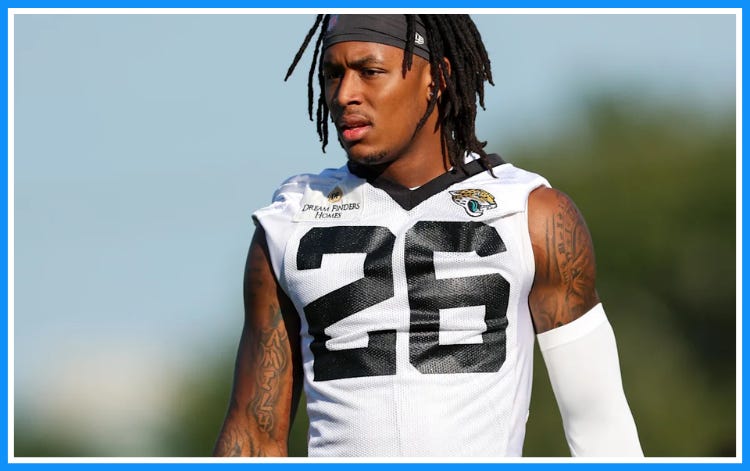
To save the Lions defense and prevent another season of let downs, the Lions must execute a blockbuster move to acquire the number one safety in football, Antonio Johnson, from the Jacksonville Jaguars. Stick with me, it’s going to get a bit choppy.
Rocked On Detroit Lions On YouTube
THE MARKET REALITY (2021–2025)
We need to establish value. There is no direct precedent for “Aging RB for Young Star Safety,” so we look at the ceiling and the floor.
The Floor (Joe Mixon to Texans, 2024): Traded for a 7th-round pick. Productive but expensive veteran. This is the baseline.
The Ceiling (D’Andre Swift to Eagles, 2023): Traded for a 4th-round pick. Younger than Montgomery is now, yet still only netted a Day 3 pick.
The Target (Kevin Byard to Eagles, 2023): Traded for a 5th, 6th, and a player. Johnson is younger and cheaper than Byard was, meaning he commands a premium.
Market for Starting Safeties (What Johnson is worth)
Kevin Byard to Eagles (2023): Traded for a 5th, 6th, and S Terrell Edmunds. Byard was an older All-Pro. Johnson is younger and cheaper, meaning Johnson arguably commands more than this package.
Minkah Fitzpatrick (Steelers, 2019): The Dolphins sent Fitzpatrick to Pittsburgh for a first-round pick, which proved to be a massive win for the Steelers.
Jamal Adams (Seahawks, 2020): The Jets traded Adams to Seattle for two first-round picks, a third-round pick, and a player, making him the highest-paid safety at the time, though the trade didn’t pan out long-term for Seattle.
THE TRADE PROPOSAL: MOVE ONE, GET ONE, CUT ONE
Move One David Montgomery (Lions): The Lions trade their productive but aging RB to a Jaguars team facing uncertainty with Travis Etienne’s free agency.
Get One Antonio Johnson (Jaguars):The Lions acquire the rising star safety entering the final year of his rookie deal ($1.2M cap hit).
Cut One Kerby Joseph (Lions): The painful reality. You cut the injured star to clear the roster spot, triggering the financial hit.
THE VALUATION GAP
Montgomery (Low Value): Teams rarely trade premium picks for 29-year-old RBs with $8M+ cap hits. His value is likely a 4th-round pick—a proven starter is worth more than a lottery ticket to a contender.
Johnson (High Value): A 24-year-old playmaker coming off a 5-INT season is a premium asset. He commands at least a 2nd-round value.
WHY MONTGOMERY HELPS JACKSONVILLE
The Jaguars aren’t just taking a salary dump; they are getting “Etienne Insurance.” While Montgomery is a veteran, his recent usage suggests he has far more tread on the tires than a typical workhorse of his age.
The Trend: Montgomery’s usage in Detroit has trended downward by design in the 2-back system.
Carries: (2023: 219 - 2024: 185 - 2025: 158)
The Benefit: He has not been ground into the dust with 300-carry seasons. He has been preserved as a high-efficiency weapon. This “low mileage” usage means he enters 2026 with fresher legs than his age suggests, offering the Jaguars a veteran starter.
With Travis Etienne set to hit free agency, reports suggest the Jaguars might let him test the market, Montgomery provides immediate stability.
Insurance: If Etienne leaves, Montgomery is a capable starter who can anchor the run game while a rookie develops.
Complement: If Etienne stays, Montgomery takes the physical pounding off Etienne’s frame, likely extending the lifespan and explosiveness of the Jaguars’ homegrown star—just as he did for Gibbs in Detroit.
Bottom Line: Acquiring David Montgomery gives the Jaguars a reliable, high-scoring power scat back who brings leadership, red-zone dominance, and a body that has been strategically preserved for this exact moment.
Trade Value Based on Reality
To make this trade work, the Lions must bridge the huge value gap between Montgomery (an aging veteran they want to offload) and Johnson (a young, cheap starter). The Lions have to “pay up” in draft capital to buy Johnson, as Montgomery alone does not move the needle.
Scenario A: The “Premium Pick” Deal (Quality Over Quantity)
In this scenario, the Jaguars want one high-quality asset they can use immediately, rather than a bundle of lottery tickets. The Lions pay a premium 2026 pick to get the deal done fast.
Lions Get: S Antonio Johnson
Jaguars Get: RB David Montgomery + 2026 2nd Round Pick
Why it makes sense:
For Jaguars: They get a Day 2 pick in the upcoming draft to find an immediate starter, plus a veteran RB to stabilize their offense.
For Lions: They secure their target without depleting their future draft capital in 2027. It hurts more now, but it’s a cleaner transaction.
Scenario B: The “Volume” Deal (Quantity Over Quality)
In this scenario, the Lions refuse to give up a 2nd round pick in the current draft. Instead, they overwhelm Jacksonville with volume, offering multiple mid-round picks spread out over two years.
Lions Get: S Antonio Johnson
Jaguars Get: RB David Montgomery + 2026 4th & 2027 3rd Round Picks
Why it makes sense:
For Jaguars: They are entering a “soft rebuild” and prioritize having more swings at the draft board to build depth. A mid round 4th and a 3rd round pick could be used to move around in the 2026 draft
For Lions: They keep their top picks (1st & 2nd) for the 2026 draft to maximize their own Super Bowl window, while paying off the debt in lower-value installments.
The Final Take
In the NFL, quality trumps quantity. Teams value a single 2nd-round pick far higher than a grab bag of mid-rounders because the hit rate on talent plummets outside the top 100. If Antonio Johnson is truly a “rising star,” Jacksonville will demand the 2026 2nd Round Pick to even pick up the phone.
The Reality Check: Cutting David Montgomery is bad business. While releasing him saves ~$3.5M, letting a dynamic offensive weapon walk for nothing is a failure of asset management. Trading him is the only viable path. Even if the Johnson deal falls through, Montgomery must be leveraged for value, not discarded for cap space.
The Financial Gymnastics: This is where the Lions get ruthless. To execute this maneuver, the front office would voluntarily eat a staggering $18 million in dead money—the combined cost of Montgomery’s trade exit and the brutal $13.5 million penalty for cutting Kerby Joseph one year into his extension.
The dead money is painful on paper, but the actual cash flow remains neutral, keeping their spending power intact while plugging the biggest hole on the defense. It is expensive, controversial, and undeniably cold-blooded. But paying an $18 million premium to remove injury risk and secure a healthy All-Pro is the exact type of aggressive calculus required to deliver a Lombardi Trophy.
THE RISE & GRIND MORNING SHOW | 1.14.26
SUBSCRIBE OR WATCH - CLICK A LINK BELOW!



The “Schematic Architect” Option: Is Jake Peetz The Next Detroit Lions OC?

January 9, 2026 | 5:24 PM
The “Modern Hybrid” Option: Why Josh Grizzard Fits the Lions’ Evolution

In the wake of “Black Monday,” the coaching carousel has spun wildly, spitting out names both expected and surprising. Among the most intriguing and now available candidates is Josh Grizzard, who was relieved of his duties as the Tampa Bay Buccaneers Offensive Coordinator this morning (January 8th, 2026 - reported prior to 11AM EST).
The “Rising Star” Option: Why David Blough is the Gamble Detroit Needs to Take

In the immediate aftermath of “Black Monday,” the Detroit Lions wasted no time severing ties with Offensive Coordinator John Morton. The move, while expected after Head Coach Dan Campbell assumed play-calling duties mid-season, has signaled a clear shift in philosophy at Allen Park. The Lions don’t just need a play-caller; they need an innovator who can merge the team’s gritty identity with modern passing concepts.

The “QB Whisperer” Option: Why Brian Daboll Is Detroit's Most Coveted Coordinator

In the modern NFL, where franchise fortunes are inextricably tied to quarterback play, few coaches possess a résumé as compelling as Brian Daboll. Fresh off his tenure as Head Coach of the New York Giants, Daboll re-enters the coordinator market not as a failed experiment, but as one of the most proven offensive architects in the league. For franchises desperate to unlock the potential of a young signal-caller, Daboll represents the “Gold Standard” of quarterback development.

2026 NFL Draft Profile: EDGE David Bailey (Texas Tech)

Now that the Lions are firmly out of the playoffs. The expected 2026 1st round draft pick will end up somewhere between picks 14-17. Exactly where the way too early projections have David Bailey slotted to be picked at the moment.


Lions’ Thrilling Victory Over Cowboys Marred By The Emergence Of A Structural Crisis

DETROIT —Thursday Night Football between the Detroit Lions and the Dallas Cowboys delivered one of the most exhilarating spectacles for Thursday Night Football in a long time. For Lions fans, the eventual 44–30 dismantling of the Cowboys—a critical “must-win”
NFL Week 11: Eagles Exposed - What The Detroit Lions Learned From MNF

What’s up, Lions Nation! Will Rock here with Rocked On Detroit Lions and Detroit Football Journal. Bringing you the most comprehensive breakdown of the Lions vs. Eagles matchup you’ll find anywhere. This weeks keys to the game submission will be three separate pieces with a bonus feature.
HANK FRALEY: THE PERFECT INTERNAL SOLUTION FOR DETROIT LIONS' OFFENSIVE COORDINATOR

While the Detroit Lions could chase big-name offensive coordinator candidates like Brian Daboll, the perfect solution to their play-calling crisis might already be in the building. Hank Fraley—the architect of the NFL’s most dominant offensive line and a coach who turned down the Seattle Seahawks to stay in Detroit—represents the safest, most seamless path forward for a Lions team in their Super Bowl window.

Why Brian Daboll Could Be Detroit's Next Offensive Coordinator

The New York Giants just fired Brian Daboll after a catastrophic 2-8 start, and the Detroit Lions are facing their own offensive coordinator crisis with Dan Campbell stripping play-calling duties from John Morton. Could the former NFL Coach of the Year be the answer to Detroit’s offensive struggles? An in-depth analysis reveals why Daboll’s track record with Josh Allen and the Buffalo Bills makes him an intriguing—but complicated—candidate for the Lions’ OC position should it open up in 2026.