


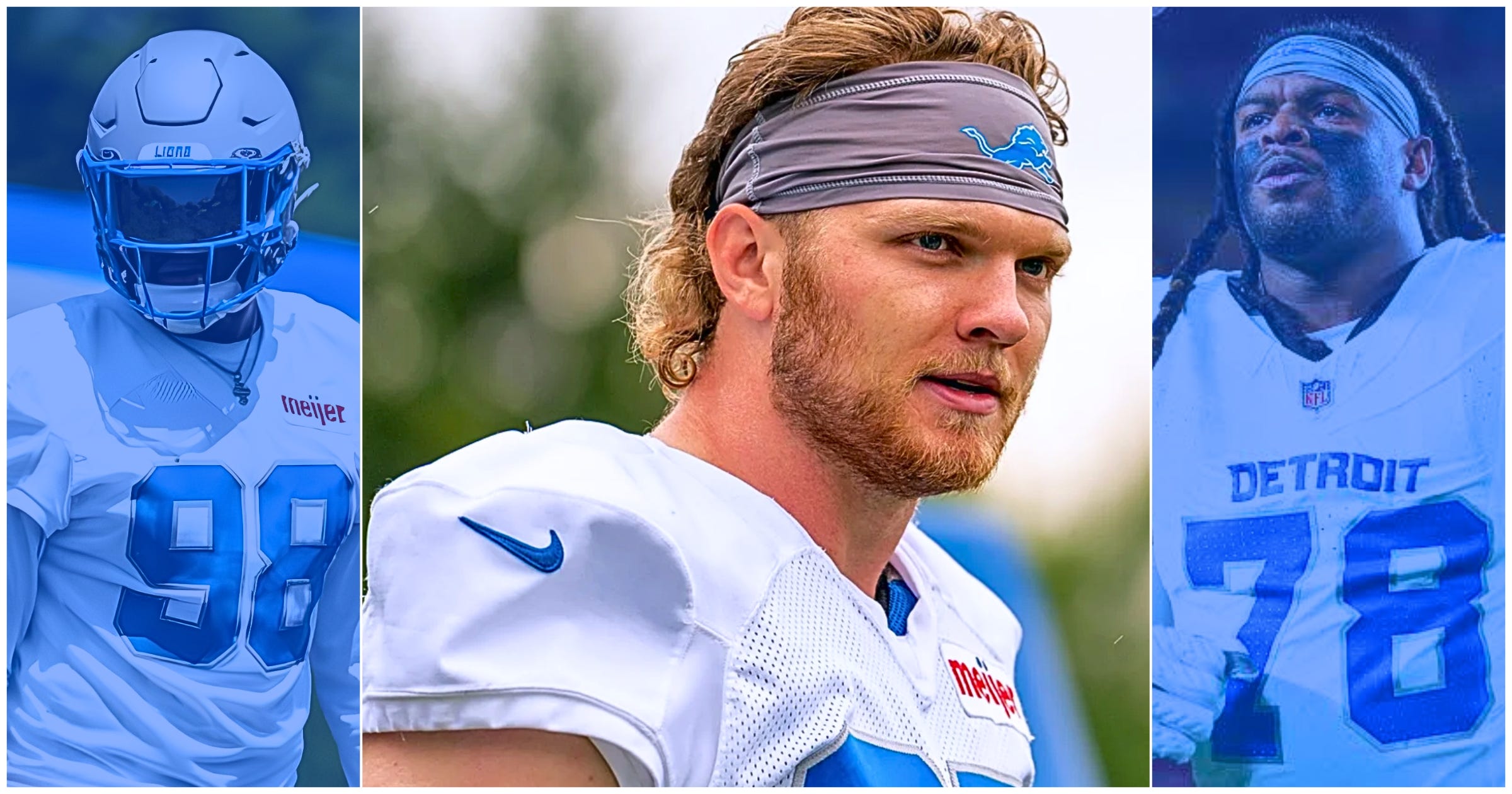
Detroit Lions—The Lions finished 2025 with 49 sacks, two edge rushers in double figures and Aidan Hutchinson leading the NFL with 100 pressures. On the surface, those are dominant pass-rush numbers. The underlying details may shock you.
This is a deep dive into what went wrong in 2025 and why I believe it can be fixed in 2026. Buckle up, it’s about 2,800 words and you may not like everything you read.
THE EFFICIENCY TOLD A DIFFERENT STORY
Detroit finished 26th in pass-rush win rate at roughly 32 percent and averaged an NFL-worst 2.92 seconds to create pressure. Through Week 12, the Lions were also averaging 5.20 seconds per sack, the longest mark in the league at that point. The sack total was strong; the rush did not consistently destroy plays early enough.
That is the problem Kelvin Sheppard’s 2026 defense is built to attack. Instead of chasing another top-of-the-market edge opposite Hutchinson, the Lions built a deeper room with D.J. Wonnum, Derrick Moore, Tyler Lacy, Ahmed Hassanein and Eric O’Neill while expanding nickel personnel, multiple fronts and post-snap movement.
The goal is harder protection identification, fresher rushers and less dependence on one or two players carrying the front.
THE PASS RUSH PRODUCED MORE THAN IT CONTROLLED
Hutchinson and Muhammad combined for 25.5 of Detroit’s 49 sacks. Every other Lions edge combined for 2.5. The production was concentrated, and too much of it arrived late.
49 sacks — tied 4th in NFL
234 pressures — 6th in NFL
32% pass-rush win rate — 26th in NFL
2.92 seconds average time to pressure — slowest in NFL
5.20 seconds average time to sack — longest in NFL through Week 12
A sack ends the down, but timing still measures the quality of the rush. If the quarterback can climb, reset or reach a second progression before pressure arrives, the offense still controls the play. Detroit accumulated sacks without consistently controlling the quarterback’s clock.
Hutchinson’s Stats Outpaced His Efficiency
The production was strong, but workload and efficiency tell a more useful story.
Aidan Hutchinson: 1,005 snaps | 622 pass rushes | 14.5 sacks | 100 pressures | 42.9 rushes per sack | 6.22 rushes per pressure
Al-Quadin Muhammad: 457 snaps | 353 pass rushes | 11 sacks | 53 pressures | 32.1 rushes per sack | 6.67 rushes per pressure
Muhammad: 34% more efficient producing sacks per pass-rush snap
Hutchinson: Slightly more efficient producing pressure per pass-rush snap
WE CAN’T IGNORE THAT THEIR JOBS WERE DIFFERENT
Muhammad rushed on a higher percentage of his snaps, while Hutchinson carried the larger workload and played more run defense. Raw totals without usage context exaggerate the gap.
Hutchinson’s pass-rush win rate exposed another issue. ESPN credited him with beating his block within 2.5 seconds on 14 percent of qualifying rushes, 17th among NFL edge defenders. The league’s best finished roughly between 21 and 25 percent.
My film review showed the same problem. Hutchinson’s first step stresses tackles, but too many rushes travel high around the edge instead of reducing the corner and closing directly on the quarterback.
He needs earlier hand wins, better half-man leverage, more speed-to-power and quicker counters when tackles overset. His get-off creates opportunities, but too often he stalls or gets carried around the arc, leaving an escape hatch.
That is the difference between recording pressure and wrecking the quarterback’s timing. Stats without context can be empty.
RUN DEFENSE SHOWED SIMILAR WARNING SIGNS
The Lions finished 14th in rushing yards allowed at 1,947, but ranked 29th in run-stop win rate at 28 percent and produced the second-fewest negative non-kneel runs in the NFL.
Hutchinson led the edge room with 14 tackles for loss, followed by Muhammad with nine and Marcus Davenport and Tyrus Wheat with one each. Their combined 25 TFLs were fewer than Myles Garrett’s 33, but not far behind a couple of the league’s top edge pairings. Snap count also has to be considered when comparing raw totals.
Among edge defenders with at least 80 run-defense snaps, Hutchinson’s 3.3-yard average depth of tackle (ADOT) ranked 103rd. Muhammad ranked 127th — last — at 7.5 yards.
The better fronts create penetration, force the back sideways and turn first-and-10 into second-and-11. Detroit too often made contact several yards downfield, leaving manageable second and third downs.
EXAMPLES OF A FEW LEAGUE LEADERS’ NUMBERS
Top-2025 TFL PAIRS
Houston: Will Anderson Jr. 20 | Danielle Hunter 15
Cleveland: Myles Garrett 33 | Alex Wright 12
Las Vegas: Maxx Crosby 28 | Tre’von Moehrig 14
Pittsburgh: Alex Highsmith 15 | Nick Herbig 13
Minnesota: Eric Wilson 17 | Jalen Redmond 12
TOP-36 ADOT (Avg Depth Of Tackle)
Myles Garrett: T-2nd | 0.0 Yds
Anfernee Jennings: T-2nd | 0.0 Yds
Jaylen Harrell: T-2nd | 0.0 Yds
Will Anderson Jr: 5th | 0.5 Yds
Maxx Crosby: T-11th | 1.4 Yds
Nic Scourton: T-13th | 1.6 Yds
Abdul Carter: T-14th | 1.7 Yds
Kayvon Thibodeaux: T-16th | 1.9 Yds

DFJ SINCERELY APPRECIATES ALL THE AMAZING SUPPORT! ENJOY 30% OR 50% OFF FOR LIFE WHEN YOU PURCHASE A SINGLE OR GIFT PACKAGE SUBSCRIPTION TODAY - AS LOW AS $25/YEAR
YOU CAN’T RUN WITH A LEAKING SEAL FOREVER
For you Ford Tough racing fans, here’s the analogy that fits: the edge rush, interior pressure, linebacker fits and coverage work like an engine, with the defensive coordinator acting as the computer controlling the system.
The Lions spent 2025 driving with a leaking head gasket. As the season waned on, multiple parts began to fail. Edge depth disappeared, the interior lost important pieces, the linebacker room thinned and the secondary eventually lost several starters.
A defense can survive a few missing parts for a few games, just as an engine can survive a small leak for a little while. Once the gasket no longer seals the cylinder head to the block, compression escapes and the entire system loses power — eventually leaving you stranded on the roadside or watching the playoffs from home.
Sheppard could still run the defense, but he rarely had every piece available. Less interior push gave quarterbacks room to climb underneath high-side edge rushes. Missing linebackers reduced pressure combinations and run-fit flexibility. Secondary injuries shortened the coverage clock and forced the edge to win faster.
INJURIES CHANGED EVERYTHING
By season’s end, the gasket was blown and just like the engine, the defense was sputtering. Sheppard kept compensating for one leak after another, but the result was too many explosive plays and too few answers.
EDGE INJURIES
Josh Paschal: Reserve/NFI Aug. 26; missed entire season.
Marcus Davenport: IR Sept. 22; missed nine games; shoulder injury after return.
Ahmed Hassanein: Preseason pectoral injury; waived with injury settlement; no regular-season appearances.
INTERIOR DEFENSIVE LINE
Levi Onwuzurike: Major ACL surgery before camp; missed entire season.
Alim McNeill: Returning from Dec. 2024 ACL tear; missed first six games; played 10; abdomen injury after return.
Mekhi Wingo: Recovering from meniscus surgery; appeared in two games.
Pat O’Connor: Knee injury in November; IR after eight appearances.
ALIM MCNEILL PRODUCTION
McNeill’s diminished production hit the edge rush especially hard. He was emerging in 2023 before a late-season knee sprain cost him four games, then developed into one of the league’s better interior disruptors in 2024 before tearing his ACL.
2023: 43 pressures | 5 sacks | 6 tackles for loss
2024: 45 pressures | 3.5 sacks | 7 tackles for loss
2025: 23 pressures | 1 sack | 2 tackles for loss
The ACL changed what Detroit had inside. McNeill returned without the same lower-body power, and rookie Tyleik Williams could not replace all of his interior disruption.
On Sept. 10, 2026, Sheppard said he had to “hold back from talking too much about Alim” because of how much better McNeill looked physically after being unable to do some normal things in 2025.
“A lot of that tape he couldn’t even put his foot in the ground and plant,” Sheppard said. “September 13th, I cannot wait to see number 54.”
LINEBACKERS
Detroit’s starting linebacker corps stayed relatively intact, but injuries thinned the rotation and reduced Sheppard’s second-level flexibility.
Malcolm Rodriguez: Recovering from 2024 ACL tear; missed first 10 games.
Zach Cunningham: Hamstring injury; IR Oct. 22; played four games.
Trevor Nowaske: Preseason elbow injury; missed first two games.
Ezekiel Turner: Right-leg injury in preseason finale; IR Aug. 26; missed season.
Those losses narrowed the pressure menu. Fewer healthy second-level options meant fewer mug looks, replacement pressures and run-fit combinations to stress protection and create cleaner one-on-ones up front.
SECONDARY INJURIES MAGNIFIED THE PROBLEM
Sheppard counted 105 explosive plays allowed in 2025 — 82 passing and 23 rushing — defining an explosive as at least 17 yards through the air or 12 on the ground. Those 82 passing explosives cannot simply be pinned on the secondary because coverage and pass rush share the same clock.
Detroit’s slow pressure increased that burden while D.J. Reed, Terrion Arnold, Kerby Joseph and Brian Branch all missed significant time. A defensive back can win the initial route, but if the quarterback can climb, reset or extend the play, coverage has to win again.
D.J. Reed: Hamstring injury Week 4; IR Oct. 1; missed six games.
Terrion Arnold: Shoulder injury plus later concussion; played eight games.
Kerby Joseph: Knee injury; played six games; missed final 11.
Brian Branch: Torn Achilles Dec. 4; missed final four games.
Ennis Rakestraw: Training-camp shoulder surgery; missed season.
Khalil Dorsey: Wrist injury; IR Oct. 8; missed significant midseason time.
Those injuries do not excuse slow edge play. They explain why the front was increasingly asked to compensate for problems around it. When interior compression disappears and coverage cannot hold as long, the edge has to beat the tackle earlier. Detroit did not do that consistently or fast enough.
SHEPPARD IS CHANGING THE PROTECTION PICTURE
Detroit’s personnel structure became predictable. The Lions played base on roughly 60 percent of their defensive snaps in 2025, compared with an NFL average near 13 percent, while using subpackages only about 34 percent of the time.
Base helped Detroit stay heavy against the run, but it also gave offenses cleaner pre-snap information. The center could identify the front, set the protection slide and determine where the back or tight end needed to help.
More nickel gives Sheppard another movable defender and more ways to disguise pressure without sending extra rushers.
Jack Campbell can mug an A-gap.
D.J. Wonnum can stand up outside.
Hutchinson can widen his alignment.
The nickel can walk onto the line.
The interior can stem before the snap.
Instead of four obvious rushers, the offense may see five or six threats. That opens the door to simulated pressure. Sheppard has said he is not a big SIM guy, but between you, me and the wall, I call BS.
Detroit can show six, rush four and drop two. Campbell can force the center toward the A-gap before dropping while the nickel replaces him from another angle. An edge can spike inside while another rusher loops behind him. The offense may have enough blockers and still block the wrong defenders.
That is protection manipulation — what I call disguised chaos. Sheppard can force the offense to declare its protection, then change the rush after the snap.
THE NEW EDGE ROOM GIVES SHEPPARD BALANCE
The Lions did not build the 2026 edge room around finding another Hutchinson. For most NFL teams, that was never practical. If you consider Madden real football, maybe stacking elite edge rushers everywhere makes sense. In the NFL, where the salary cap and roster construction actually exist, most teams know better.
What the Lions built instead was depth and versatility.
D.J. Wonnum: Length and alignment versatility.
Derrick Moore: Power from either edge.
Tyler Lacy: Bigger end for heavier fronts.
Ahmed Hassanein: Power and speed.
Eric O’Neill: High-motor rotational option.
Those traits give Kacy Rodgers and Sheppard more ways to build the front by down, distance and opponent. First-and-10 can feature a heavier edge structure to squeeze the run; third-and-8 can put Hutchinson, Wonnum and Moore together with one edge reduced inside.
Tite and Mint fronts tighten interior gaps. A 4-3 Under look changes the strength of the front. Late stems, cross-face movement and gap exchanges disrupt blocking angles, while NASCAR packages put multiple natural pass rushers on the field at once.
The rotation should also reduce Hutchinson’s workload. He played about 91 percent of Detroit’s defensive snaps and logged more than 1,000 total snaps in 2025. A deeper room can preserve him for high-leverage downs while giving Detroit stronger run-defense options on early downs — an area where Hutchinson struggled most.
SCHEME DEFINITIONS
Tite front: A three-man structure with a nose tackle over the center and both ends aligned in 4i-techniques on the inside shoulders of the offensive tackles. It clogs the interior B-gaps and spills runs outside toward the linebackers.
Mint front: The same 4i-0-4i interior structure with an outside linebacker walked onto the line as an edge player, creating a four-man presentation while preserving the Tite front’s interior run rules.
ADDING A $40 MILLION EDGE-IS-NOT-THE-ANSWER
I am not naive. An elite edge rusher improves almost any defense. The roster-construction issue is whether another massive contract at one position solves more problems than spreading those resources across several rushers or positions. A deeper room gives Sheppard more fronts, fresher legs, different body types and injury insurance.
Pass rush by committee creates more ways to attack protections without depending on two players staying healthy for 1,000 snaps. After what happened in 2025, building redundancy into the front is part of the answer.
Holmes’ roster-building model pairs elite players with Tier 2 veterans and young talent expected to develop by Year 3. Layer enough of those players together and you can build a dominant defense without sacrificing the rest of the roster. Patience is hard, but I will gladly wait for my marshmallows if the payoff is sustained success instead of one expensive season.
Let me ask you a question — how did it work for the Packers in 2025?
THE NEW PASS RUSH NEEDS A DIFFERENT SCORECARD
Detroit has proved it can accumulate sacks. That alone is not the measuring stick. Baltimore and Denver have both shown in recent seasons that leading the NFL in sacks does not guarantee a Super Bowl.
Start with Detroit’s NFL-worst 2.92-second average time to pressure and 26th-ranked pass-rush win rate. Pressure has to arrive faster, Hutchinson needs more early block wins and the interior must remove the quarterback’s escape lane.
The run defense also needs more negative plays. Creating second-and-10 and third-and-8 opens Sheppard’s full menu — NASCAR packages, Tite and Mint fronts, 4-3 Under looks, mugged A-gaps, late stems, overloads, twists, cross-face movement, gap exchanges and disguised rush packages.
A faster rush helps the secondary, while healthier coverage and better disguise help the rush. Detroit could finish with fewer than 49 sacks and still field a better defense if negative plays increase, pressure arrives faster and explosive plays decrease.
ROCK’S READ
This is the best Lions defense I have seen put together since 2021. The depth is better, the front is more versatile and Sheppard has more ways to attack protections without asking Hutchinson to carry a 91-percent workload. Detroit could finish with fewer than 49 sacks and still field a better defense if the interior closes escape lanes, the edge wins earlier, the run defense creates more negative plays and the secondary stays healthier. The sack total does not need to rise for this defense to take a major step forward — the disruption just needs to arrive sooner.
Will the deeper rotation and nickel-heavy pressure package make Hutchinson more dangerous in 2026, or do the Lions still need another premium edge rusher?
Please comment, like & share the article with any NFL fan who wants to talk some ball.
About Will Rock
Will Rock Is The Founder Of Detroit Football Journal And DFJ Sports, Providing Independent NFL Coverage With Credentialed Access Since 2024. His Work Focuses On Detroit Lions News, NFL Draft Scouting, Roster Analysis And Film Study.
Get Detroit Lions News, Film Study And Independent NFL Coverage From Detroit Football Journal Delivered To Your Inbox.
Watch On YouTube:
Rocked On Detroit Lions
DFJ Sports NFL
Follow Me Here:
DFJ Sports On X | Will Rock On X